

380
Solubility Product and Precipitation
cause inadequate precipitation of some of the ions. This problem is overcome
by using a buffer that maintains a constant desired pH.
Dissolving a Precipitate
When a precipitate is treated with a reagent that can react with one of its
ions, its solubility is increased, because the reduction of the concentration of
one ion causes the solubility equilibrium to shift to the right. Two different
types of reaction may be used to dissolve precipitates.
1. The negative ion of the precipitate may react with an added ion to
form a weak acid or base.
2. The positive ion of the precipitate may react with a substance to form
a slightly ionized complex ion (Chapter 25).
The most common example of the first type is the dissolving of insoluble salts of weak acids by strong acids. Many hydroxides, carbonates, sulfides,
phosphates, borates, oxalates, and salts of other weak acids may be dissolved
by strong acids, even though their solubility in water is extremely low. In the
following problems, we consider two common questions: "How much precipitate will dissolve under certain conditions?" and "What conditions are
needed to totally dissolve a given amount of precipitate?"
PROBLEM:
How many moles of CaC 2 O 4 will dissolve in one liter of 0.100 M HC1?
SOLUTION:
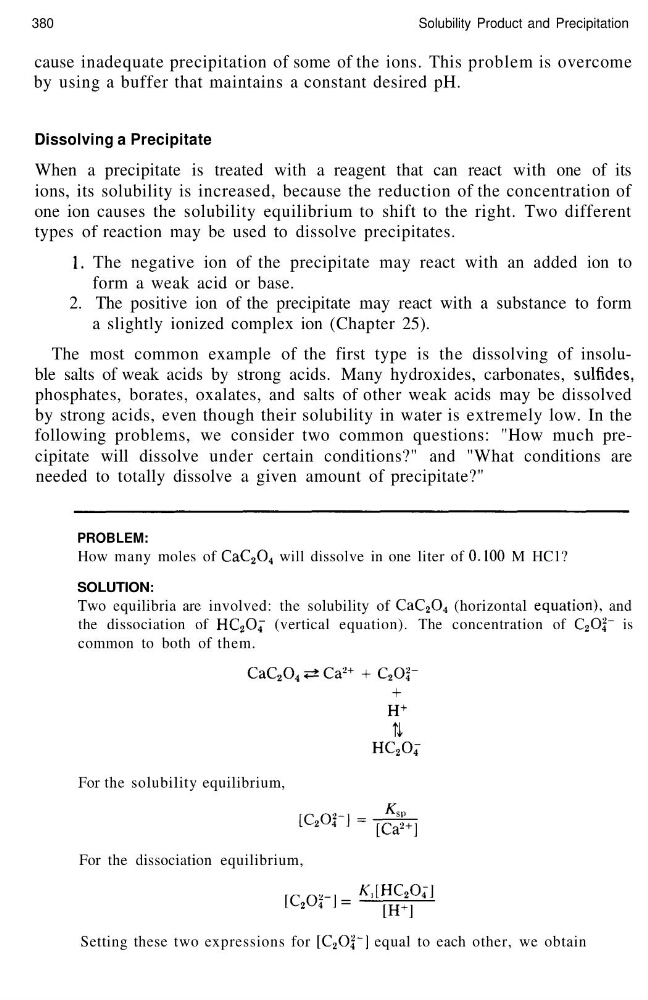
Two equilibria are involved: the solubility of CaC 2 O 4 (horizontal equation), and
the dissociation of HC 2 C>4~ (vertical equation). The concentration of C 2 O|~ is
common to both of them.
CaC 2 O 4 «± Ca
2
H
+
Ti
HC 2 O 4 -
For the solubility equilibrium,
[Ca
2+ ]
For the dissociation equilibrium,
K,[HC 2 O 4 -
[C 2 0|-J =
[H
+ J
Setting these two expressions for [C 2 O 4 ~] equal to each other, we obtain
Solubility Product and Precipitation
cause inadequate precipitation of some of the ions. This problem is overcome
by using a buffer that maintains a constant desired pH.
Dissolving a Precipitate
When a precipitate is treated with a reagent that can react with one of its
ions, its solubility is increased, because the reduction of the concentration of
one ion causes the solubility equilibrium to shift to the right. Two different
types of reaction may be used to dissolve precipitates.
1. The negative ion of the precipitate may react with an added ion to
form a weak acid or base.
2. The positive ion of the precipitate may react with a substance to form
a slightly ionized complex ion (Chapter 25).
The most common example of the first type is the dissolving of insoluble salts of weak acids by strong acids. Many hydroxides, carbonates, sulfides,
phosphates, borates, oxalates, and salts of other weak acids may be dissolved
by strong acids, even though their solubility in water is extremely low. In the
following problems, we consider two common questions: "How much precipitate will dissolve under certain conditions?" and "What conditions are
needed to totally dissolve a given amount of precipitate?"
PROBLEM:
How many moles of CaC 2 O 4 will dissolve in one liter of 0.100 M HC1?
SOLUTION:
Two equilibria are involved: the solubility of CaC 2 O 4 (horizontal equation), and
the dissociation of HC 2 C>4~ (vertical equation). The concentration of C 2 O|~ is
common to both of them.
CaC 2 O 4 «± Ca
2
H
+
Ti
HC 2 O 4 -
For the solubility equilibrium,
[Ca
2+ ]
For the dissociation equilibrium,
K,[HC 2 O 4 -
[C 2 0|-J =
[H
+ J
Setting these two expressions for [C 2 O 4 ~] equal to each other, we obtain