

Control of Precipitation
379
[H
+ ]
2 [S
2 -] = 1.2 x 10²¹
By means of buffers, you can maintain the [S
2 ~] at whatever value you wish
when you saturate a solution with H 2 S. How this capability permits the separation of ions is illustrated in the next problem.
PROBLEM:
To what pH must a solution be buffered in order that the maximum amount of
CdS be precipitated, on saturation with H 2 S, without precipitating any FeS? The
original solution is 0.020 M in both Cd
2+ and Fe
2+ .
SOLUTION:
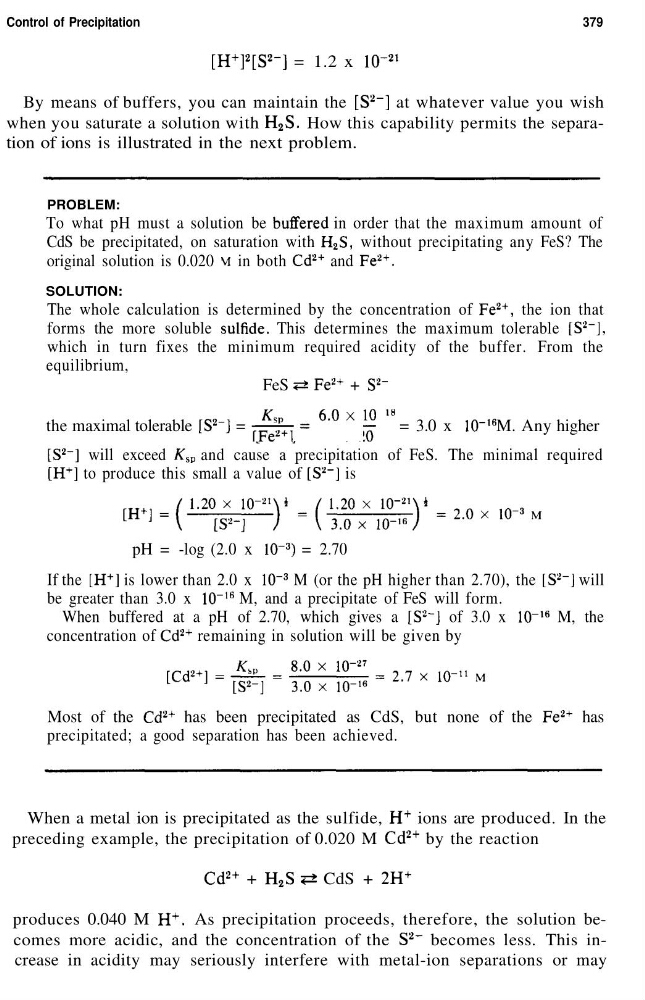
The whole calculation is determined by the concentration of Fe
2+ , the ion that
forms the more soluble sulfide. This determines the maximum tolerable [S
2 ~],
which in turn fixes the minimum required acidity of the buffer. From the
equilibrium,
FeS <=* Fe
2+ + S
2 ~
the maximal tolerable [S
2
'] = r|%- =
6 '°
X ^ " = 3.0 x 1Q-'
6 M. Any higher
[S
2 ~] will exceed K sf and cause a precipitation of FeS. The minimal required
[H
+ ] to produce this small a value of [S
2 ~] is
pH = -log (2.0 x 10³
) = 2.70
If the [H
+ ] is lower than 2.0 x 10~
3 M (or the pH higher than 2.70), the [S
2 ~J will
be greater than 3.0 x 10~
16 M, and a precipitate of FeS will form.
When buffered at a pH of 2.70, which gives a [S
2 ~] of 3.0 x 10~
16 M, the
concentration of Cd
2+ remaining in solution will be given by
Most of the Cd
2+ has been precipitated as CdS, but none of the Fe
2+ has
precipitated; a good separation has been achieved.
When a metal ion is precipitated as the sulfide, H
+ ions are produced. In the
preceding example, the precipitation of 0.020 M Cd
2+ by the reaction
Cd
2+ + H 2 S <=* CdS + 2H
+
produces 0.040 M H
+ . As precipitation proceeds, therefore, the solution becomes more acidic, and the concentration of the S
2 ~ becomes less. This increase in acidity may seriously interfere with metal-ion separations or may
379
[H
+ ]
2 [S
2 -] = 1.2 x 10²¹
By means of buffers, you can maintain the [S
2 ~] at whatever value you wish
when you saturate a solution with H 2 S. How this capability permits the separation of ions is illustrated in the next problem.
PROBLEM:
To what pH must a solution be buffered in order that the maximum amount of
CdS be precipitated, on saturation with H 2 S, without precipitating any FeS? The
original solution is 0.020 M in both Cd
2+ and Fe
2+ .
SOLUTION:
The whole calculation is determined by the concentration of Fe
2+ , the ion that
forms the more soluble sulfide. This determines the maximum tolerable [S
2 ~],
which in turn fixes the minimum required acidity of the buffer. From the
equilibrium,
FeS <=* Fe
2+ + S
2 ~
the maximal tolerable [S
2
'] = r|%- =
6 '°
X ^ " = 3.0 x 1Q-'
6 M. Any higher
[S
2 ~] will exceed K sf and cause a precipitation of FeS. The minimal required
[H
+ ] to produce this small a value of [S
2 ~] is
pH = -log (2.0 x 10³
) = 2.70
If the [H
+ ] is lower than 2.0 x 10~
3 M (or the pH higher than 2.70), the [S
2 ~J will
be greater than 3.0 x 10~
16 M, and a precipitate of FeS will form.
When buffered at a pH of 2.70, which gives a [S
2 ~] of 3.0 x 10~
16 M, the
concentration of Cd
2+ remaining in solution will be given by
Most of the Cd
2+ has been precipitated as CdS, but none of the Fe
2+ has
precipitated; a good separation has been achieved.
When a metal ion is precipitated as the sulfide, H
+ ions are produced. In the
preceding example, the precipitation of 0.020 M Cd
2+ by the reaction
Cd
2+ + H 2 S <=* CdS + 2H
+
produces 0.040 M H
+ . As precipitation proceeds, therefore, the solution becomes more acidic, and the concentration of the S
2 ~ becomes less. This increase in acidity may seriously interfere with metal-ion separations or may