

378
Solubility Product and Precipitation
CONTROL OF PRECIPITATION
Precipitation by Hydrogen Sulfide
For many reasons, H 2 S is an important reagent for the separation of metal
ions in solution. H 2 S is a gas and therefore is easy to obtain from a commerical cylinder; it is easy to saturate a solution with H 2 S (the saturation
concentration is 0.10 M); the enormous range in /C sp values makes precipitations and separations amenable to control by pH control; and most metals form
sulfides that are insoluble to some degree.
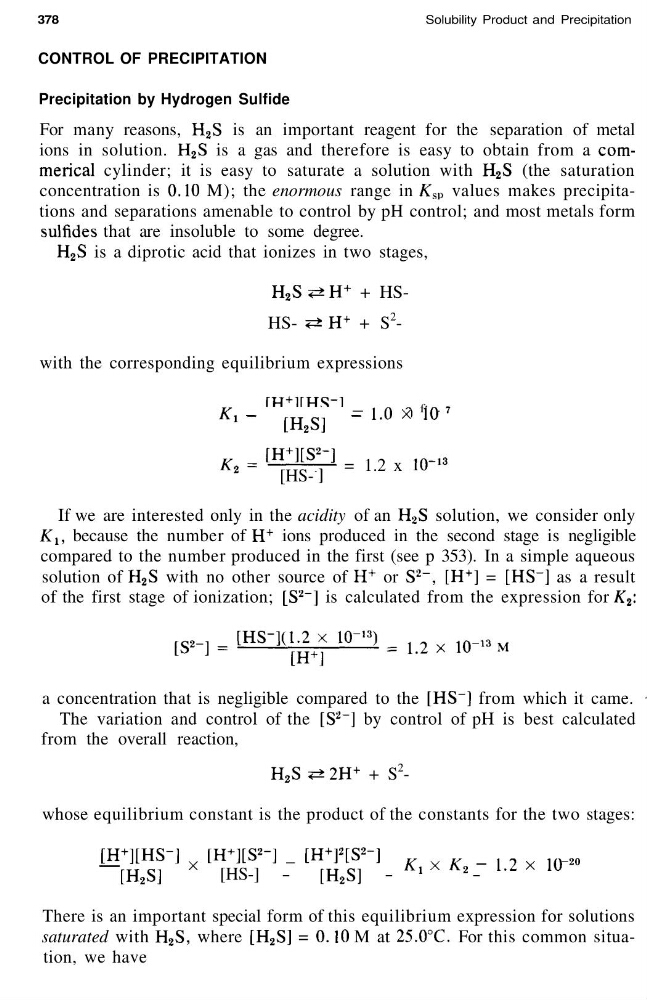
H 2 S is a diprotic acid that ionizes in two stages,
H 2 S ?± H
+ + HSHS- +± H
+ + S
2 -
with the corresponding equilibrium expressions
_
n ft _
Kl ~
[H 2 S]
~
L °
X 10
[HS= 1.2 x
If we are interested only in the acidity of an H 2 S solution, we consider only
KI, because the number of H
+ ions produced in the second stage is negligible
compared to the number produced in the first (see p 353). In a simple aqueous
solution of H 2 S with no other source of H
+ or S
2 ~, [H
+ ] = [HS~] as a result
of the first stage of ionization; [S
2 ~] is calculated from the expression for K 2 :
a concentration that is negligible compared to the [HS~] from which it came.
The variation and control of the [S
2 ~] by control of pH is best calculated
from the overall reaction,
H 2 S *± 2H+ + S
2 -
whose equilibrium constant is the product of the constants for the two stages:
[H+][HS-j
[H+][S
2 -] _ [H+HS
2 -]
_
[H 2 S]
X
[HS-] -
[H 2 S] - *i
x ** -
L2 x 10
There is an important special form of this equilibrium expression for solutions
saturated with H 2 S, where [H 2 S] = 0. 10 M at 25.0°C. For this common situation, we have
Solubility Product and Precipitation
CONTROL OF PRECIPITATION
Precipitation by Hydrogen Sulfide
For many reasons, H 2 S is an important reagent for the separation of metal
ions in solution. H 2 S is a gas and therefore is easy to obtain from a commerical cylinder; it is easy to saturate a solution with H 2 S (the saturation
concentration is 0.10 M); the enormous range in /C sp values makes precipitations and separations amenable to control by pH control; and most metals form
sulfides that are insoluble to some degree.
H 2 S is a diprotic acid that ionizes in two stages,
H 2 S ?± H
+ + HSHS- +± H
+ + S
2 -
with the corresponding equilibrium expressions
_
n ft _
Kl ~
[H 2 S]
~
L °
X 10
[HS= 1.2 x
If we are interested only in the acidity of an H 2 S solution, we consider only
KI, because the number of H
+ ions produced in the second stage is negligible
compared to the number produced in the first (see p 353). In a simple aqueous
solution of H 2 S with no other source of H
+ or S
2 ~, [H
+ ] = [HS~] as a result
of the first stage of ionization; [S
2 ~] is calculated from the expression for K 2 :
a concentration that is negligible compared to the [HS~] from which it came.
The variation and control of the [S
2 ~] by control of pH is best calculated
from the overall reaction,
H 2 S *± 2H+ + S
2 -
whose equilibrium constant is the product of the constants for the two stages:
[H+][HS-j
[H+][S
2 -] _ [H+HS
2 -]
_
[H 2 S]
X
[HS-] -
[H 2 S] - *i
x ** -
L2 x 10
There is an important special form of this equilibrium expression for solutions
saturated with H 2 S, where [H 2 S] = 0. 10 M at 25.0°C. For this common situation, we have