

Criterion for Precipitation
377
[Ag
+ ] = 2.00 x 10³ M (given)
=
(1 -°
OXl °"
3g)
= 3.09 x 10- M
(
162 -°mfe)
(0 -
2001iter)
Q = (2.00 x 10³
)
2
(3.09 x 10'
5
) = 1.24 x lO'
10
K, v = 1.12 x 10~
12 (from Table 24-1)
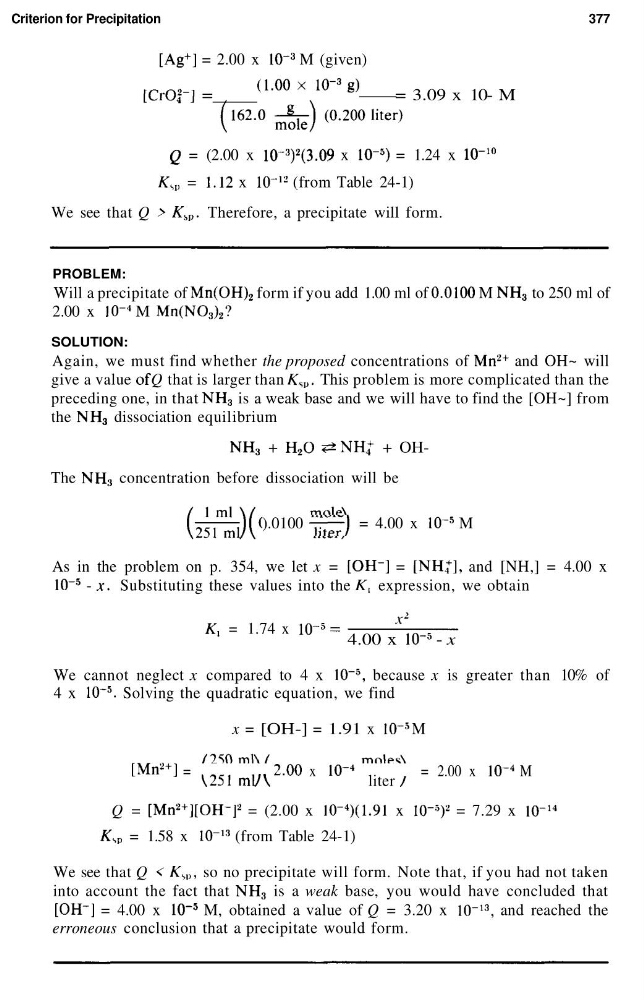
We see that Q > K., v . Therefore, a precipitate will form.
PROBLEM:
Will a precipitate of Mn(OH) 2 form if you add 1.00 ml of 0.0100 M NH 3 to 250 ml of
2.00 x 10⁴ M Mn(NO 3 ) 2 ?
SOLUTION:
Again, we must find whether the proposed concentrations of Mn
2+ and OH~ will
give a value of Q that is larger than K^ v . This problem is more complicated than the
preceding one, in that NH 3 is a weak base and we will have to find the [OH~] from
the NH 3 dissociation equilibrium
NH 3 + H 2 O +± NH| + OHThe NH 3 concentration before dissociation will be
).0100 -rr—) = 4.00 x 10~
5 M
As in the problem on p. 354, we let x = [OR-] = [NH 4
+ ], and [NH,] = 4.00 x
10~
5 - x. Substituting these values into the K, expression, we obtain
, = 1.74 x 10~
5 = 4.00 x 10~
5 - x
We cannot neglect x compared to 4 x 10~
5 , because x is greater than 10% of
4 x 10^
5
. Solving the quadratic equation, we find
x = [OH-] = 1.91 x 10⁵ M
[Mn«+] =
2.00 x 10= 2.00 x 10- M
\251 ml/ V
liter /
Q = [Mn
2+ ][OH-]
2 = (2.00 x 10-")(1.91 x 10'
5
)
2 = 7.29 x 10~
14
X sp = 1.58 x 10-'
3 (from Table 24-1)
We see that Q < K^ v , so no precipitate will form. Note that, if you had not taken
into account the fact that NH 3 is a weak base, you would have concluded that
[OH-] = 4.00 x 10⁵ M, obtained a value of Q = 3.20 x 10~
13 , and reached the
erroneous conclusion that a precipitate would form.
377
[Ag
+ ] = 2.00 x 10³ M (given)
=
(1 -°
OXl °"
3g)
= 3.09 x 10- M
(
162 -°mfe)
(0 -
2001iter)
Q = (2.00 x 10³
)
2
(3.09 x 10'
5
) = 1.24 x lO'
10
K, v = 1.12 x 10~
12 (from Table 24-1)
We see that Q > K., v . Therefore, a precipitate will form.
PROBLEM:
Will a precipitate of Mn(OH) 2 form if you add 1.00 ml of 0.0100 M NH 3 to 250 ml of
2.00 x 10⁴ M Mn(NO 3 ) 2 ?
SOLUTION:
Again, we must find whether the proposed concentrations of Mn
2+ and OH~ will
give a value of Q that is larger than K^ v . This problem is more complicated than the
preceding one, in that NH 3 is a weak base and we will have to find the [OH~] from
the NH 3 dissociation equilibrium
NH 3 + H 2 O +± NH| + OHThe NH 3 concentration before dissociation will be
).0100 -rr—) = 4.00 x 10~
5 M
As in the problem on p. 354, we let x = [OR-] = [NH 4
+ ], and [NH,] = 4.00 x
10~
5 - x. Substituting these values into the K, expression, we obtain
, = 1.74 x 10~
5 = 4.00 x 10~
5 - x
We cannot neglect x compared to 4 x 10~
5 , because x is greater than 10% of
4 x 10^
5
. Solving the quadratic equation, we find
x = [OH-] = 1.91 x 10⁵ M
[Mn«+] =
2.00 x 10= 2.00 x 10- M
\251 ml/ V
liter /
Q = [Mn
2+ ][OH-]
2 = (2.00 x 10-")(1.91 x 10'
5
)
2 = 7.29 x 10~
14
X sp = 1.58 x 10-'
3 (from Table 24-1)
We see that Q < K^ v , so no precipitate will form. Note that, if you had not taken
into account the fact that NH 3 is a weak base, you would have concluded that
[OH-] = 4.00 x 10⁵ M, obtained a value of Q = 3.20 x 10~
13 , and reached the
erroneous conclusion that a precipitate would form.