

382
Solubility Product and Precipitation
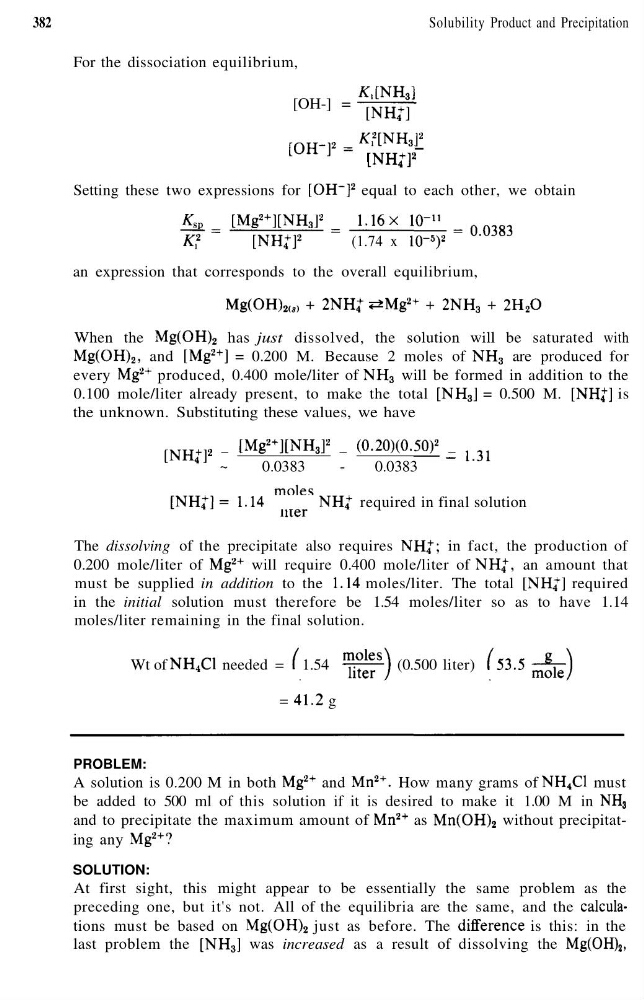
For the dissociation equilibrium,
[OH-] =
[OH-]'= rxTTJ+12
[NH 4 +]
*.
2 [NH 3 J
2
[NH 4 +]
2
Setting these two expressions for [OH"]
2 equal to each other, we obtain
KSP
[Mg
2+ ][NH 3 J
2
1.16 x 10-"
K?
[NH 4
+ ]
2
(1.74 x 10~
5 )
2
an expression that corresponds to the overall equilibrium,
Mg(OH) 2(sl + 2NH 4
+ ?±Mg
2+ + 2NH 3 + 2H 2 O
When the Mg(OH) 2 has just dissolved, the solution will be saturated with
Mg(OH) 2 , and [Mg
2+ ] = 0.200 M. Because 2 moles of NH 3 are produced for
every Mg
2+ produced, 0.400 mole/liter of NH 3 will be formed in addition to the
0.100 mole/liter already present, to make the total [NH 3 J = 0.500 M. [NHf] is
the unknown. Substituting these values, we have
2 _ [Mg
2 +][NH 3 ]
2 _ (0.20)(O.SO)
2 _
~
0.0383
-
0.0383
~
[NH 4 +] =1.14
NH| required in final solution
The dissolving of the precipitate also requires NHJ"; in fact, the production of
0.200 mole/liter of Mg
2+ will require 0.400 mole/liter of NH^, an amount that
must be supplied in addition to the 1.14 moles/liter. The total [NHj"] required
in the initial solution must therefore be 1.54 moles/liter so as to have 1.14
moles/liter remaining in the final solution.
Wt of NH 4 C1 needed = ( 1.54
!
^
i
) (0.500 liter) (s3.5
= 41. 2 g
PROBLEM:
A solution is 0.200 M in both Mg
2+ and Mn
2+ . How many grams of NH 4 C1 must
be added to 500 ml of this solution if it is desired to make it 1.00 M in NH 3
and to precipitate the maximum amount of Mn
2+ as Mn(OH) 2 without precipitating any Mg
2+ ?
SOLUTION:
At first sight, this might appear to be essentially the same problem as the
preceding one, but it's not. All of the equilibria are the same, and the calculations must be based on Mg(OH) 2 just as before. The difference is this: in the
last problem the [NH 3 ] was increased as a result of dissolving the Mg(OH) z ,
Solubility Product and Precipitation
For the dissociation equilibrium,
[OH-] =
[OH-]'= rxTTJ+12
[NH 4 +]
*.
2 [NH 3 J
2
[NH 4 +]
2
Setting these two expressions for [OH"]
2 equal to each other, we obtain
KSP
[Mg
2+ ][NH 3 J
2
1.16 x 10-"
K?
[NH 4
+ ]
2
(1.74 x 10~
5 )
2
an expression that corresponds to the overall equilibrium,
Mg(OH) 2(sl + 2NH 4
+ ?±Mg
2+ + 2NH 3 + 2H 2 O
When the Mg(OH) 2 has just dissolved, the solution will be saturated with
Mg(OH) 2 , and [Mg
2+ ] = 0.200 M. Because 2 moles of NH 3 are produced for
every Mg
2+ produced, 0.400 mole/liter of NH 3 will be formed in addition to the
0.100 mole/liter already present, to make the total [NH 3 J = 0.500 M. [NHf] is
the unknown. Substituting these values, we have
2 _ [Mg
2 +][NH 3 ]
2 _ (0.20)(O.SO)
2 _
~
0.0383
-
0.0383
~
[NH 4 +] =1.14
NH| required in final solution
The dissolving of the precipitate also requires NHJ"; in fact, the production of
0.200 mole/liter of Mg
2+ will require 0.400 mole/liter of NH^, an amount that
must be supplied in addition to the 1.14 moles/liter. The total [NHj"] required
in the initial solution must therefore be 1.54 moles/liter so as to have 1.14
moles/liter remaining in the final solution.
Wt of NH 4 C1 needed = ( 1.54
!
^
i
) (0.500 liter) (s3.5
= 41. 2 g
PROBLEM:
A solution is 0.200 M in both Mg
2+ and Mn
2+ . How many grams of NH 4 C1 must
be added to 500 ml of this solution if it is desired to make it 1.00 M in NH 3
and to precipitate the maximum amount of Mn
2+ as Mn(OH) 2 without precipitating any Mg
2+ ?
SOLUTION:
At first sight, this might appear to be essentially the same problem as the
preceding one, but it's not. All of the equilibria are the same, and the calculations must be based on Mg(OH) 2 just as before. The difference is this: in the
last problem the [NH 3 ] was increased as a result of dissolving the Mg(OH) z ,