

358
Acid-Base Equilibria
This problem shows that one way to make a buffer is to partially neutralize
a weak acid with a strong base Partial neutralization of a weak base with a
strong acid also will work
PROBLEM:
How many grams of sodium acetate must be added to 250 ml of 0 200 M
HC 2 H 3 O 2 in order to prepare a buffer with pH = 5 OO
9
SOLUTION:
The pH is given as 5 00, therefore, [H
+ ] = 1 00 x 10~
5 M We are also told
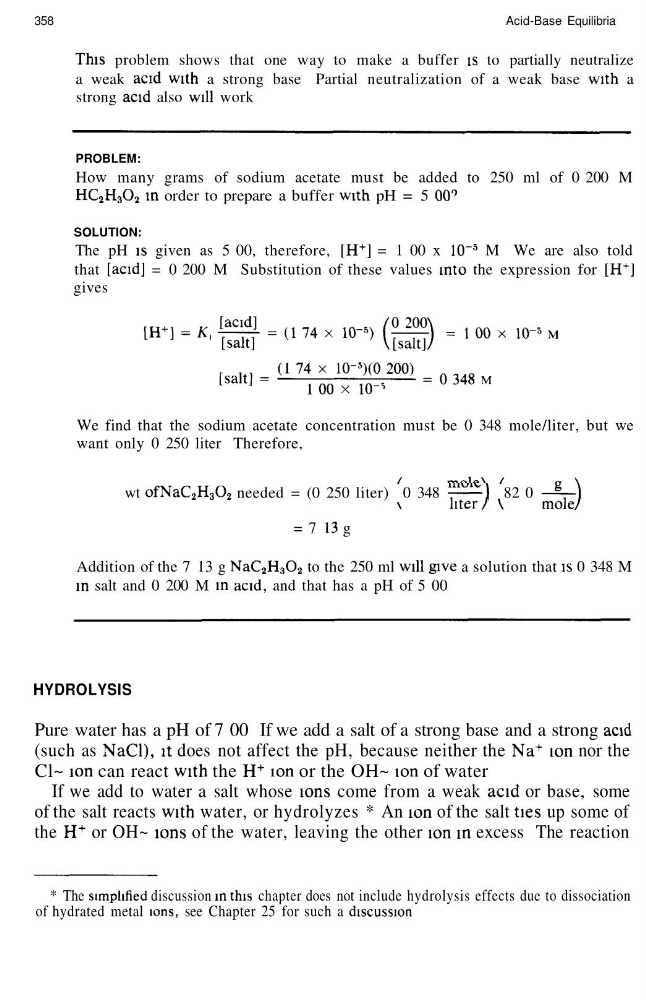
that [acid] = 0 200 M Substitution of these values into the expression for [H
+ ]
gives
We find that the sodium acetate concentration must be 0 348 mole/liter, but we
want only 0 250 liter Therefore,
wt of NaC 2 H 3 O 2 needed = (0 250 liter) 0 348 -^^) 82 0
liter/ \
mole/
= 7 13 g
Addition of the 7 13 g NaC 2 H 3 O 2 to the 250 ml will give a solution that is 0 348 M
in salt and 0 200 M in acid, and that has a pH of 5 00
HYDROLYSIS
Pure water has a pH of 7 00 If we add a salt of a strong base and a strong acid
(such as NaCl), it does not affect the pH, because neither the Na"
1
" ion nor the
Cl~ ion can react with the H
+ ion or the OH~ ion of water
If we add to water a salt whose ions come from a weak acid or base, some
of the salt reacts with water, or hydrolyzes * An ion of the salt ties up some of
the H
+ or OH~ ions of the water, leaving the other ion in excess The reaction
* The simplified discussion in this chapter does not include hydrolysis effects due to dissociation
of hydrated metal ions, see Chapter 25 for such a discussion
Acid-Base Equilibria
This problem shows that one way to make a buffer is to partially neutralize
a weak acid with a strong base Partial neutralization of a weak base with a
strong acid also will work
PROBLEM:
How many grams of sodium acetate must be added to 250 ml of 0 200 M
HC 2 H 3 O 2 in order to prepare a buffer with pH = 5 OO
9
SOLUTION:
The pH is given as 5 00, therefore, [H
+ ] = 1 00 x 10~
5 M We are also told
that [acid] = 0 200 M Substitution of these values into the expression for [H
+ ]
gives
We find that the sodium acetate concentration must be 0 348 mole/liter, but we
want only 0 250 liter Therefore,
wt of NaC 2 H 3 O 2 needed = (0 250 liter) 0 348 -^^) 82 0
liter/ \
mole/
= 7 13 g
Addition of the 7 13 g NaC 2 H 3 O 2 to the 250 ml will give a solution that is 0 348 M
in salt and 0 200 M in acid, and that has a pH of 5 00
HYDROLYSIS
Pure water has a pH of 7 00 If we add a salt of a strong base and a strong acid
(such as NaCl), it does not affect the pH, because neither the Na"
1
" ion nor the
Cl~ ion can react with the H
+ ion or the OH~ ion of water
If we add to water a salt whose ions come from a weak acid or base, some
of the salt reacts with water, or hydrolyzes * An ion of the salt ties up some of
the H
+ or OH~ ions of the water, leaving the other ion in excess The reaction
* The simplified discussion in this chapter does not include hydrolysis effects due to dissociation
of hydrated metal ions, see Chapter 25 for such a discussion