

Buffers
357
PROBLEM:
What is the pH of the solution when 0.10 mole of HCI is added to 1.00 liter
of the buffer in the preceding problem?
SOLUTION:
The 0.10 mole of HCI (strong acid) reacts with the salt,
H
+ + C 2 H 3 O 2 - -> HC 2 H 3 O 2
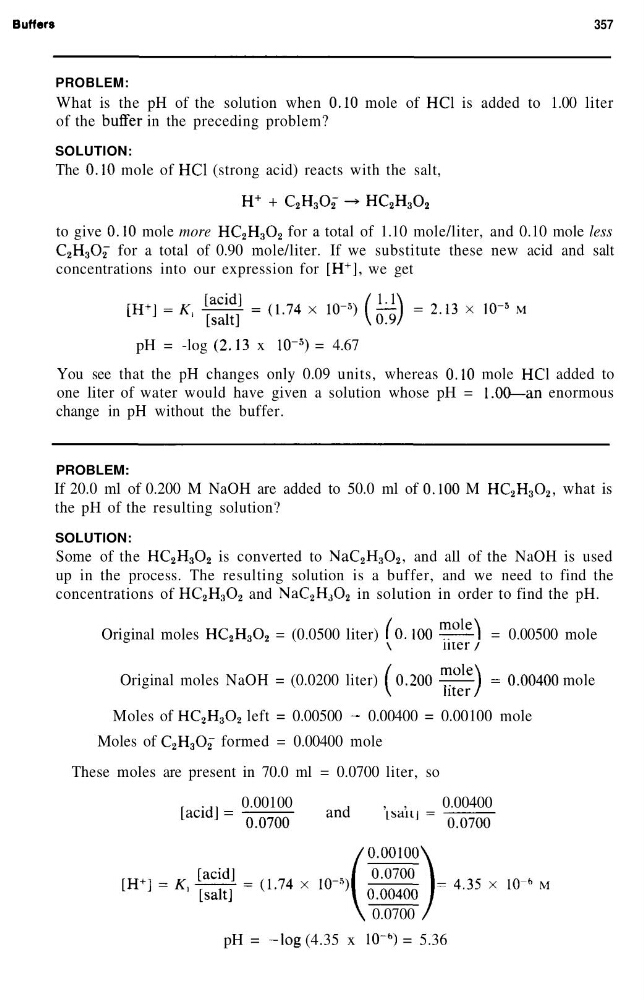
to give 0.10 mole more HC 2 H 3 O 2 for a total of 1.10 mole/liter, and 0.10 mole less
C 2 H 3 O2~ for a total of 0.90 mole/liter. If we substitute these new acid and salt
concentrations into our expression for [H
+ ], we get
pH = -log (2. 13 x 105
) = 4.67
You see that the pH changes only 0.09 units, whereas 0.10 mole HCI added to
one liter of water would have given a solution whose pH = 1.00 — an enormous
change in pH without the buffer.
PROBLEM:
If 20.0 ml of 0.200 M NaOH are added to 50.0 ml of 0.100 M HC 2 H 3 O 2 , what is
the pH of the resulting solution?
SOLUTION:
Some of the HC 2 H 3 O 2 is converted to NaC 2 H 3 O 2 , and all of the NaOH is used
up in the process. The resulting solution is a buffer, and we need to find the
concentrations of HC 2 H 3 O 2 and NaC 2 H 3 O 2 in solution in order to find the pH.
Original moles HC 2 H 3 O 2 = (0.0500 liter) ( 0. 100 ^~-\ = 0.00500 mole
Original moles NaOH = (0.0200 liter) ( 0.200 BHli^ = Q.00400 mole
\
liter/
Moles of HC 2 H 3 O 2 left = 0.00500 - 0.00400 = 0.00100 mole
Moles of C 2 H 3 O 2 - formed = 0.00400 mole
These moles are present in 70.0 ml = 0.0700 liter, so
0.00100
J
, ,
0.00400
[aCldJ = ^OOT
and
O.OOIOO
0.0700
pH = -log (4.35 x 10-") = 5.36
357
PROBLEM:
What is the pH of the solution when 0.10 mole of HCI is added to 1.00 liter
of the buffer in the preceding problem?
SOLUTION:
The 0.10 mole of HCI (strong acid) reacts with the salt,
H
+ + C 2 H 3 O 2 - -> HC 2 H 3 O 2
to give 0.10 mole more HC 2 H 3 O 2 for a total of 1.10 mole/liter, and 0.10 mole less
C 2 H 3 O2~ for a total of 0.90 mole/liter. If we substitute these new acid and salt
concentrations into our expression for [H
+ ], we get
pH = -log (2. 13 x 105
) = 4.67
You see that the pH changes only 0.09 units, whereas 0.10 mole HCI added to
one liter of water would have given a solution whose pH = 1.00 — an enormous
change in pH without the buffer.
PROBLEM:
If 20.0 ml of 0.200 M NaOH are added to 50.0 ml of 0.100 M HC 2 H 3 O 2 , what is
the pH of the resulting solution?
SOLUTION:
Some of the HC 2 H 3 O 2 is converted to NaC 2 H 3 O 2 , and all of the NaOH is used
up in the process. The resulting solution is a buffer, and we need to find the
concentrations of HC 2 H 3 O 2 and NaC 2 H 3 O 2 in solution in order to find the pH.
Original moles HC 2 H 3 O 2 = (0.0500 liter) ( 0. 100 ^~-\ = 0.00500 mole
Original moles NaOH = (0.0200 liter) ( 0.200 BHli^ = Q.00400 mole
\
liter/
Moles of HC 2 H 3 O 2 left = 0.00500 - 0.00400 = 0.00100 mole
Moles of C 2 H 3 O 2 - formed = 0.00400 mole
These moles are present in 70.0 ml = 0.0700 liter, so
0.00100
J
, ,
0.00400
[aCldJ = ^OOT
and
O.OOIOO
0.0700
pH = -log (4.35 x 10-") = 5.36