

356
Acid-Base Equilibria
BUFFERS
A solution that contains a weak acid plus a salt of that acid, or a weak base
plus a salt of that base, is known as a buffer. Such a solution has the capability
to buffer against (to resist) changes in pH when small amounts of strong acid
or base are added. Only very small changes occur.
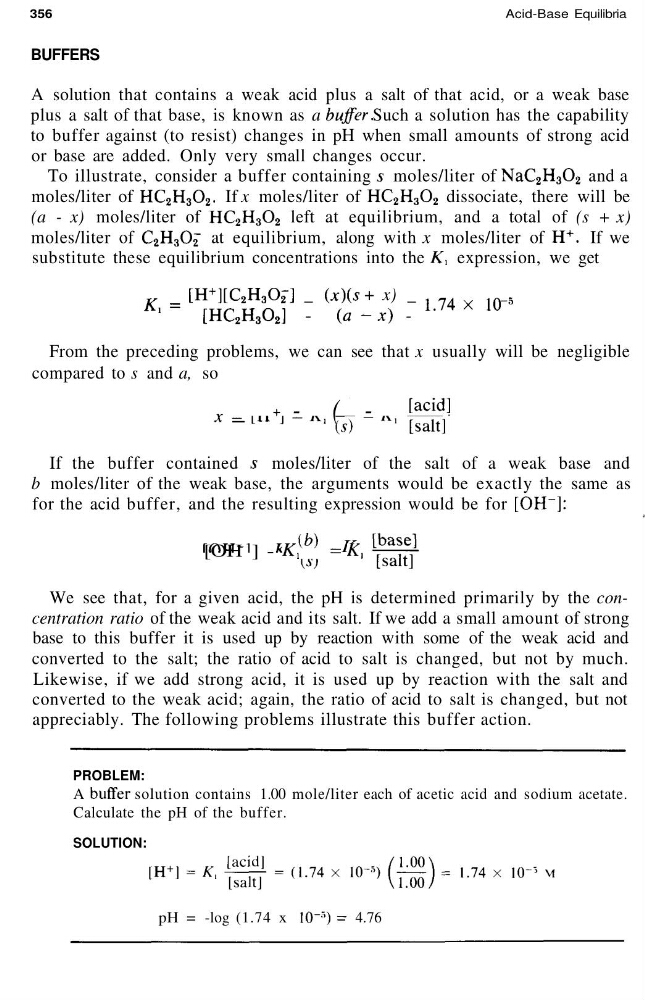
To illustrate, consider a buffer containing 5 moles/liter of NaC 2 H 3 O 2 and a
moles/liter of HC 2 H 3 O 2 . If x moles/liter of HC 2 H 3 O 2 dissociate, there will be
(a - x) moles/liter of HC 2 H 3 O 2 left at equilibrium, and a total of (s + x)
moles/liter of C 2 H 3 O 2 " at equilibrium, along with x moles/liter of H
+ . If we
substitute these equilibrium concentrations into the K, expression, we get
[H
+ ][C 2 H 3 0 2 -] _ (x)(s + x) _
*'
=
[HC 2 H 3 0 2 ] - (a-x) -
L?4 X 10
From the preceding problems, we can see that x usually will be negligible
compared to s and a, so
_ + - ( -
[add]
If the buffer contained s moles/liter of the salt of a weak base and
b moles/liter of the weak base, the arguments would be exactly the same as
for the acid buffer, and the resulting expression would be for [OH~]:
rnu-i K(b )
K
[OH ] - *,
= K,
We see that, for a given acid, the pH is determined primarily by the concentration ratio of the weak acid and its salt. If we add a small amount of strong
base to this buffer it is used up by reaction with some of the weak acid and
converted to the salt; the ratio of acid to salt is changed, but not by much.
Likewise, if we add strong acid, it is used up by reaction with the salt and
converted to the weak acid; again, the ratio of acid to salt is changed, but not
appreciably. The following problems illustrate this buffer action.
PROBLEM:
A buffer solution contains 1.00 mole/liter each of acetic acid and sodium acetate.
Calculate the pH of the buffer.
SOLUTION:
pH = -log (1.74 x 10³
) = 4.76
Acid-Base Equilibria
BUFFERS
A solution that contains a weak acid plus a salt of that acid, or a weak base
plus a salt of that base, is known as a buffer. Such a solution has the capability
to buffer against (to resist) changes in pH when small amounts of strong acid
or base are added. Only very small changes occur.
To illustrate, consider a buffer containing 5 moles/liter of NaC 2 H 3 O 2 and a
moles/liter of HC 2 H 3 O 2 . If x moles/liter of HC 2 H 3 O 2 dissociate, there will be
(a - x) moles/liter of HC 2 H 3 O 2 left at equilibrium, and a total of (s + x)
moles/liter of C 2 H 3 O 2 " at equilibrium, along with x moles/liter of H
+ . If we
substitute these equilibrium concentrations into the K, expression, we get
[H
+ ][C 2 H 3 0 2 -] _ (x)(s + x) _
*'
=
[HC 2 H 3 0 2 ] - (a-x) -
L?4 X 10
From the preceding problems, we can see that x usually will be negligible
compared to s and a, so
_ + - ( -
[add]
If the buffer contained s moles/liter of the salt of a weak base and
b moles/liter of the weak base, the arguments would be exactly the same as
for the acid buffer, and the resulting expression would be for [OH~]:
rnu-i K(b )
K
[OH ] - *,
= K,
We see that, for a given acid, the pH is determined primarily by the concentration ratio of the weak acid and its salt. If we add a small amount of strong
base to this buffer it is used up by reaction with some of the weak acid and
converted to the salt; the ratio of acid to salt is changed, but not by much.
Likewise, if we add strong acid, it is used up by reaction with the salt and
converted to the weak acid; again, the ratio of acid to salt is changed, but not
appreciably. The following problems illustrate this buffer action.
PROBLEM:
A buffer solution contains 1.00 mole/liter each of acetic acid and sodium acetate.
Calculate the pH of the buffer.
SOLUTION:
pH = -log (1.74 x 10³
) = 4.76