

Common-Ion Effect
355
PROBLEM:
What is the pH after 1.00 g NaC 2 H 3 O 2 is added to 150 ml of 0.0500 M
HC 2 H 3 O 2 ?
SOLUTION:
First, find the concentrations of the substances put into solution. NaC 2 H 3 O 2
is a soluble salt that is completely dissociated in solution; for every mole of
NaC 2 H 3 O 2 put into solution, we get one mole of C 2 H 3 O 2 ~. So, from NaC 2 H 3 O 2 ,
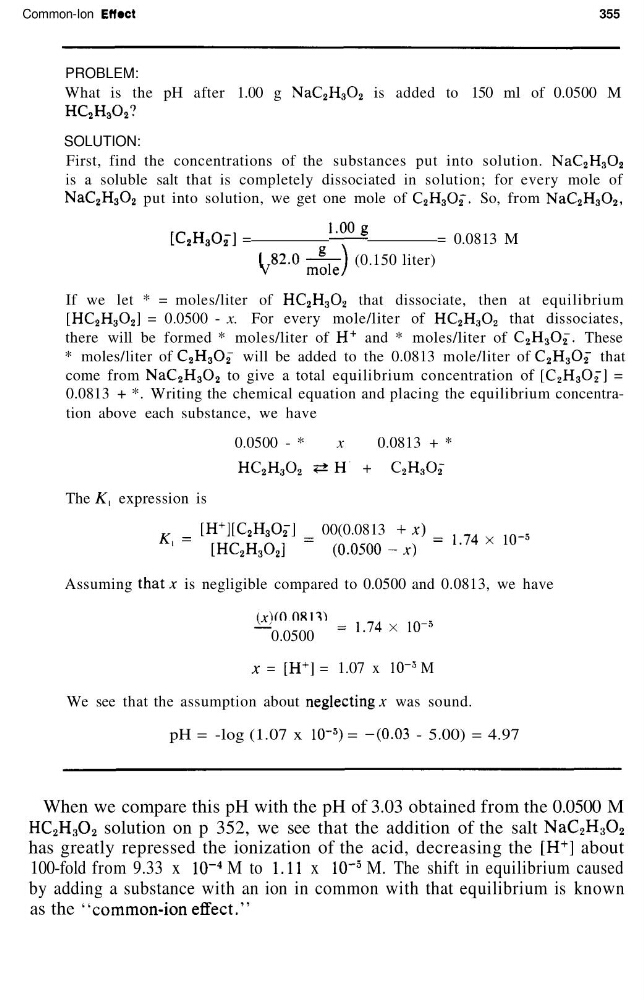
[C 2 H 3 O 2 -] =
^-^
= 0.0813 M
(82.0 -V) (0.150 liter)
V
mole/
If we let * = moles/liter of HC 2 H 3 O 2 that dissociate, then at equilibrium
[HC 2 H 3 O 2 ] = 0.0500 - x. For every mole/liter of HC 2 H 3 O 2 that dissociates,
there will be formed * moles/liter of H
+ and * moles/liter of C 2 H 3 O 2 ~. These
* moles/liter of C 2 H 3 O 2 - will be added to the 0.0813 mole/liter of C 2 H 3 O2- that
come from NaC 2 H 3 O 2 to give a total equilibrium concentration of [C 2 H 3 O 2 ~] =
0.0813 + *. Writing the chemical equation and placing the equilibrium concentration above each substance, we have
0.0500 - *
x
0.0813 + *
HC 2 H 3 O 2 «^ ri + C2ri 3 O 2
The K, expression is
= [H+][C 2 H 3 0 2 -J = 00(0.0813 +x) =
[HC 2 H 3 0 2 ]
(0.0500-*)
Assuming that* is negligible compared to 0.0500 and 0.0813, we have
0.0500 ='74x10 -
5
x = [H
+ ] = 1.07 x 10~
3 M
We see that the assumption about neglecting* was sound.
pH = -log (1.07 x 10⁵
) = -(0.03 - 5.00) = 4.97
When we compare this pH with the pH of 3.03 obtained from the 0.0500 M
HC 2 H 3 O 2 solution on p 352, we see that the addition of the salt NaC 2 H 3 O 2
has greatly repressed the ionization of the acid, decreasing the [H
+ ] about
100-fold from 9.33 x 10~
4 M to 1.11 x 10'
5 M. The shift in equilibrium caused
by adding a substance with an ion in common with that equilibrium is known
as the "common-ion effect."
355
PROBLEM:
What is the pH after 1.00 g NaC 2 H 3 O 2 is added to 150 ml of 0.0500 M
HC 2 H 3 O 2 ?
SOLUTION:
First, find the concentrations of the substances put into solution. NaC 2 H 3 O 2
is a soluble salt that is completely dissociated in solution; for every mole of
NaC 2 H 3 O 2 put into solution, we get one mole of C 2 H 3 O 2 ~. So, from NaC 2 H 3 O 2 ,
[C 2 H 3 O 2 -] =
^-^
= 0.0813 M
(82.0 -V) (0.150 liter)
V
mole/
If we let * = moles/liter of HC 2 H 3 O 2 that dissociate, then at equilibrium
[HC 2 H 3 O 2 ] = 0.0500 - x. For every mole/liter of HC 2 H 3 O 2 that dissociates,
there will be formed * moles/liter of H
+ and * moles/liter of C 2 H 3 O 2 ~. These
* moles/liter of C 2 H 3 O 2 - will be added to the 0.0813 mole/liter of C 2 H 3 O2- that
come from NaC 2 H 3 O 2 to give a total equilibrium concentration of [C 2 H 3 O 2 ~] =
0.0813 + *. Writing the chemical equation and placing the equilibrium concentration above each substance, we have
0.0500 - *
x
0.0813 + *
HC 2 H 3 O 2 «^ ri + C2ri 3 O 2
The K, expression is
= [H+][C 2 H 3 0 2 -J = 00(0.0813 +x) =
[HC 2 H 3 0 2 ]
(0.0500-*)
Assuming that* is negligible compared to 0.0500 and 0.0813, we have
0.0500 ='74x10 -
5
x = [H
+ ] = 1.07 x 10~
3 M
We see that the assumption about neglecting* was sound.
pH = -log (1.07 x 10⁵
) = -(0.03 - 5.00) = 4.97
When we compare this pH with the pH of 3.03 obtained from the 0.0500 M
HC 2 H 3 O 2 solution on p 352, we see that the addition of the salt NaC 2 H 3 O 2
has greatly repressed the ionization of the acid, decreasing the [H
+ ] about
100-fold from 9.33 x 10~
4 M to 1.11 x 10'
5 M. The shift in equilibrium caused
by adding a substance with an ion in common with that equilibrium is known
as the "common-ion effect."