

Hydrolysis
359
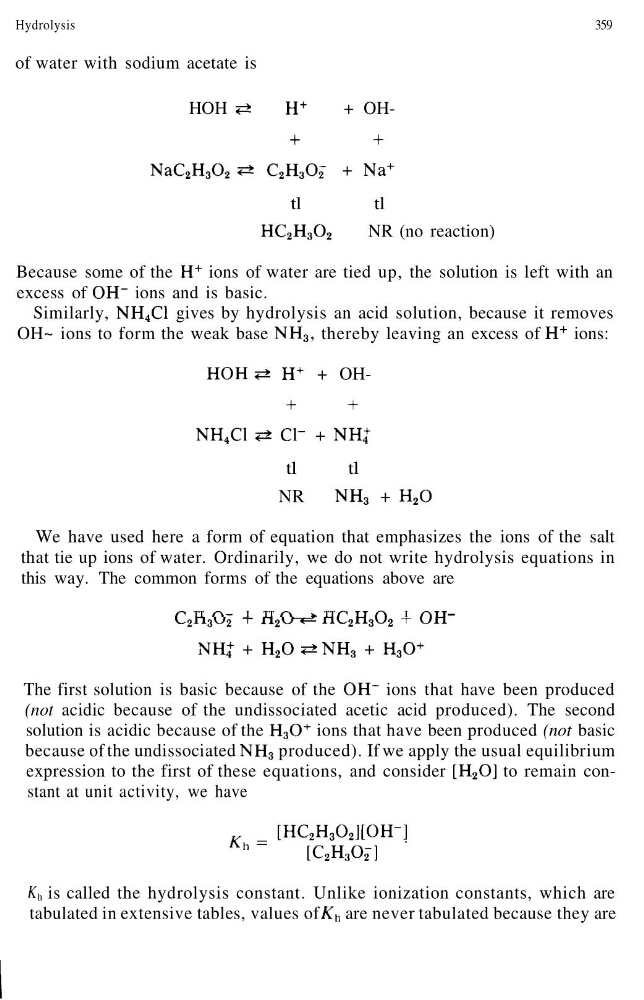
of water with sodium acetate is
HOH ?±
H+
+ OHNaC 2 H 3 O 2 ?* C 2 H 3 O2- + Na
+
tl
tl
HC 2 H 3 O 2
NR (no reaction)
Because some of the H
+ ions of water are tied up, the solution is left with an
excess of OH~ ions and is basic.
Similarly, NH 4 C1 gives by hydrolysis an acid solution, because it removes
OH~ ions to form the weak base NH 3 , thereby leaving an excess of H
+ ions:
HOH?± H+ + OHNH 4 C1 «* Cl- + NHJ
tl
tl
NR
NH 3 + H 2 O
We have used here a form of equation that emphasizes the ions of the salt
that tie up ions of water. Ordinarily, we do not write hydrolysis equations in
this way. The common forms of the equations above are
C
TT /~V—
I
TT f~\
* TT /"~< TT /~\
I OT-J —
2 n 3 v-' 2 ~r iT 2 w
+
The first solution is basic because of the OH~ ions that have been produced
(not acidic because of the undissociated acetic acid produced). The second
solution is acidic because of the H 3 O
+ ions that have been produced (not basic
because of the undissociated NH 3 produced). If we apply the usual equilibrium
expression to the first of these equations, and consider [H 2 O] to remain constant at unit activity, we have
= [HC 2 H 3 0 2 J[QH-]
11
[C 2 H 3 0 2 -]
K h is called the hydrolysis constant. Unlike ionization constants, which are
tabulated in extensive tables, values of A^ h are never tabulated because they are
359
of water with sodium acetate is
HOH ?±
H+
+ OHNaC 2 H 3 O 2 ?* C 2 H 3 O2- + Na
+
tl
tl
HC 2 H 3 O 2
NR (no reaction)
Because some of the H
+ ions of water are tied up, the solution is left with an
excess of OH~ ions and is basic.
Similarly, NH 4 C1 gives by hydrolysis an acid solution, because it removes
OH~ ions to form the weak base NH 3 , thereby leaving an excess of H
+ ions:
HOH?± H+ + OHNH 4 C1 «* Cl- + NHJ
tl
tl
NR
NH 3 + H 2 O
We have used here a form of equation that emphasizes the ions of the salt
that tie up ions of water. Ordinarily, we do not write hydrolysis equations in
this way. The common forms of the equations above are
C
TT /~V—
I
TT f~\
* TT /"~< TT /~\
I OT-J —
2 n 3 v-' 2 ~r iT 2 w
+
The first solution is basic because of the OH~ ions that have been produced
(not acidic because of the undissociated acetic acid produced). The second
solution is acidic because of the H 3 O
+ ions that have been produced (not basic
because of the undissociated NH 3 produced). If we apply the usual equilibrium
expression to the first of these equations, and consider [H 2 O] to remain constant at unit activity, we have
= [HC 2 H 3 0 2 J[QH-]
11
[C 2 H 3 0 2 -]
K h is called the hydrolysis constant. Unlike ionization constants, which are
tabulated in extensive tables, values of A^ h are never tabulated because they are