

342
Hydrogen-Ion Concentration and pH
TABLE 22-1
Relations Among Concentrations of Strong Acid or Strong Base and Solution pH and pOH
Concentration of HCI (M)
PH
pOH
Concentration of NaOH (M)
10-'
1
13
10- 3
3
11
10~
5
5
g
0
7
7
0
9
5
10s
11
3
10~
3
13
1
10-'
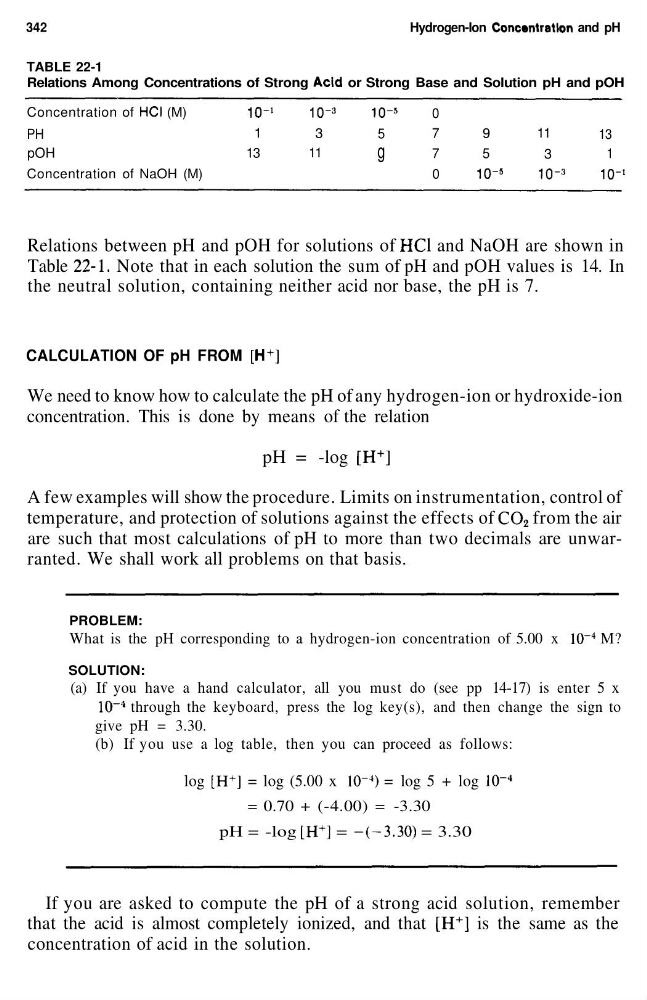
Relations between pH and pOH for solutions of HCI and NaOH are shown in
Table 22-1. Note that in each solution the sum of pH and pOH values is 14. In
the neutral solution, containing neither acid nor base, the pH is 7.
CALCULATION OF pH FROM [H
+ ]
We need to know how to calculate the pH of any hydrogen-ion or hydroxide-ion
concentration. This is done by means of the relation
pH = -log [H
+ ]
A few examples will show the procedure. Limits on instrumentation, control of
temperature, and protection of solutions against the effects of CO 2 from the air
are such that most calculations of pH to more than two decimals are unwarranted. We shall work all problems on that basis.
PROBLEM:
What is the pH corresponding to a hydrogen-ion concentration of 5.00 x 10~
4 M?
SOLUTION:
(a) If you have a hand calculator, all you must do (see pp 14-17) is enter 5 x
10~
4 through the keyboard, press the log key(s), and then change the sign to
give pH = 3.30.
(b) If you use a log table, then you can proceed as follows:
log [H
+ ] = log (5.00 x 10⁴
) = log 5 + log lO'
4
= 0.70 + (-4.00) = -3.30
pH = -log IH+] = -(-3.30) = 3.30
If you are asked to compute the pH of a strong acid solution, remember
that the acid is almost completely ionized, and that [H
+ ] is the same as the
concentration of acid in the solution.
Hydrogen-Ion Concentration and pH
TABLE 22-1
Relations Among Concentrations of Strong Acid or Strong Base and Solution pH and pOH
Concentration of HCI (M)
PH
pOH
Concentration of NaOH (M)
10-'
1
13
10- 3
3
11
10~
5
5
g
0
7
7
0
9
5
10s
11
3
10~
3
13
1
10-'
Relations between pH and pOH for solutions of HCI and NaOH are shown in
Table 22-1. Note that in each solution the sum of pH and pOH values is 14. In
the neutral solution, containing neither acid nor base, the pH is 7.
CALCULATION OF pH FROM [H
+ ]
We need to know how to calculate the pH of any hydrogen-ion or hydroxide-ion
concentration. This is done by means of the relation
pH = -log [H
+ ]
A few examples will show the procedure. Limits on instrumentation, control of
temperature, and protection of solutions against the effects of CO 2 from the air
are such that most calculations of pH to more than two decimals are unwarranted. We shall work all problems on that basis.
PROBLEM:
What is the pH corresponding to a hydrogen-ion concentration of 5.00 x 10~
4 M?
SOLUTION:
(a) If you have a hand calculator, all you must do (see pp 14-17) is enter 5 x
10~
4 through the keyboard, press the log key(s), and then change the sign to
give pH = 3.30.
(b) If you use a log table, then you can proceed as follows:
log [H
+ ] = log (5.00 x 10⁴
) = log 5 + log lO'
4
= 0.70 + (-4.00) = -3.30
pH = -log IH+] = -(-3.30) = 3.30
If you are asked to compute the pH of a strong acid solution, remember
that the acid is almost completely ionized, and that [H
+ ] is the same as the
concentration of acid in the solution.