

Definition of pH and pOH
341
rium, the principles of chemical equilibrium discussed in Chapter 16 apply, and
we can write the equilibrium-constant expression
This equilibrium is of such importance that K bears the special subscript w. In
pure water at 25.0°C, the concentration of H
+ is 1.0 x 10"
7 M— that is, [H
+ ] =
1.0 x 10"
7 M. Because the dissociation provides equal numbers of H
+ and OH~
ions, it follows that in pure water [OH~] = 1.0 x 10~
7 M also. Knowing the
equilibrium concentrations, we can evaluate K w numerically:
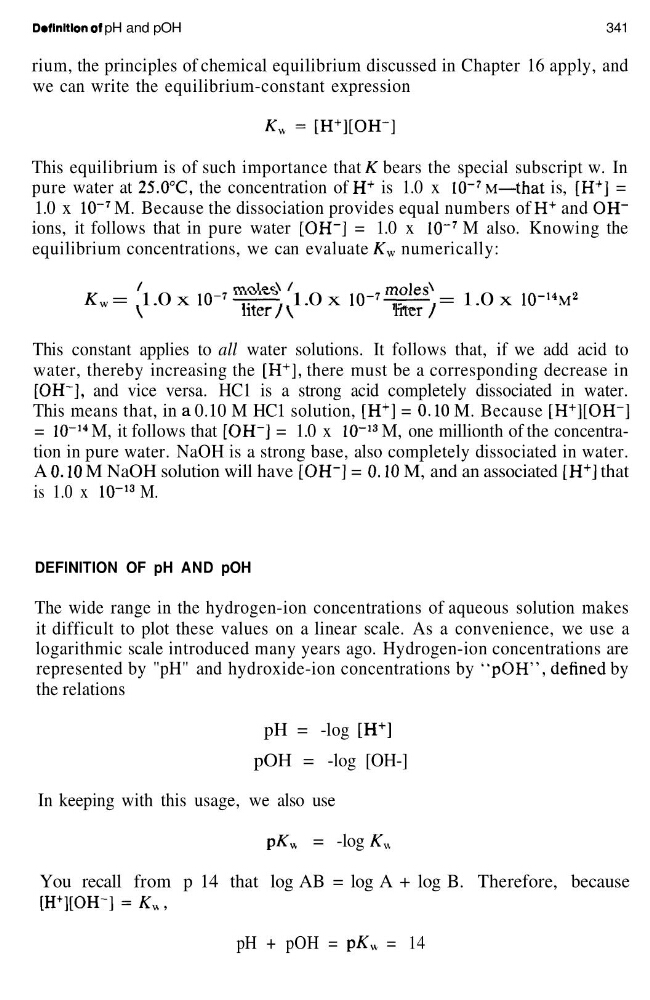
K w = 1.0 x lO7 -^^ 1.0 x 10⁷ ^^ = 1.0 x 10"
14 M
2
\
liter / \
liter /
This constant applies to all water solutions. It follows that, if we add acid to
water, thereby increasing the [H
+ ], there must be a corresponding decrease in
[OH~], and vice versa. HC1 is a strong acid completely dissociated in water.
This means that, in a 0.10 M HC1 solution, [H
+ ] = 0.10 M. Because [H
+ ][OH~]
= 10~
14 M, it follows that [OH~] = 1.0 x 10"
13 M, one millionth of the concentration in pure water. NaOH is a strong base, also completely dissociated in water.
A 0.10 M NaOH solution will have [OH"] = 0.10 M, and an associated [H
+
] that
is 1.0 x 10~
13 M.
DEFINITION OF pH AND pOH
The wide range in the hydrogen-ion concentrations of aqueous solution makes
it difficult to plot these values on a linear scale. As a convenience, we use a
logarithmic scale introduced many years ago. Hydrogen-ion concentrations are
represented by "pH" and hydroxide-ion concentrations by "pOH", denned by
the relations
pH = -log [H+]
pOH = -log [OH-]
In keeping with this usage, we also use
pKv, = -log K n
You recall from p 14 that log AB = log A + log B. Therefore, because
pH + pOH = ptf w = 14
341
rium, the principles of chemical equilibrium discussed in Chapter 16 apply, and
we can write the equilibrium-constant expression
This equilibrium is of such importance that K bears the special subscript w. In
pure water at 25.0°C, the concentration of H
+ is 1.0 x 10"
7 M— that is, [H
+ ] =
1.0 x 10"
7 M. Because the dissociation provides equal numbers of H
+ and OH~
ions, it follows that in pure water [OH~] = 1.0 x 10~
7 M also. Knowing the
equilibrium concentrations, we can evaluate K w numerically:
K w = 1.0 x lO7 -^^ 1.0 x 10⁷ ^^ = 1.0 x 10"
14 M
2
\
liter / \
liter /
This constant applies to all water solutions. It follows that, if we add acid to
water, thereby increasing the [H
+ ], there must be a corresponding decrease in
[OH~], and vice versa. HC1 is a strong acid completely dissociated in water.
This means that, in a 0.10 M HC1 solution, [H
+ ] = 0.10 M. Because [H
+ ][OH~]
= 10~
14 M, it follows that [OH~] = 1.0 x 10"
13 M, one millionth of the concentration in pure water. NaOH is a strong base, also completely dissociated in water.
A 0.10 M NaOH solution will have [OH"] = 0.10 M, and an associated [H
+
] that
is 1.0 x 10~
13 M.
DEFINITION OF pH AND pOH
The wide range in the hydrogen-ion concentrations of aqueous solution makes
it difficult to plot these values on a linear scale. As a convenience, we use a
logarithmic scale introduced many years ago. Hydrogen-ion concentrations are
represented by "pH" and hydroxide-ion concentrations by "pOH", denned by
the relations
pH = -log [H+]
pOH = -log [OH-]
In keeping with this usage, we also use
pKv, = -log K n
You recall from p 14 that log AB = log A + log B. Therefore, because
pH + pOH = ptf w = 14