

Calculation of pH from |H*]
343
PROBLEM:
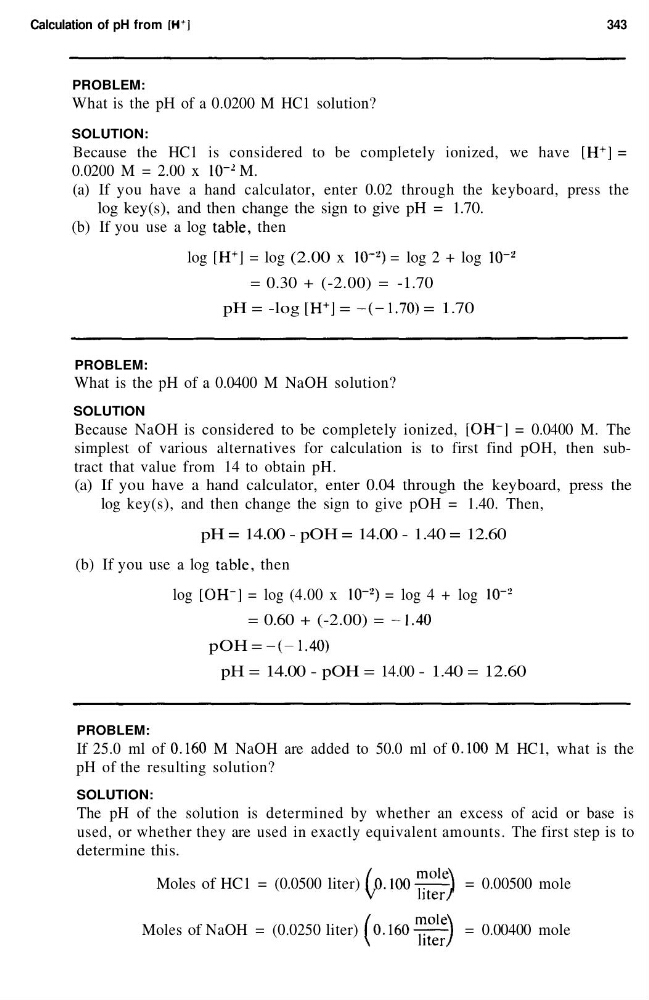
What is the pH of a 0.0200 M HC1 solution?
SOLUTION:
Because the HC1 is considered to be completely ionized, we have [H
+ ] =
0.0200 M = 2.00 x 10~
2 M.
(a) If you have a hand calculator, enter 0.02 through the keyboard, press the
log key(s), and then change the sign to give pH = 1.70.
(b) If you use a log table, then
log [H
+ ] = log (2.00 x 10~
2
) = log 2 + log 10~
2
= 0.30 + (-2.00) = -1.70
pH = -log [H
+ ] = -(-1.70) = 1.70
PROBLEM:
What is the pH of a 0.0400 M NaOH solution?
SOLUTION
Because NaOH is considered to be completely ionized, [OH~] = 0.0400 M. The
simplest of various alternatives for calculation is to first find pOH, then subtract that value from 14 to obtain pH.
(a) If you have a hand calculator, enter 0.04 through the keyboard, press the
log key(s), and then change the sign to give pOH = 1.40. Then,
pH = 14.00 - pOH = 14.00 - 1.40 = 12.60
(b) If you use a log table, then
log [OH~] = log (4.00 x 10~
2 ) = log 4 + log 10~
2
= 0.60 + (-2.00) = -1.40
pOH = -(-1.40)
pH = 14.00 - pOH = 14.00 - 1.40 = 12.60
PROBLEM:
If 25.0 ml of 0.160 M NaOH are added to 50.0 ml of 0.100 M HC1, what is the
pH of the resulting solution?
SOLUTION:
The pH of the solution is determined by whether an excess of acid or base is
used, or whether they are used in exactly equivalent amounts. The first step is to
determine this.
Moles of HC1 = (0.0500 liter) (0.100-™^ = 0.00500 mole
V
liter/
Moles of NaOH = (0.0250 liter) (0.160-™^ = 0.00400 mole
\
liter/
343
PROBLEM:
What is the pH of a 0.0200 M HC1 solution?
SOLUTION:
Because the HC1 is considered to be completely ionized, we have [H
+ ] =
0.0200 M = 2.00 x 10~
2 M.
(a) If you have a hand calculator, enter 0.02 through the keyboard, press the
log key(s), and then change the sign to give pH = 1.70.
(b) If you use a log table, then
log [H
+ ] = log (2.00 x 10~
2
) = log 2 + log 10~
2
= 0.30 + (-2.00) = -1.70
pH = -log [H
+ ] = -(-1.70) = 1.70
PROBLEM:
What is the pH of a 0.0400 M NaOH solution?
SOLUTION
Because NaOH is considered to be completely ionized, [OH~] = 0.0400 M. The
simplest of various alternatives for calculation is to first find pOH, then subtract that value from 14 to obtain pH.
(a) If you have a hand calculator, enter 0.04 through the keyboard, press the
log key(s), and then change the sign to give pOH = 1.40. Then,
pH = 14.00 - pOH = 14.00 - 1.40 = 12.60
(b) If you use a log table, then
log [OH~] = log (4.00 x 10~
2 ) = log 4 + log 10~
2
= 0.60 + (-2.00) = -1.40
pOH = -(-1.40)
pH = 14.00 - pOH = 14.00 - 1.40 = 12.60
PROBLEM:
If 25.0 ml of 0.160 M NaOH are added to 50.0 ml of 0.100 M HC1, what is the
pH of the resulting solution?
SOLUTION:
The pH of the solution is determined by whether an excess of acid or base is
used, or whether they are used in exactly equivalent amounts. The first step is to
determine this.
Moles of HC1 = (0.0500 liter) (0.100-™^ = 0.00500 mole
V
liter/
Moles of NaOH = (0.0250 liter) (0.160-™^ = 0.00400 mole
\
liter/