

298
Electrochemistry II: Balancing Equations
3. Assign to C whatever charge is needed (along with the assignments in 1
and 2) to give the overall charge on the organic molecule (usually zero).
This charge frequently will be a fraction.
4. Proceed to balance the equation either (a) by making half-reactions and
taking the difference, or (b) by using the stepwise procedure of the
preceding problems.
PROBLEM:
Write a balanced ionic equation for the reaction of Cr 2 Of~ with C 2 H 3 OC1 in acid
solution, given that CO 2 and C1 2 are the two main products from the organic
compound.
SOLUTION:
We use the stepwise procedure.
(1) Write down the oxidizing and reducing agents, and their corresponding
reduced and oxidized forms as products:
Cr 2 Of- + 2C 2 H 3 OC1 -> 2Cr
3+ + 4CO 2 + C1 2
Preliminary coefficients are used in front of Cr
3+ and C 2 H 3 OC1 because,
no matter what the final coefficients, there will always be 2Cr
3+ for each
Cr 2 Of-, and 2C 2 H 3 OC1 will be needed for every C1 2 . Also, there will
always be 4CO 2 produced for every 2C 2 H 3 OC1.
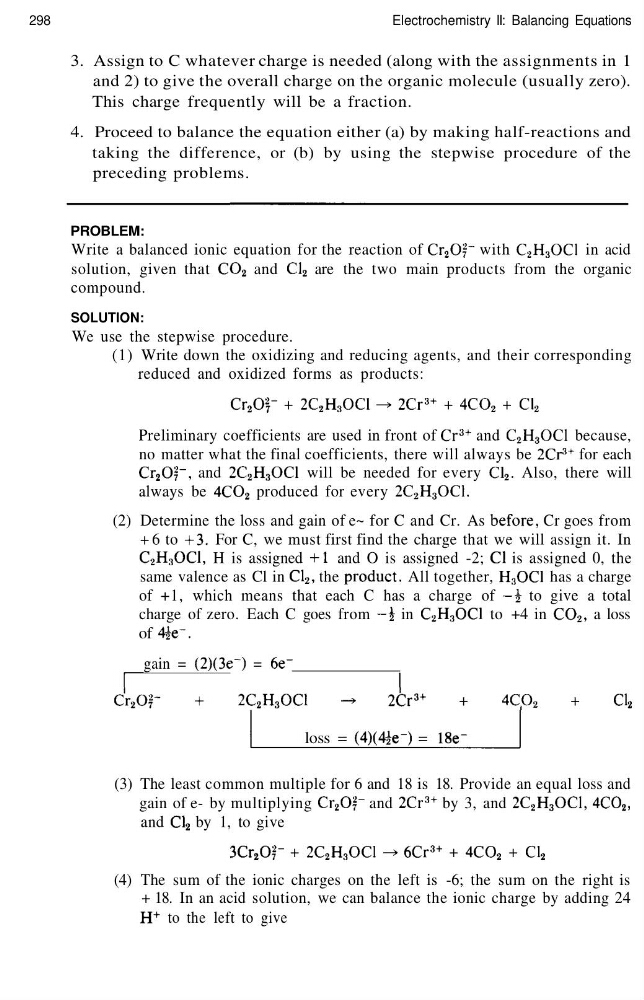
(2) Determine the loss and gain of e~ for C and Cr. As before, Cr goes from
+ 6 to +3. For C, we must first find the charge that we will assign it. In
C 2 H 3 OC1, H is assigned +1 and O is assigned -2; Cl is assigned 0, the
same valence as Cl in C1 2 , the product. All together, H 3 OC1 has a charge
of +1, which means that each C has a charge of — i to give a total
charge of zero. Each C goes from —i in C 2 H 3 OC1 to +4 in CO 2 , a loss
of 4|e~.
gain = (2)(3e~) = 6e~
2C 2 H 3 OC1
-»
2Cr
3+
+
4C,O 2
+
C1 2
loss = (4)(4ie-) = 18e~
(3) The least common multiple for 6 and 18 is 18. Provide an equal loss and
gain of e- by multiplying Cr 2 Or and 2Cr
3+ by 3, and 2C 2 H 3 OC1, 4C0 2 ,
and C1 2 by 1, to give
3Cr 2 Of- + 2C 2 H 3 OC1 -> 6Cr
3+ + 4CO 2 + C1 2
(4) The sum of the ionic charges on the left is -6; the sum on the right is
+ 18. In an acid solution, we can balance the ionic charge by adding 24
H
+ to the left to give
Electrochemistry II: Balancing Equations
3. Assign to C whatever charge is needed (along with the assignments in 1
and 2) to give the overall charge on the organic molecule (usually zero).
This charge frequently will be a fraction.
4. Proceed to balance the equation either (a) by making half-reactions and
taking the difference, or (b) by using the stepwise procedure of the
preceding problems.
PROBLEM:
Write a balanced ionic equation for the reaction of Cr 2 Of~ with C 2 H 3 OC1 in acid
solution, given that CO 2 and C1 2 are the two main products from the organic
compound.
SOLUTION:
We use the stepwise procedure.
(1) Write down the oxidizing and reducing agents, and their corresponding
reduced and oxidized forms as products:
Cr 2 Of- + 2C 2 H 3 OC1 -> 2Cr
3+ + 4CO 2 + C1 2
Preliminary coefficients are used in front of Cr
3+ and C 2 H 3 OC1 because,
no matter what the final coefficients, there will always be 2Cr
3+ for each
Cr 2 Of-, and 2C 2 H 3 OC1 will be needed for every C1 2 . Also, there will
always be 4CO 2 produced for every 2C 2 H 3 OC1.
(2) Determine the loss and gain of e~ for C and Cr. As before, Cr goes from
+ 6 to +3. For C, we must first find the charge that we will assign it. In
C 2 H 3 OC1, H is assigned +1 and O is assigned -2; Cl is assigned 0, the
same valence as Cl in C1 2 , the product. All together, H 3 OC1 has a charge
of +1, which means that each C has a charge of — i to give a total
charge of zero. Each C goes from —i in C 2 H 3 OC1 to +4 in CO 2 , a loss
of 4|e~.
gain = (2)(3e~) = 6e~
2C 2 H 3 OC1
-»
2Cr
3+
+
4C,O 2
+
C1 2
loss = (4)(4ie-) = 18e~
(3) The least common multiple for 6 and 18 is 18. Provide an equal loss and
gain of e- by multiplying Cr 2 Or and 2Cr
3+ by 3, and 2C 2 H 3 OC1, 4C0 2 ,
and C1 2 by 1, to give
3Cr 2 Of- + 2C 2 H 3 OC1 -> 6Cr
3+ + 4CO 2 + C1 2
(4) The sum of the ionic charges on the left is -6; the sum on the right is
+ 18. In an acid solution, we can balance the ionic charge by adding 24
H
+ to the left to give