

Balancing Molecular Equations
299
3Cr 2 Of- + 2C 2 H 3 OC1 + 24H
+ -> 6Cr
3+ + 4CO 2 + C1 2
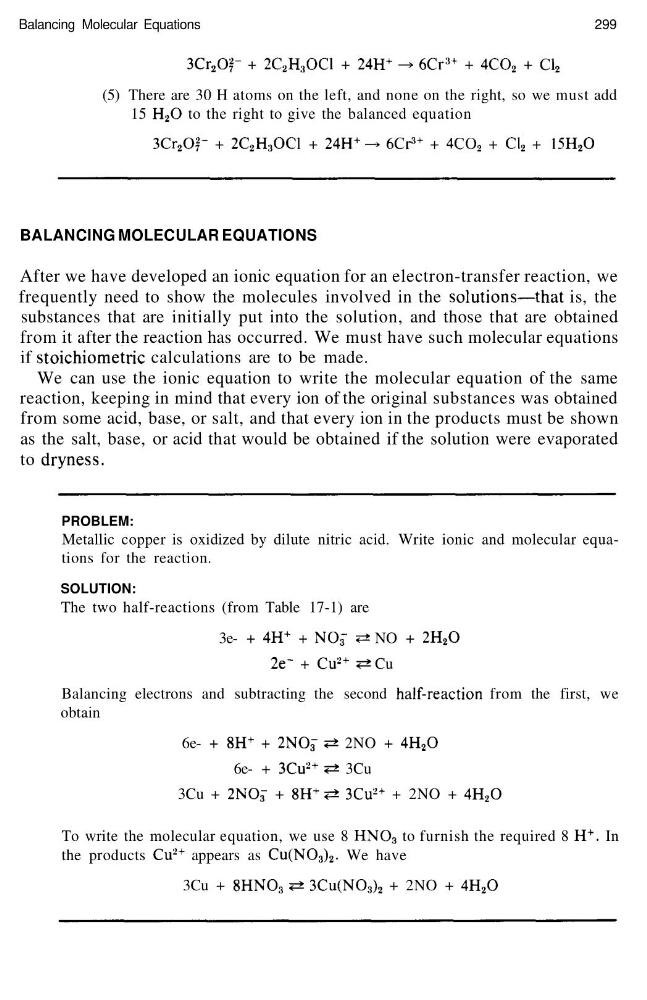
(5) There are 30 H atoms on the left, and none on the right, so we must add
15 H 2 O to the right to give the balanced equation
3Cr 2 O|- + 2C 2 H 3 OC1 + 24H
+ — 6Cr
3+ + 4CO 2 + C1 2 + 15H 2 O
BALANCING MOLECULAR EQUATIONS
After we have developed an ionic equation for an electron-transfer reaction, we
frequently need to show the molecules involved in the solutions—that is, the
substances that are initially put into the solution, and those that are obtained
from it after the reaction has occurred. We must have such molecular equations
if stoichiometric calculations are to be made.
We can use the ionic equation to write the molecular equation of the same
reaction, keeping in mind that every ion of the original substances was obtained
from some acid, base, or salt, and that every ion in the products must be shown
as the salt, base, or acid that would be obtained if the solution were evaporated
to dry ness.
PROBLEM:
Metallic copper is oxidized by dilute nitric acid. Write ionic and molecular equations for the reaction.
SOLUTION:
The two half-reactions (from Table 17-1) are
3e- + 4H
+ + NO 3 - *± NO + 2H 2 O
2e~ + Cu
2+ *± Cu
Balancing electrons and subtracting the second half-reaction from the first, we
obtain
6e- + 8H
+ + 2NO 3 - «=* 2NO + 4H 2 O
6e- + 3Cu
2+ ?± 3Cu
3Cu + 2NO 3 - + 8H
+ <=* 3Cu
2+ + 2NO + 4H 2 O
To write the molecular equation, we use 8 HNO 3 to furnish the required 8 H
+ . In
the products Cu
2+ appears as Cu(NO 3 ) 2 . We have
3Cu + 8HNO 3 ?± 3Cu(NO 3 ) 2 + 2NO + 4H 2 O
299
3Cr 2 Of- + 2C 2 H 3 OC1 + 24H
+ -> 6Cr
3+ + 4CO 2 + C1 2
(5) There are 30 H atoms on the left, and none on the right, so we must add
15 H 2 O to the right to give the balanced equation
3Cr 2 O|- + 2C 2 H 3 OC1 + 24H
+ — 6Cr
3+ + 4CO 2 + C1 2 + 15H 2 O
BALANCING MOLECULAR EQUATIONS
After we have developed an ionic equation for an electron-transfer reaction, we
frequently need to show the molecules involved in the solutions—that is, the
substances that are initially put into the solution, and those that are obtained
from it after the reaction has occurred. We must have such molecular equations
if stoichiometric calculations are to be made.
We can use the ionic equation to write the molecular equation of the same
reaction, keeping in mind that every ion of the original substances was obtained
from some acid, base, or salt, and that every ion in the products must be shown
as the salt, base, or acid that would be obtained if the solution were evaporated
to dry ness.
PROBLEM:
Metallic copper is oxidized by dilute nitric acid. Write ionic and molecular equations for the reaction.
SOLUTION:
The two half-reactions (from Table 17-1) are
3e- + 4H
+ + NO 3 - *± NO + 2H 2 O
2e~ + Cu
2+ *± Cu
Balancing electrons and subtracting the second half-reaction from the first, we
obtain
6e- + 8H
+ + 2NO 3 - «=* 2NO + 4H 2 O
6e- + 3Cu
2+ ?± 3Cu
3Cu + 2NO 3 - + 8H
+ <=* 3Cu
2+ + 2NO + 4H 2 O
To write the molecular equation, we use 8 HNO 3 to furnish the required 8 H
+ . In
the products Cu
2+ appears as Cu(NO 3 ) 2 . We have
3Cu + 8HNO 3 ?± 3Cu(NO 3 ) 2 + 2NO + 4H 2 O