

Balancing Equations Containing Organic Compounds
297
gain = 3e~
MnO 4 -
+
AsO$~
-H>
MnO 2
loss = 2e~
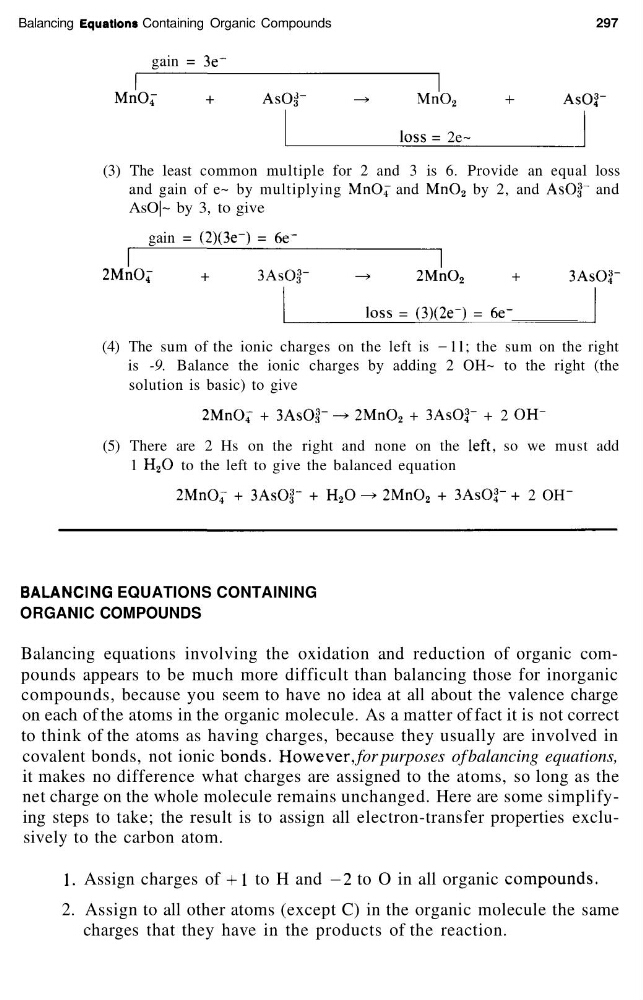
(3) The least common multiple for 2 and 3 is 6. Provide an equal loss
and gain of e~ by multiplying MnOif and MnO 2 by 2, and AsOf^ and
AsO|~ by 3, to give
gain = (2)(3e~) = 6e~
2MnO 4 -
+
3AsO 3
3 -
-^
2MnO 2
+
3AsOJloss = (3)(2e~) = 6e~
(4) The sum of the ionic charges on the left is -11; the sum on the right
is -9. Balance the ionic charges by adding 2 OH~ to the right (the
solution is basic) to give
2MnO 4 - + 3AsO 3
3 - -* 2MnO 2 + 3AsO 4
3 ~ + 2 OR(5) There are 2 Hs on the right and none on the left, so we must add
1 H 2 O to the left to give the balanced equation
2MnO 4 ~ + 3AsOi~ + H 2 O -H> 2MnO 2 + SAsOfr + 2 OH
BALANCING EQUATIONS CONTAINING
ORGANIC COMPOUNDS
Balancing equations involving the oxidation and reduction of organic compounds appears to be much more difficult than balancing those for inorganic
compounds, because you seem to have no idea at all about the valence charge
on each of the atoms in the organic molecule. As a matter of fact it is not correct
to think of the atoms as having charges, because they usually are involved in
covalent bonds, not ionic bonds. However, for purposes of balancing equations,
it makes no difference what charges are assigned to the atoms, so long as the
net charge on the whole molecule remains unchanged. Here are some simplifying steps to take; the result is to assign all electron-transfer properties exclusively to the carbon atom.
1. Assign charges of +1 to H and -2 to O in all organic compounds.
2. Assign to all other atoms (except C) in the organic molecule the same
charges that they have in the products of the reaction.
297
gain = 3e~
MnO 4 -
+
AsO$~
-H>
MnO 2
loss = 2e~
(3) The least common multiple for 2 and 3 is 6. Provide an equal loss
and gain of e~ by multiplying MnOif and MnO 2 by 2, and AsOf^ and
AsO|~ by 3, to give
gain = (2)(3e~) = 6e~
2MnO 4 -
+
3AsO 3
3 -
-^
2MnO 2
+
3AsOJloss = (3)(2e~) = 6e~
(4) The sum of the ionic charges on the left is -11; the sum on the right
is -9. Balance the ionic charges by adding 2 OH~ to the right (the
solution is basic) to give
2MnO 4 - + 3AsO 3
3 - -* 2MnO 2 + 3AsO 4
3 ~ + 2 OR(5) There are 2 Hs on the right and none on the left, so we must add
1 H 2 O to the left to give the balanced equation
2MnO 4 ~ + 3AsOi~ + H 2 O -H> 2MnO 2 + SAsOfr + 2 OH
BALANCING EQUATIONS CONTAINING
ORGANIC COMPOUNDS
Balancing equations involving the oxidation and reduction of organic compounds appears to be much more difficult than balancing those for inorganic
compounds, because you seem to have no idea at all about the valence charge
on each of the atoms in the organic molecule. As a matter of fact it is not correct
to think of the atoms as having charges, because they usually are involved in
covalent bonds, not ionic bonds. However, for purposes of balancing equations,
it makes no difference what charges are assigned to the atoms, so long as the
net charge on the whole molecule remains unchanged. Here are some simplifying steps to take; the result is to assign all electron-transfer properties exclusively to the carbon atom.
1. Assign charges of +1 to H and -2 to O in all organic compounds.
2. Assign to all other atoms (except C) in the organic molecule the same
charges that they have in the products of the reaction.