

287
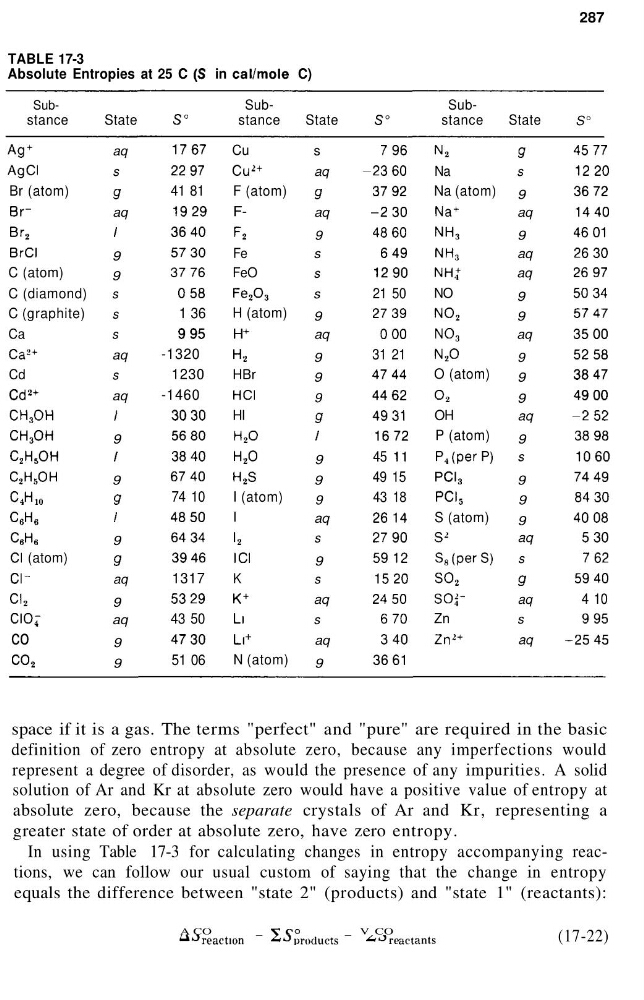
TABLE 17-3
Absolute Entropies at 25 C (S in cal/mole C)
Substance
Ag
+
AgCI
Br (atom)
BrBr 2
BrCI
C (atom)
C (diamond)
C (graphite)
Ca
Ca
2+
Cd
Cd
2+
CH 3 OH
CH 3 OH
C 2 H 5 OH
C 2 H 5 OH
C 4 Hi 0
C 6 H 6
C 6 H 6
Cl (atom)
ciCI 2
ClOjco
C0 2
State
aq
s
9
aq
1
9
9
s
s
s
aq
s
aq
1
9
1
9
9
1
9
9
aq
9
aq
9
9
S°
1767
2297
41 81
1929
3640
5730
3776
058
1 36
995
-1320
1230
-1460
3030
5680
3840
6740
74 10
4850
6434
3946
1317
5329
43 50
4730
51 06
Substance
Cu
Cu"
F (atom)
FF 2
Fe
FeO
Fe 2 0 3
H (atom)
H
+
H 2
HBr
HCI
HI
H 2 O
H 2 0
H 2 S
I (atom)
I
I 2
ICI
K
K
+
Li
Li
+
N (atom)
State
s
aq
9
aq
9
s
s
s
9
aq
9
9
9
9
1
9
9
9
aq
s
9
s
aq
s
aq
9
S°
796
-2360
3792
-230
4860
649
1290
21 50
2739
000
31 21
4744
4462
4931
1672
45 11
49 15
43 18
2614
2790
5912
1520
2450
670
340
3661
Substance
N 2
Na
Na (atom)
Na
+
NH 3
NH 3
NH 4
+
NO
NO 2
N0 3
N 2 0
O (atom)
0 2
OH
P (atom)
P 4 (perP)
PCI 3
PCI 5
S (atom)
S
2
S 8 (perS)
SO 2
so^Zn
Zn
2+
State
9
s
9
aq
9
aq
aq
9
9
aq
9
9
9
aq
9
s
9
9
9
aq
s
9
aq
s
aq
S°
4577
1220
3672
1440
4601
2630
2697
5034
5747
3500
5258
3847
4900
-252
3898
1060
7449
8430
4008
530
762
5940
4 10
995
-2545
space if it is a gas. The terms "perfect" and "pure" are required in the basic
definition of zero entropy at absolute zero, because any imperfections would
represent a degree of disorder, as would the presence of any impurities. A solid
solution of Ar and Kr at absolute zero would have a positive value of entropy at
absolute zero, because the separate crystals of Ar and Kr, representing a
greater state of order at absolute zero, have zero entropy.
In using Table 17-3 for calculating changes in entropy accompanying reactions, we can follow our usual custom of saying that the change in entropy
equals the difference between "state 2" (products) and "state 1" (reactants):
A CO
_ V co
_ V CO
"-•^reaction
-"^products
•'"-'re
(17-22)
TABLE 17-3
Absolute Entropies at 25 C (S in cal/mole C)
Substance
Ag
+
AgCI
Br (atom)
BrBr 2
BrCI
C (atom)
C (diamond)
C (graphite)
Ca
Ca
2+
Cd
Cd
2+
CH 3 OH
CH 3 OH
C 2 H 5 OH
C 2 H 5 OH
C 4 Hi 0
C 6 H 6
C 6 H 6
Cl (atom)
ciCI 2
ClOjco
C0 2
State
aq
s
9
aq
1
9
9
s
s
s
aq
s
aq
1
9
1
9
9
1
9
9
aq
9
aq
9
9
S°
1767
2297
41 81
1929
3640
5730
3776
058
1 36
995
-1320
1230
-1460
3030
5680
3840
6740
74 10
4850
6434
3946
1317
5329
43 50
4730
51 06
Substance
Cu
Cu"
F (atom)
FF 2
Fe
FeO
Fe 2 0 3
H (atom)
H
+
H 2
HBr
HCI
HI
H 2 O
H 2 0
H 2 S
I (atom)
I
I 2
ICI
K
K
+
Li
Li
+
N (atom)
State
s
aq
9
aq
9
s
s
s
9
aq
9
9
9
9
1
9
9
9
aq
s
9
s
aq
s
aq
9
S°
796
-2360
3792
-230
4860
649
1290
21 50
2739
000
31 21
4744
4462
4931
1672
45 11
49 15
43 18
2614
2790
5912
1520
2450
670
340
3661
Substance
N 2
Na
Na (atom)
Na
+
NH 3
NH 3
NH 4
+
NO
NO 2
N0 3
N 2 0
O (atom)
0 2
OH
P (atom)
P 4 (perP)
PCI 3
PCI 5
S (atom)
S
2
S 8 (perS)
SO 2
so^Zn
Zn
2+
State
9
s
9
aq
9
aq
aq
9
9
aq
9
9
9
aq
9
s
9
9
9
aq
s
9
aq
s
aq
S°
4577
1220
3672
1440
4601
2630
2697
5034
5747
3500
5258
3847
4900
-252
3898
1060
7449
8430
4008
530
762
5940
4 10
995
-2545
space if it is a gas. The terms "perfect" and "pure" are required in the basic
definition of zero entropy at absolute zero, because any imperfections would
represent a degree of disorder, as would the presence of any impurities. A solid
solution of Ar and Kr at absolute zero would have a positive value of entropy at
absolute zero, because the separate crystals of Ar and Kr, representing a
greater state of order at absolute zero, have zero entropy.
In using Table 17-3 for calculating changes in entropy accompanying reactions, we can follow our usual custom of saying that the change in entropy
equals the difference between "state 2" (products) and "state 1" (reactants):
A CO
_ V co
_ V CO
"-•^reaction
-"^products
•'"-'re
(17-22)