

288
Electrochemistry I Batteries and Free Energy
PROBLEM:
Calculate the change in standard entropy for the reaction
PC1 5(01 «* PC1 3(9) + a*,,
SOLUTION:
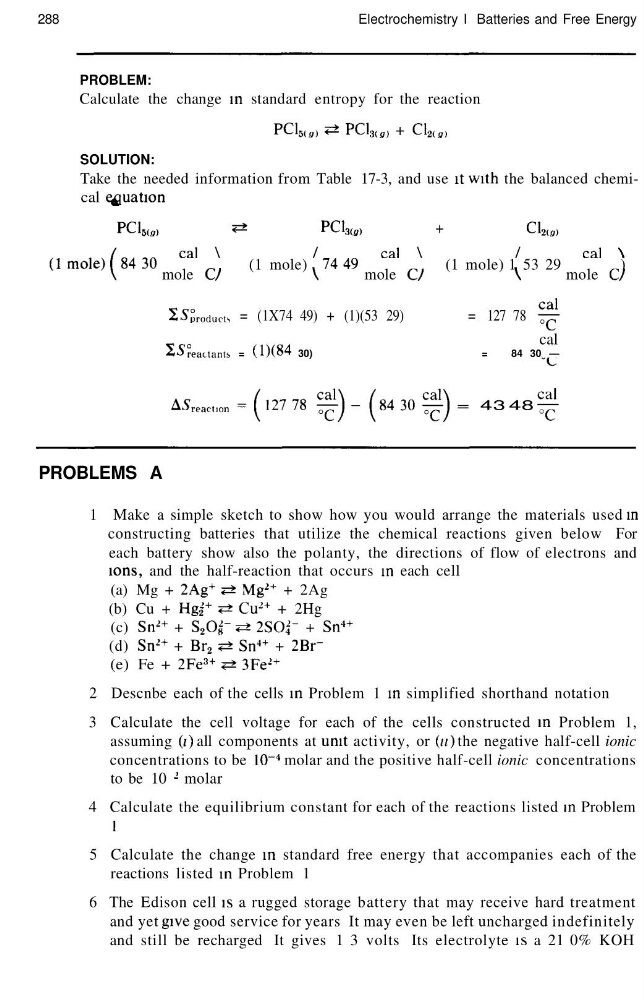
Take the needed information from Table 17-3, and use it with the balanced chemical equation
PCl 5(fl )
«=*
PCl 3(fll
+
C1 2(0 )
(
cal \
/
cal \
/
cal \
8430
(1 mole) 7449
(1 mole) 1 53 29
)
mole C/
V
mole C/
V
mole C/
SSproducts = (1X74 49) + (1)(53 29)
= 127 78 ^
cal
SSSeactants = (D(84 30)
=
84 30 —
f) _( 8 43of) = 43 48 f
PROBLEMS A
1 Make a simple sketch to show how you would arrange the materials used in
constructing batteries that utilize the chemical reactions given below For
each battery show also the polanty, the directions of flow of electrons and
ions, and the half-reaction that occurs in each cell
(a) Mg + 2Ag
+ <=* Mg
2+ + 2Ag
(b) Cu + Hg|
+ ?± Cu
2+ + 2Hg
(c) Sn
2+ + S-jO
2 ,- <=* 2SO
2 ,- + Sn
4+
(d) Sn
2+ + Br 2 +± Sn
4+ + 2Br~
(e) Fe + 2Fe
3+ ?± 3Fe
2+
2 Descnbe each of the cells in Problem 1 in simplified shorthand notation
3 Calculate the cell voltage for each of the cells constructed in Problem 1,
assuming (i) all components at unit activity, or (n) the negative half-cell ionic
concentrations to be 10~
4 molar and the positive half-cell ionic concentrations
to be 10
2 molar
4 Calculate the equilibrium constant for each of the reactions listed in Problem
5 Calculate the change in standard free energy that accompanies each of the
reactions listed in Problem 1
6 The Edison cell is a rugged storage battery that may receive hard treatment
and yet give good service for years It may even be left uncharged indefinitely
and still be recharged It gives 1 3 volts Its electrolyte is a 21 0% KOH
Electrochemistry I Batteries and Free Energy
PROBLEM:
Calculate the change in standard entropy for the reaction
PC1 5(01 «* PC1 3(9) + a*,,
SOLUTION:
Take the needed information from Table 17-3, and use it with the balanced chemical equation
PCl 5(fl )
«=*
PCl 3(fll
+
C1 2(0 )
(
cal \
/
cal \
/
cal \
8430
(1 mole) 7449
(1 mole) 1 53 29
)
mole C/
V
mole C/
V
mole C/
SSproducts = (1X74 49) + (1)(53 29)
= 127 78 ^
cal
SSSeactants = (D(84 30)
=
84 30 —
f) _( 8 43of) = 43 48 f
PROBLEMS A
1 Make a simple sketch to show how you would arrange the materials used in
constructing batteries that utilize the chemical reactions given below For
each battery show also the polanty, the directions of flow of electrons and
ions, and the half-reaction that occurs in each cell
(a) Mg + 2Ag
+ <=* Mg
2+ + 2Ag
(b) Cu + Hg|
+ ?± Cu
2+ + 2Hg
(c) Sn
2+ + S-jO
2 ,- <=* 2SO
2 ,- + Sn
4+
(d) Sn
2+ + Br 2 +± Sn
4+ + 2Br~
(e) Fe + 2Fe
3+ ?± 3Fe
2+
2 Descnbe each of the cells in Problem 1 in simplified shorthand notation
3 Calculate the cell voltage for each of the cells constructed in Problem 1,
assuming (i) all components at unit activity, or (n) the negative half-cell ionic
concentrations to be 10~
4 molar and the positive half-cell ionic concentrations
to be 10
2 molar
4 Calculate the equilibrium constant for each of the reactions listed in Problem
5 Calculate the change in standard free energy that accompanies each of the
reactions listed in Problem 1
6 The Edison cell is a rugged storage battery that may receive hard treatment
and yet give good service for years It may even be left uncharged indefinitely
and still be recharged It gives 1 3 volts Its electrolyte is a 21 0% KOH