

286
Electrochemistry I: Batteries and Free Energy
The positive sign of the 43.48 e.u. indicates that the reaction goes with an increase
in entropy—that the products represent a state of greater molecular disorder than
do the reactants.
Entropies of Transition
When a substance changes from one physical state to another at a temperature
where the two states can coexist (such as at the melting point or the normal
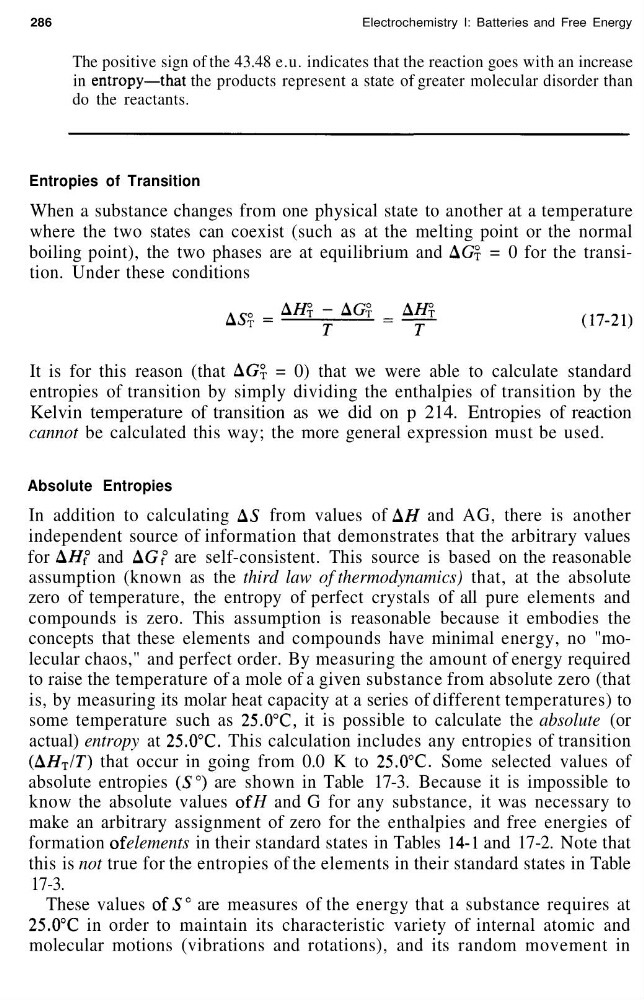
boiling point), the two phases are at equilibrium and AG? = 0 for the transition. Under these conditions
It is for this reason (that AG£ = 0) that we were able to calculate standard
entropies of transition by simply dividing the enthalpies of transition by the
Kelvin temperature of transition as we did on p 214. Entropies of reaction
cannot be calculated this way; the more general expression must be used.
Absolute Entropies
In addition to calculating AS from values of AH and AG, there is another
independent source of information that demonstrates that the arbitrary values
for A/f t ° and AG f ° are self-consistent. This source is based on the reasonable
assumption (known as the third law of thermodynamics) that, at the absolute
zero of temperature, the entropy of perfect crystals of all pure elements and
compounds is zero. This assumption is reasonable because it embodies the
concepts that these elements and compounds have minimal energy, no "molecular chaos," and perfect order. By measuring the amount of energy required
to raise the temperature of a mole of a given substance from absolute zero (that
is, by measuring its molar heat capacity at a series of different temperatures) to
some temperature such as 25.0°C, it is possible to calculate the absolute (or
actual) entropy at 25.0°C. This calculation includes any entropies of transition
(A// T /r) that occur in going from 0.0 K to 25.0°C. Some selected values of
absolute entropies (S°) are shown in Table 17-3. Because it is impossible to
know the absolute values of H and G for any substance, it was necessary to
make an arbitrary assignment of zero for the enthalpies and free energies of
formation of elements in their standard states in Tables 14-1 and 17-2. Note that
this is not true for the entropies of the elements in their standard states in Table
17-3.
These values ofS° are measures of the energy that a substance requires at
25.0°C in order to maintain its characteristic variety of internal atomic and
molecular motions (vibrations and rotations), and its random movement in
Electrochemistry I: Batteries and Free Energy
The positive sign of the 43.48 e.u. indicates that the reaction goes with an increase
in entropy—that the products represent a state of greater molecular disorder than
do the reactants.
Entropies of Transition
When a substance changes from one physical state to another at a temperature
where the two states can coexist (such as at the melting point or the normal
boiling point), the two phases are at equilibrium and AG? = 0 for the transition. Under these conditions
It is for this reason (that AG£ = 0) that we were able to calculate standard
entropies of transition by simply dividing the enthalpies of transition by the
Kelvin temperature of transition as we did on p 214. Entropies of reaction
cannot be calculated this way; the more general expression must be used.
Absolute Entropies
In addition to calculating AS from values of AH and AG, there is another
independent source of information that demonstrates that the arbitrary values
for A/f t ° and AG f ° are self-consistent. This source is based on the reasonable
assumption (known as the third law of thermodynamics) that, at the absolute
zero of temperature, the entropy of perfect crystals of all pure elements and
compounds is zero. This assumption is reasonable because it embodies the
concepts that these elements and compounds have minimal energy, no "molecular chaos," and perfect order. By measuring the amount of energy required
to raise the temperature of a mole of a given substance from absolute zero (that
is, by measuring its molar heat capacity at a series of different temperatures) to
some temperature such as 25.0°C, it is possible to calculate the absolute (or
actual) entropy at 25.0°C. This calculation includes any entropies of transition
(A// T /r) that occur in going from 0.0 K to 25.0°C. Some selected values of
absolute entropies (S°) are shown in Table 17-3. Because it is impossible to
know the absolute values of H and G for any substance, it was necessary to
make an arbitrary assignment of zero for the enthalpies and free energies of
formation of elements in their standard states in Tables 14-1 and 17-2. Note that
this is not true for the entropies of the elements in their standard states in Table
17-3.
These values ofS° are measures of the energy that a substance requires at
25.0°C in order to maintain its characteristic variety of internal atomic and
molecular motions (vibrations and rotations), and its random movement in