

275
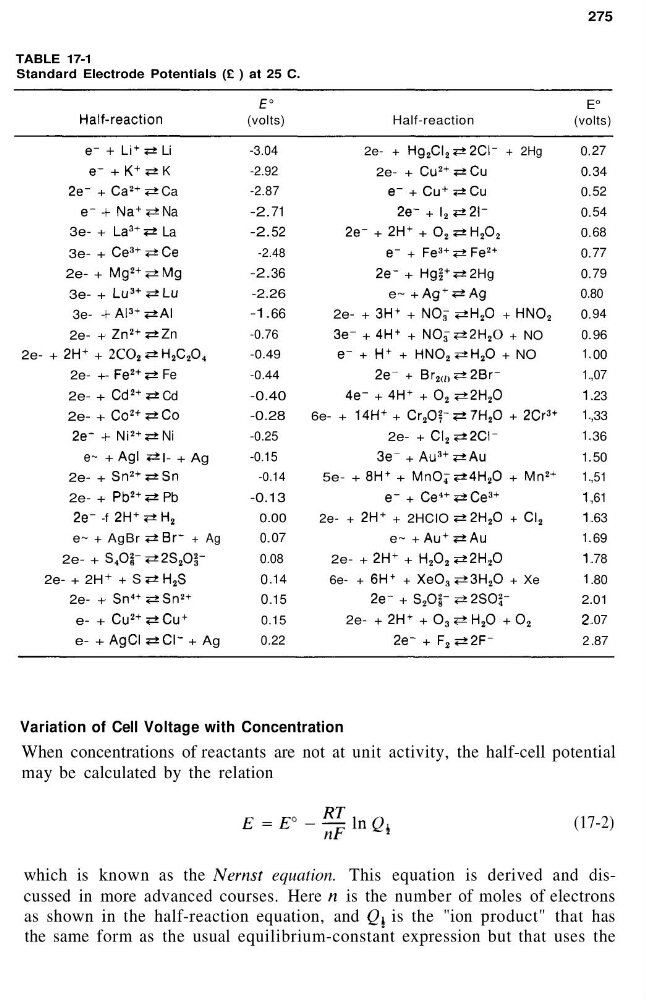
TABLE 17-1
Standard Electrode Potentials (£ ) at 25 C.
Half-reaction
2e~ +
e~ -
3e- +
3e- +
2e- +
3e- +
3e- -
2e- +
2e- + 2H
+ +
2e- +
2e- +
2e- +
2e~ -
e~
2e- +
2e- +
2e~ -
e~ +
2e- +
2e- + 2H
2e- +
e- +
e- +
+ K
+
i- Na
+
La
3+
Ce
3+
Mg
2+
<=*
+±
«=>
Li
K
Ca
Na
La
(volts)
-3.04
-2.92
-2.87
-2.
-2.
71
52
<=tCe
-2.48
<=* Mg
-2.36
Lu
3+ <=sLu
-2.26
H AI
3+
Zn
2+
2CO2
- Fe
2+
Cd
2+
Co
2+
h Ni
2+
+ Agl
Sn
2 +
Pb
2+
5=»
5=t
Al
Zn
5=tH2C204
5=i Fe
-1.66
-0.76
Half-reaction
2e- + Hg2CI2
2e- + Cu
2+
e~ + Cu
+
2e~ + I 2
2e~ + 2H
+ + O 2
e~ + Fe
3+
2e- + Hgl
+
e~ + Ag
+
2e- + 3H
+ + NO^3e~ + 4H
+ + NOf
<=s2CI- + 2Hg
s=s2|5=t
<^
5=S
H2O2
Fe
2+
2Hg
5=iAg
^
f±
-0.49
e~ + H
+ + HNO2«±
H20 + HNO2
2H2O + NO
H 2 O + NO
-0.44
2e" + Br2(i) «=s2Br<=s Cd
-0.40
5=tCo
<=s
*±
Ni
I- + Ag
-0.28
-0.25
-0.15
«=tSn
-0.14
5=4 Pb
-0.13
f 2H
+ <^H2
0.00
AgBr
s 4 oji+ + S
Sn
4+
Cu
2+
AgCI
«=sBr- + Ag
<=*
?=*
5=t
2S2Otr
H 2 S
Sn
2+
0. 07
0.08
0
0
.14
.15
«=tCu
+
0.15
** Cl- + Ag
0.22
4e~ + 4H+ + 0 2
6e- + 14H
+ + Cr20?2e- + CI 2
3e- + Au
3+
5e- + 8H
+ + MnOj
e~ + Ce
4+
2e- + 2H
+ + 2HCIO
e~ + Au
+
2e- + 2H+ + H202
6e- + 6H+ + XeO3
2e~ + S 2 O|2e- + 2H+ + O 3
2e~ + F 2
<^
5=t
<=t
fS
<=*
«=>
2H2O
7H2O + 2Cr
3+
Au
4H20 + Mn
2+
Ce
3+
5=!2H2O + Clj
«=«Au
<=*
<^
2H2O
3H2O + Xe
E°
(volts)
0.
0.
0.
0.
0.
0.
0.
27
34
52
54
68
77
79
0.80
0.
0.
1.
1.
1.
1.
1.
1.
1.
1
1
1.
1
1
94
96
00
,07
.23
,33
36
50
,51
,61
.63
69
.78
.80
<^2SOi~
2.01
«=»
«=s
H 2 O + O 2
2
2
.07
.87
Variation of Cell Voltage with Concentration
When concentrations of reactants are not at unit activity, the half-cell potential
may be calculated by the relation
(17-2)
which is known as the Nernst equation. This equation is derived and discussed in more advanced courses. Here n is the number of moles of electrons
as shown in the half-reaction equation, and Q^ is the "ion product" that has
the same form as the usual equilibrium-constant expression but that uses the
TABLE 17-1
Standard Electrode Potentials (£ ) at 25 C.
Half-reaction
2e~ +
e~ -
3e- +
3e- +
2e- +
3e- +
3e- -
2e- +
2e- + 2H
+ +
2e- +
2e- +
2e- +
2e~ -
e~
2e- +
2e- +
2e~ -
e~ +
2e- +
2e- + 2H
2e- +
e- +
e- +
+ K
+
i- Na
+
La
3+
Ce
3+
Mg
2+
<=*
+±
«=>
Li
K
Ca
Na
La
(volts)
-3.04
-2.92
-2.87
-2.
-2.
71
52
<=tCe
-2.48
<=* Mg
-2.36
Lu
3+ <=sLu
-2.26
H AI
3+
Zn
2+
2CO2
- Fe
2+
Cd
2+
Co
2+
h Ni
2+
+ Agl
Sn
2 +
Pb
2+
5=»
5=t
Al
Zn
5=tH2C204
5=i Fe
-1.66
-0.76
Half-reaction
2e- + Hg2CI2
2e- + Cu
2+
e~ + Cu
+
2e~ + I 2
2e~ + 2H
+ + O 2
e~ + Fe
3+
2e- + Hgl
+
e~ + Ag
+
2e- + 3H
+ + NO^3e~ + 4H
+ + NOf
<=s2CI- + 2Hg
s=s2|5=t
<^
5=S
H2O2
Fe
2+
2Hg
5=iAg
^
f±
-0.49
e~ + H
+ + HNO2«±
H20 + HNO2
2H2O + NO
H 2 O + NO
-0.44
2e" + Br2(i) «=s2Br<=s Cd
-0.40
5=tCo
<=s
*±
Ni
I- + Ag
-0.28
-0.25
-0.15
«=tSn
-0.14
5=4 Pb
-0.13
f 2H
+ <^H2
0.00
AgBr
s 4 oji+ + S
Sn
4+
Cu
2+
AgCI
«=sBr- + Ag
<=*
?=*
5=t
2S2Otr
H 2 S
Sn
2+
0. 07
0.08
0
0
.14
.15
«=tCu
+
0.15
** Cl- + Ag
0.22
4e~ + 4H+ + 0 2
6e- + 14H
+ + Cr20?2e- + CI 2
3e- + Au
3+
5e- + 8H
+ + MnOj
e~ + Ce
4+
2e- + 2H
+ + 2HCIO
e~ + Au
+
2e- + 2H+ + H202
6e- + 6H+ + XeO3
2e~ + S 2 O|2e- + 2H+ + O 3
2e~ + F 2
<^
5=t
<=t
fS
<=*
«=>
2H2O
7H2O + 2Cr
3+
Au
4H20 + Mn
2+
Ce
3+
5=!2H2O + Clj
«=«Au
<=*
<^
2H2O
3H2O + Xe
E°
(volts)
0.
0.
0.
0.
0.
0.
0.
27
34
52
54
68
77
79
0.80
0.
0.
1.
1.
1.
1.
1.
1.
1.
1
1
1.
1
1
94
96
00
,07
.23
,33
36
50
,51
,61
.63
69
.78
.80
<^2SOi~
2.01
«=»
«=s
H 2 O + O 2
2
2
.07
.87
Variation of Cell Voltage with Concentration
When concentrations of reactants are not at unit activity, the half-cell potential
may be calculated by the relation
(17-2)
which is known as the Nernst equation. This equation is derived and discussed in more advanced courses. Here n is the number of moles of electrons
as shown in the half-reaction equation, and Q^ is the "ion product" that has
the same form as the usual equilibrium-constant expression but that uses the