

276
Electrochemistry I: Batteries and Free Energy
actual ionic concentrations, not the equilibrium values. It also differs because
half-reactions by themselves are fictitious, and isolated electrons do not exist
in aqueous solution—thus, there is no factor in the (?j expression for [e~]
n ,
the "electron concentration." If we express the gas constant R in fundamental units (using the value of 1.013 x 10
8 dynes/cm
2 for 1 atm that we
determined on p 158, along with the volume of 22,400 cm
3
/mole at 1 atm and
273.2 K), we get R = 8.314 x 10
7 ergs/mole K. Reexpressed in different
units, R = 8.314 volt coulombs/mole K. The total electrical charge F on one
mole of electrons is 96,487 coulombs/mole of electrons. If we use these
values of R and F, limit ourselves to 25.0°C for convenient use of Table 17-1.
and convert the logarithm to base 10, then the general expression for the
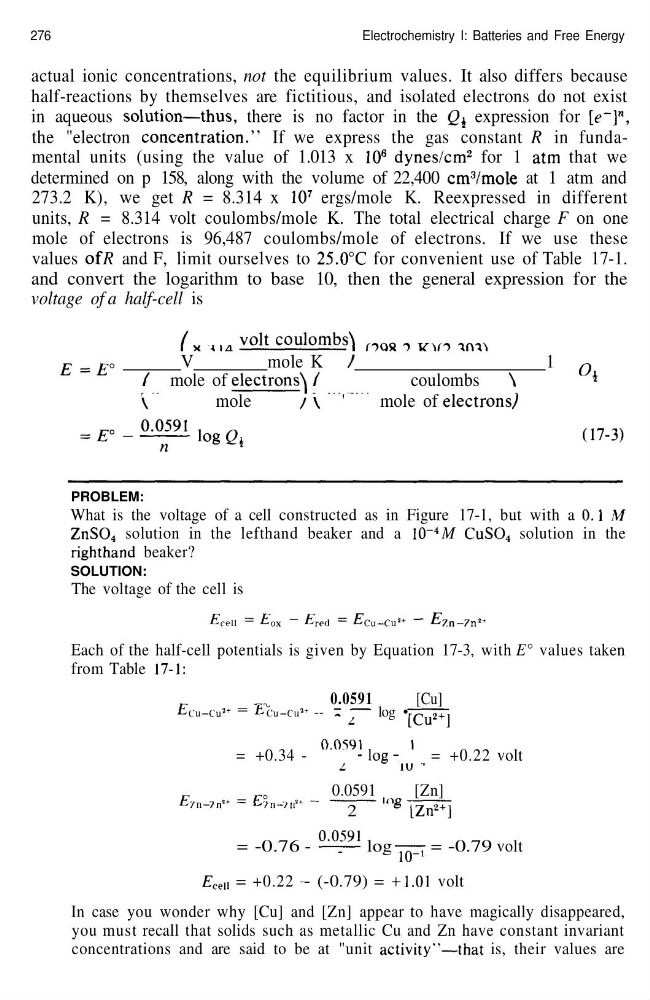
voltage of a half-cell is
/
volt coulombsN
V
mole K /
1 o
t mole of electrons'^ /
coulombs
\
*
\
mole
/ \ '
mole of electrons/
PROBLEM:
What is the voltage of a cell constructed as in Figure 17-1, but with a 0. 1 M
ZnSO 4 solution in the lefthand beaker and a 10~
4 M CuSO 4 solution in the
righthand beaker?
SOLUTION:
The voltage of the cell is
Each of the half-cell potentials is given by Equation 17-3, with E° values taken
from Table 17-1:
0.0591
[Cu]
£tu-cu'
+ = -fccu-cu
!+ -- ; — log •
[Cu
2+ ]
= +0.34 -
- log= +0.22 volt
0.0591
[Zn]
'"/n
"""-'"
2
° [Zn
2+ ]
= -0.76 - °'
0
.
591 log —p = -0.79 volt
Eceii = +0.22 - (-0.79) = +1.01 volt
In case you wonder why [Cu] and [Zn] appear to have magically disappeared,
you must recall that solids such as metallic Cu and Zn have constant invariant
concentrations and are said to be at "unit activity"—that is, their values are
Electrochemistry I: Batteries and Free Energy
actual ionic concentrations, not the equilibrium values. It also differs because
half-reactions by themselves are fictitious, and isolated electrons do not exist
in aqueous solution—thus, there is no factor in the (?j expression for [e~]
n ,
the "electron concentration." If we express the gas constant R in fundamental units (using the value of 1.013 x 10
8 dynes/cm
2 for 1 atm that we
determined on p 158, along with the volume of 22,400 cm
3
/mole at 1 atm and
273.2 K), we get R = 8.314 x 10
7 ergs/mole K. Reexpressed in different
units, R = 8.314 volt coulombs/mole K. The total electrical charge F on one
mole of electrons is 96,487 coulombs/mole of electrons. If we use these
values of R and F, limit ourselves to 25.0°C for convenient use of Table 17-1.
and convert the logarithm to base 10, then the general expression for the
voltage of a half-cell is
/
volt coulombsN
V
mole K /
1 o
t mole of electrons'^ /
coulombs
\
*
\
mole
/ \ '
mole of electrons/
PROBLEM:
What is the voltage of a cell constructed as in Figure 17-1, but with a 0. 1 M
ZnSO 4 solution in the lefthand beaker and a 10~
4 M CuSO 4 solution in the
righthand beaker?
SOLUTION:
The voltage of the cell is
Each of the half-cell potentials is given by Equation 17-3, with E° values taken
from Table 17-1:
0.0591
[Cu]
£tu-cu'
+ = -fccu-cu
!+ -- ; — log •
[Cu
2+ ]
= +0.34 -
- log= +0.22 volt
0.0591
[Zn]
'"/n
"""-'"
2
° [Zn
2+ ]
= -0.76 - °'
0
.
591 log —p = -0.79 volt
Eceii = +0.22 - (-0.79) = +1.01 volt
In case you wonder why [Cu] and [Zn] appear to have magically disappeared,
you must recall that solids such as metallic Cu and Zn have constant invariant
concentrations and are said to be at "unit activity"—that is, their values are