

274
Electrochemistry I: Batteries and Free Energy
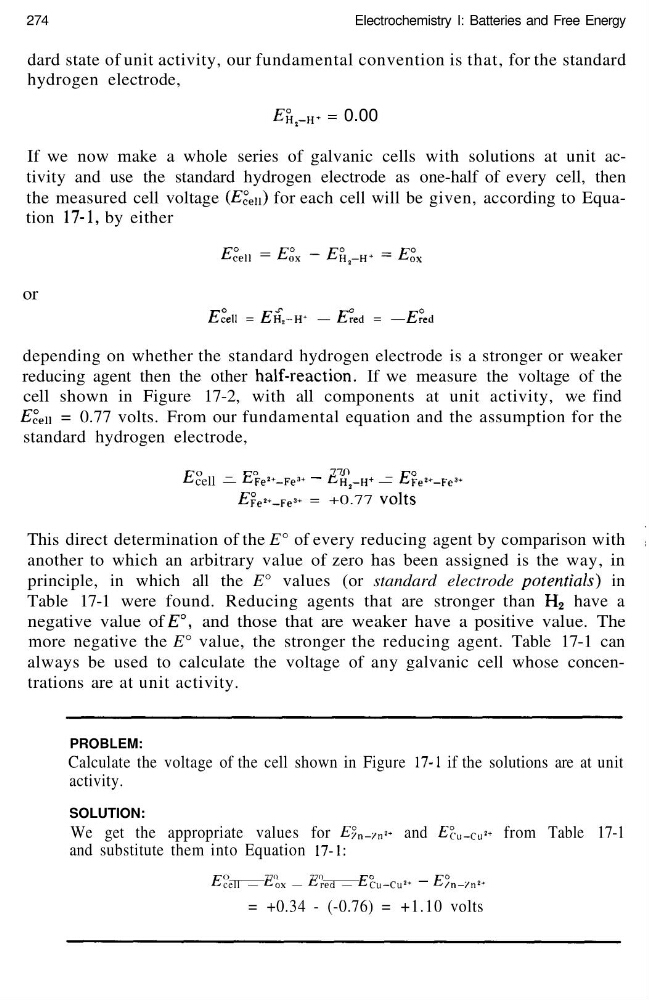
dard state of unit activity, our fundamental convention is that, for the standard
hydrogen electrode,
£&,_„, = 0.00
If we now make a whole series of galvanic cells with solutions at unit activity and use the standard hydrogen electrode as one-half of every cell, then
the measured cell voltage (£? e ii) for each cell will be given, according to Equation 17-1, by either
or
Ecell = EH,-H* — Ered = — Ered
depending on whether the standard hydrogen electrode is a stronger or weaker
reducing agent then the other half- reaction. If we measure the voltage of the
cell shown in Figure 17-2, with all components at unit activity, we find
Eceii = 0.77 volts. From our fundamental equation and the assumption for the
standard hydrogen electrode,
£
o
_ 170
770
_ 770
cell — CFe
!+ -Fe
3+ ~~ CH,-H
+ — CFe
2 *-Fe
3 *
£?e--Fe" = +0.77 VOltS
This direct determination of the E° of every reducing agent by comparison with
another to which an arbitrary value of zero has been assigned is the way, in
principle, in which all the E° values (or standard electrode potentials') in
Table 17-1 were found. Reducing agents that are stronger than H 2 have a
negative value of E°, and those that are weaker have a positive value. The
more negative the E° value, the stronger the reducing agent. Table 17-1 can
always be used to calculate the voltage of any galvanic cell whose concentrations are at unit activity.
PROBLEM:
Calculate the voltage of the cell shown in Figure 17-1 if the solutions are at unit
activity.
SOLUTION:
We get the appropriate values for £? n -/n
! * and EC U _ CU
! * from Table 17-1
and substitute them into Equation 17-1:
£
O
770
770
770
770
cell — C-ox — Creel — ^Cii-Cu" ~~ C-/n-Xn
! *
= +0.34 - (-0.76) = +1.10 volts
Electrochemistry I: Batteries and Free Energy
dard state of unit activity, our fundamental convention is that, for the standard
hydrogen electrode,
£&,_„, = 0.00
If we now make a whole series of galvanic cells with solutions at unit activity and use the standard hydrogen electrode as one-half of every cell, then
the measured cell voltage (£? e ii) for each cell will be given, according to Equation 17-1, by either
or
Ecell = EH,-H* — Ered = — Ered
depending on whether the standard hydrogen electrode is a stronger or weaker
reducing agent then the other half- reaction. If we measure the voltage of the
cell shown in Figure 17-2, with all components at unit activity, we find
Eceii = 0.77 volts. From our fundamental equation and the assumption for the
standard hydrogen electrode,
£
o
_ 170
770
_ 770
cell — CFe
!+ -Fe
3+ ~~ CH,-H
+ — CFe
2 *-Fe
3 *
£?e--Fe" = +0.77 VOltS
This direct determination of the E° of every reducing agent by comparison with
another to which an arbitrary value of zero has been assigned is the way, in
principle, in which all the E° values (or standard electrode potentials') in
Table 17-1 were found. Reducing agents that are stronger than H 2 have a
negative value of E°, and those that are weaker have a positive value. The
more negative the E° value, the stronger the reducing agent. Table 17-1 can
always be used to calculate the voltage of any galvanic cell whose concentrations are at unit activity.
PROBLEM:
Calculate the voltage of the cell shown in Figure 17-1 if the solutions are at unit
activity.
SOLUTION:
We get the appropriate values for £? n -/n
! * and EC U _ CU
! * from Table 17-1
and substitute them into Equation 17-1:
£
O
770
770
770
770
cell — C-ox — Creel — ^Cii-Cu" ~~ C-/n-Xn
! *
= +0.34 - (-0.76) = +1.10 volts