

Electron-Transfer Potential
273
between the solid electrode and the solution, and a double // indicates the salt
bridge or some other junction between the two half-cells.
Standard Electrode Potentials
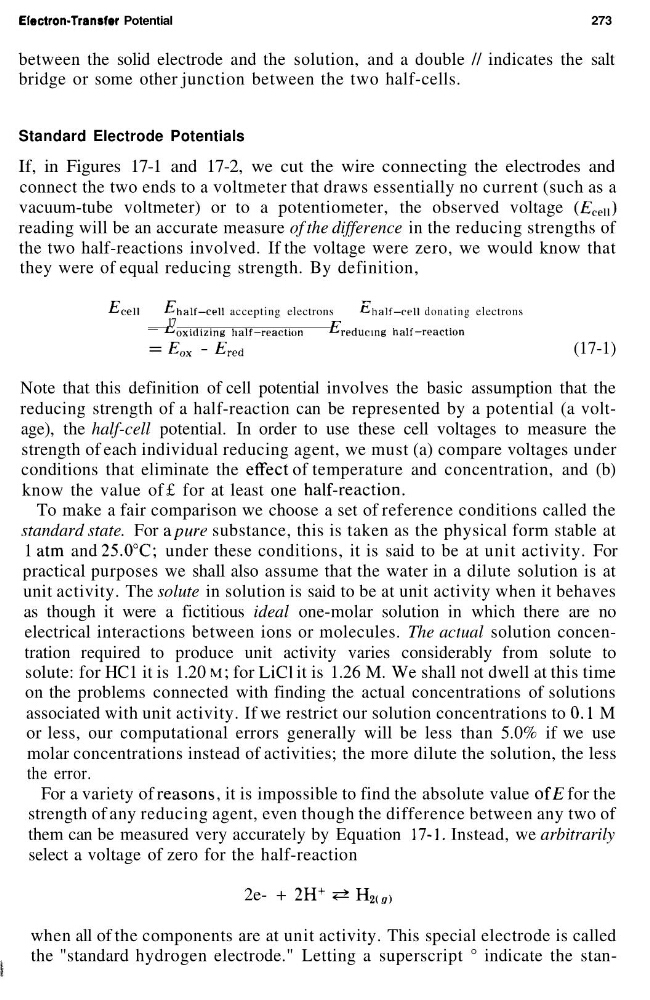
If, in Figures 17-1 and 17-2, we cut the wire connecting the electrodes and
connect the two ends to a voltmeter that draws essentially no current (such as a
vacuum-tube voltmeter) or to a potentiometer, the observed voltage (£ ce ii)
reading will be an accurate measure of the difference in the reducing strengths of
the two half-reactions involved. If the voltage were zero, we would know that
they were of equal reducing strength. By definition,
^cell
^half—cell accepting electrons
*^half—cell donating electrons
17
17
^oxidizing half—reaction
^-reducing half—reaction
= £ ox - £ red
(17-1)
Note that this definition of cell potential involves the basic assumption that the
reducing strength of a half-reaction can be represented by a potential (a voltage), the half-cell potential. In order to use these cell voltages to measure the
strength of each individual reducing agent, we must (a) compare voltages under
conditions that eliminate the effect of temperature and concentration, and (b)
know the value of £ for at least one half-reaction.
To make a fair comparison we choose a set of reference conditions called the
standard state. For apure substance, this is taken as the physical form stable at
1 atm and 25.0°C; under these conditions, it is said to be at unit activity. For
practical purposes we shall also assume that the water in a dilute solution is at
unit activity. The solute in solution is said to be at unit activity when it behaves
as though it were a fictitious ideal one-molar solution in which there are no
electrical interactions between ions or molecules. The actual solution concentration required to produce unit activity varies considerably from solute to
solute: for HC1 it is 1.20 M; for LiCl it is 1.26 M. We shall not dwell at this time
on the problems connected with finding the actual concentrations of solutions
associated with unit activity. If we restrict our solution concentrations to 0.1 M
or less, our computational errors generally will be less than 5.0% if we use
molar concentrations instead of activities; the more dilute the solution, the less
the error.
For a variety of reasons, it is impossible to find the absolute value ofE for the
strength of any reducing agent, even though the difference between any two of
them can be measured very accurately by Equation 17-1. Instead, we arbitrarily
select a voltage of zero for the half-reaction
2e- + 2H+ ?± H 2(9)
when all of the components are at unit activity. This special electrode is called
the "standard hydrogen electrode." Letting a superscript ° indicate the stan-
273
between the solid electrode and the solution, and a double // indicates the salt
bridge or some other junction between the two half-cells.
Standard Electrode Potentials
If, in Figures 17-1 and 17-2, we cut the wire connecting the electrodes and
connect the two ends to a voltmeter that draws essentially no current (such as a
vacuum-tube voltmeter) or to a potentiometer, the observed voltage (£ ce ii)
reading will be an accurate measure of the difference in the reducing strengths of
the two half-reactions involved. If the voltage were zero, we would know that
they were of equal reducing strength. By definition,
^cell
^half—cell accepting electrons
*^half—cell donating electrons
17
17
^oxidizing half—reaction
^-reducing half—reaction
= £ ox - £ red
(17-1)
Note that this definition of cell potential involves the basic assumption that the
reducing strength of a half-reaction can be represented by a potential (a voltage), the half-cell potential. In order to use these cell voltages to measure the
strength of each individual reducing agent, we must (a) compare voltages under
conditions that eliminate the effect of temperature and concentration, and (b)
know the value of £ for at least one half-reaction.
To make a fair comparison we choose a set of reference conditions called the
standard state. For apure substance, this is taken as the physical form stable at
1 atm and 25.0°C; under these conditions, it is said to be at unit activity. For
practical purposes we shall also assume that the water in a dilute solution is at
unit activity. The solute in solution is said to be at unit activity when it behaves
as though it were a fictitious ideal one-molar solution in which there are no
electrical interactions between ions or molecules. The actual solution concentration required to produce unit activity varies considerably from solute to
solute: for HC1 it is 1.20 M; for LiCl it is 1.26 M. We shall not dwell at this time
on the problems connected with finding the actual concentrations of solutions
associated with unit activity. If we restrict our solution concentrations to 0.1 M
or less, our computational errors generally will be less than 5.0% if we use
molar concentrations instead of activities; the more dilute the solution, the less
the error.
For a variety of reasons, it is impossible to find the absolute value ofE for the
strength of any reducing agent, even though the difference between any two of
them can be measured very accurately by Equation 17-1. Instead, we arbitrarily
select a voltage of zero for the half-reaction
2e- + 2H+ ?± H 2(9)
when all of the components are at unit activity. This special electrode is called
the "standard hydrogen electrode." Letting a superscript ° indicate the stan-