

272
Electrons
- Pt
Pt coated with
finely divided Pt
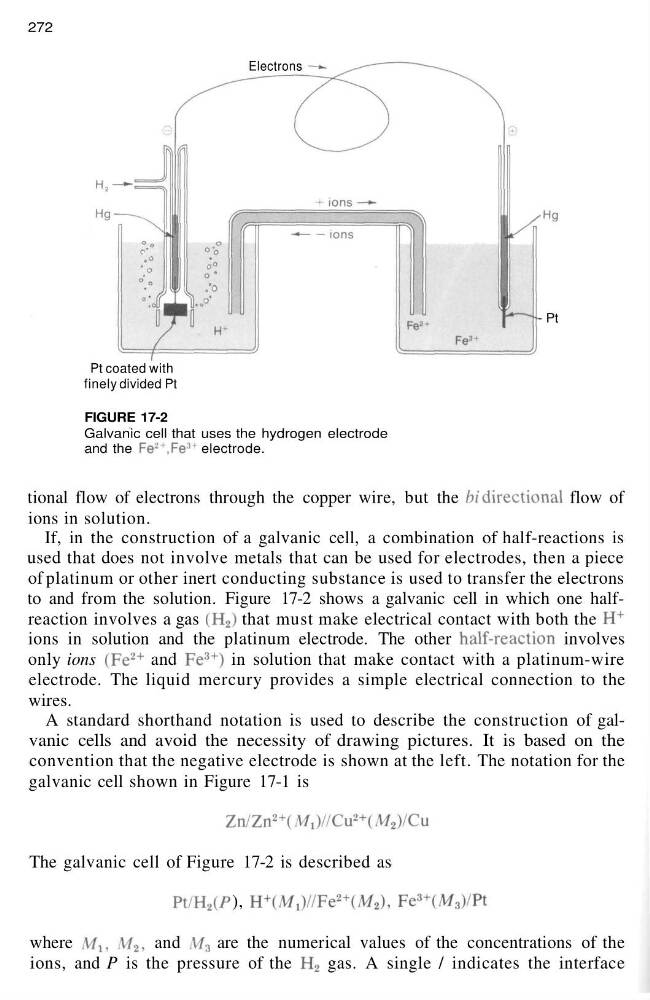
FIGURE 17-2
Galvanic cell that uses the hydrogen electrode
and the Fe
2+ ,Fe
3+ electrode.
tional flow of electrons through the copper wire, but the bi directional flow of
ions in solution.
If, in the construction of a galvanic cell, a combination of half-reactions is
used that does not involve metals that can be used for electrodes, then a piece
of platinum or other inert conducting substance is used to transfer the electrons
to and from the solution. Figure 17-2 shows a galvanic cell in which one halfreaction involves a gas (H 2 ) that must make electrical contact with both the H
+
ions in solution and the platinum electrode. The other half- reaction involves
only ions (Fe
2+ and Fe
3+
) in solution that make contact with a platinum-wire
electrode. The liquid mercury provides a simple electrical connection to the
wires.
A standard shorthand notation is used to describe the construction of galvanic cells and avoid the necessity of drawing pictures. It is based on the
convention that the negative electrode is shown at the left. The notation for the
galvanic cell shown in Figure 17-1 is
Zn/Zn
2+ (
+ ( M 2 )/Cu
The galvanic cell of Figure 17-2 is described as
), H
+ (M,)//Fe
2 +(M 2 ), Fe
3+ (M 3 )/Pt
where M l , M 2 , and M 3 are the numerical values of the concentrations of the
ions, and P is the pressure of the H 2 gas. A single / indicates the interface
Electrons
- Pt
Pt coated with
finely divided Pt
FIGURE 17-2
Galvanic cell that uses the hydrogen electrode
and the Fe
2+ ,Fe
3+ electrode.
tional flow of electrons through the copper wire, but the bi directional flow of
ions in solution.
If, in the construction of a galvanic cell, a combination of half-reactions is
used that does not involve metals that can be used for electrodes, then a piece
of platinum or other inert conducting substance is used to transfer the electrons
to and from the solution. Figure 17-2 shows a galvanic cell in which one halfreaction involves a gas (H 2 ) that must make electrical contact with both the H
+
ions in solution and the platinum electrode. The other half- reaction involves
only ions (Fe
2+ and Fe
3+
) in solution that make contact with a platinum-wire
electrode. The liquid mercury provides a simple electrical connection to the
wires.
A standard shorthand notation is used to describe the construction of galvanic cells and avoid the necessity of drawing pictures. It is based on the
convention that the negative electrode is shown at the left. The notation for the
galvanic cell shown in Figure 17-1 is
Zn/Zn
2+ (
+ ( M 2 )/Cu
The galvanic cell of Figure 17-2 is described as
), H
+ (M,)//Fe
2 +(M 2 ), Fe
3+ (M 3 )/Pt
where M l , M 2 , and M 3 are the numerical values of the concentrations of the
ions, and P is the pressure of the H 2 gas. A single / indicates the interface