

271
Electrons
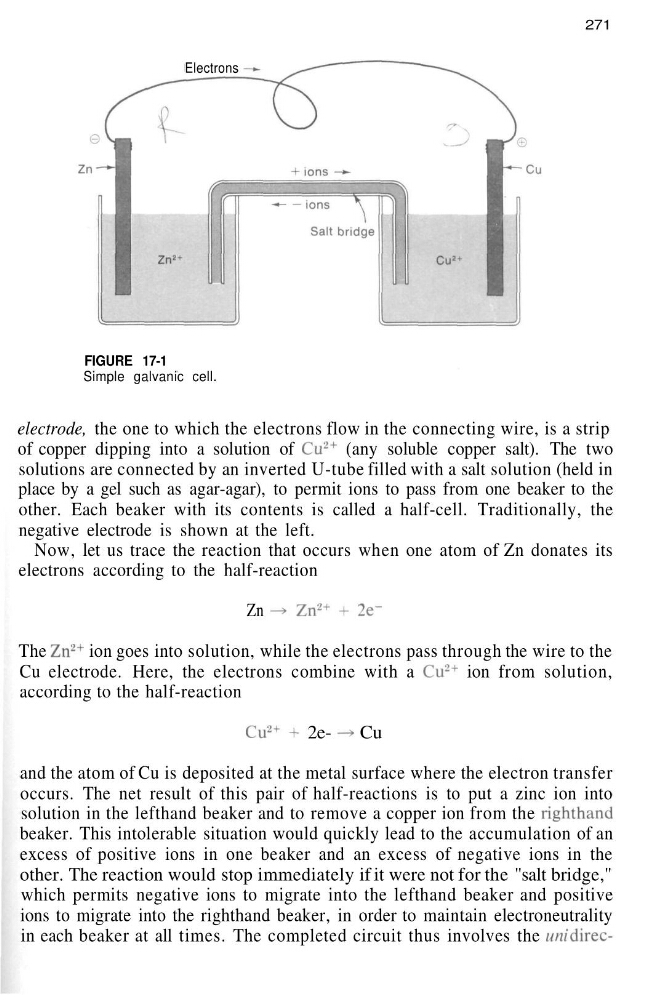
FIGURE 17-1
Simple galvanic cell.
electrode, the one to which the electrons flow in the connecting wire, is a strip
of copper dipping into a solution of Cu'
2+ (any soluble copper salt). The two
solutions are connected by an inverted U-tube filled with a salt solution (held in
place by a gel such as agar-agar), to permit ions to pass from one beaker to the
other. Each beaker with its contents is called a half-cell. Traditionally, the
negative electrode is shown at the left.
Now, let us trace the reaction that occurs when one atom of Zn donates its
electrons according to the half-reaction
Zn —> Zn
2
2e~
The Zn
2+ ion goes into solution, while the electrons pass through the wire to the
Cu electrode. Here, the electrons combine with a Cu
2+ ion from solution,
according to the half-reaction
Cu
2 '
2e- -» Cu
and the atom of Cu is deposited at the metal surface where the electron transfer
occurs. The net result of this pair of half-reactions is to put a zinc ion into
solution in the lefthand beaker and to remove a copper ion from the righthand
beaker. This intolerable situation would quickly lead to the accumulation of an
excess of positive ions in one beaker and an excess of negative ions in the
other. The reaction would stop immediately if it were not for the "salt bridge,"
which permits negative ions to migrate into the lefthand beaker and positive
ions to migrate into the righthand beaker, in order to maintain electroneutrality
in each beaker at all times. The completed circuit thus involves the M/iidirec-
Electrons
FIGURE 17-1
Simple galvanic cell.
electrode, the one to which the electrons flow in the connecting wire, is a strip
of copper dipping into a solution of Cu'
2+ (any soluble copper salt). The two
solutions are connected by an inverted U-tube filled with a salt solution (held in
place by a gel such as agar-agar), to permit ions to pass from one beaker to the
other. Each beaker with its contents is called a half-cell. Traditionally, the
negative electrode is shown at the left.
Now, let us trace the reaction that occurs when one atom of Zn donates its
electrons according to the half-reaction
Zn —> Zn
2
2e~
The Zn
2+ ion goes into solution, while the electrons pass through the wire to the
Cu electrode. Here, the electrons combine with a Cu
2+ ion from solution,
according to the half-reaction
Cu
2 '
2e- -» Cu
and the atom of Cu is deposited at the metal surface where the electron transfer
occurs. The net result of this pair of half-reactions is to put a zinc ion into
solution in the lefthand beaker and to remove a copper ion from the righthand
beaker. This intolerable situation would quickly lead to the accumulation of an
excess of positive ions in one beaker and an excess of negative ions in the
other. The reaction would stop immediately if it were not for the "salt bridge,"
which permits negative ions to migrate into the lefthand beaker and positive
ions to migrate into the righthand beaker, in order to maintain electroneutrality
in each beaker at all times. The completed circuit thus involves the M/iidirec-