

The Effect of Temperature on K,, and Equilibrium Position
261
dissociated. If K v is very large (or very small), it means that the equilibrium
position lies far to the right (or to the left). In either of these cases it is possible to
choose A' so that it will be very small and amenable to a simplified math solution.
The value of K v for the PC1 5 equilibrium is neither very large nor very small, and
hence it never will be possible to neglect A'.
THE EFFECT OF TEMPERATURE ON K p
AND EQUILIBRIUM POSITION
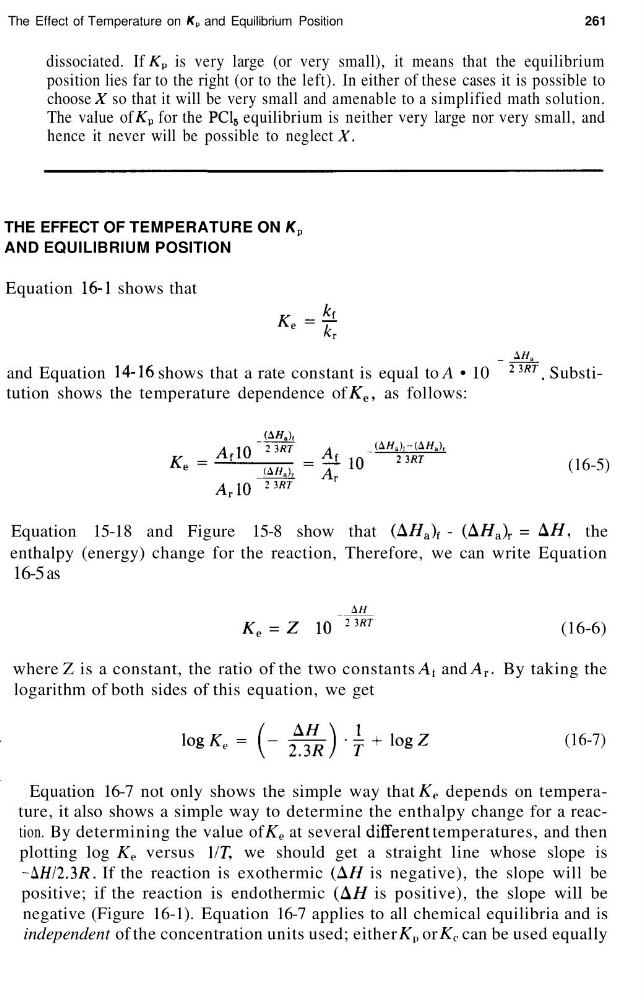
Equation 16-1 shows that
_
and Equation 14-16 shows that a rate constant is equal to A • 10
2 3ffr . Substitution shows the temperature dependence of K e , as follows:
(A//.),
(A//.),-(Aff.) r
(16-5)
A r 10
Equation 15-18 and Figure 15-8 show that (A// a ) f - (A# a ) r = A//, the
enthalpy (energy) change for the reaction, Therefore, we can write Equation
16-5 as
K e = Z KT
23 *
r
(16-6)
where Z is a constant, the ratio of the two constants A t and A r . By taking the
logarithm of both sides of this equation, we get
(16-7)
Equation 16-7 not only shows the simple way that K? depends on temperature, it also shows a simple way to determine the enthalpy change for a reaction. By determining the value of K e at several different temperatures, and then
plotting log K e versus \IT , we should get a straight line whose slope is
-A/f/2.3/?. If the reaction is exothermic (A// is negative), the slope will be
positive; if the reaction is endothermic (A// is positive), the slope will be
negative (Figure 16-1). Equation 16-7 applies to all chemical equilibria and is
independent of the concentration units used; either K v or K c can be used equally
261
dissociated. If K v is very large (or very small), it means that the equilibrium
position lies far to the right (or to the left). In either of these cases it is possible to
choose A' so that it will be very small and amenable to a simplified math solution.
The value of K v for the PC1 5 equilibrium is neither very large nor very small, and
hence it never will be possible to neglect A'.
THE EFFECT OF TEMPERATURE ON K p
AND EQUILIBRIUM POSITION
Equation 16-1 shows that
_
and Equation 14-16 shows that a rate constant is equal to A • 10
2 3ffr . Substitution shows the temperature dependence of K e , as follows:
(A//.),
(A//.),-(Aff.) r
(16-5)
A r 10
Equation 15-18 and Figure 15-8 show that (A// a ) f - (A# a ) r = A//, the
enthalpy (energy) change for the reaction, Therefore, we can write Equation
16-5 as
K e = Z KT
23 *
r
(16-6)
where Z is a constant, the ratio of the two constants A t and A r . By taking the
logarithm of both sides of this equation, we get
(16-7)
Equation 16-7 not only shows the simple way that K? depends on temperature, it also shows a simple way to determine the enthalpy change for a reaction. By determining the value of K e at several different temperatures, and then
plotting log K e versus \IT , we should get a straight line whose slope is
-A/f/2.3/?. If the reaction is exothermic (A// is negative), the slope will be
positive; if the reaction is endothermic (A// is positive), the slope will be
negative (Figure 16-1). Equation 16-7 applies to all chemical equilibria and is
independent of the concentration units used; either K v or K c can be used equally