

260
Chemical Equilibrium In Gases
THE PERCENTAGE DECOMPOSITION OF GASES
Many gases decompose into simpler ones at elevated temperatures, and it often
is important to know the extent to which decomposition takes place.
PROBLEM:
K g = 1.78 atm at 250.0°C for the decomposition reaction PC1 5 <± PC1 3 + C1 2 .
Calculate the percentage of PC1 5 that dissociates if 0.0500 mole of PC1 5 is placed in
a closed vessel at 250.0°C and 2.00 atm pressure.
SOLUTION:
Although you are told that you are starting with 0.0500 mole PC1 5 , this piece of
information is not needed to find the percentage dissociation at the given pressure
and temperature. If you were asked for the volume of the reaction vessel, then you
would need to know the actual number of moles; otherwise not. To answer the
question that is asked, it is simpler to just start with one mole (don't worry about
the volume) and assume that X moles of PC1 5 dissociate to give X moles each of
PC1 3 and C1 2 and 1 - X moles of PC1 5 at equilibrium.
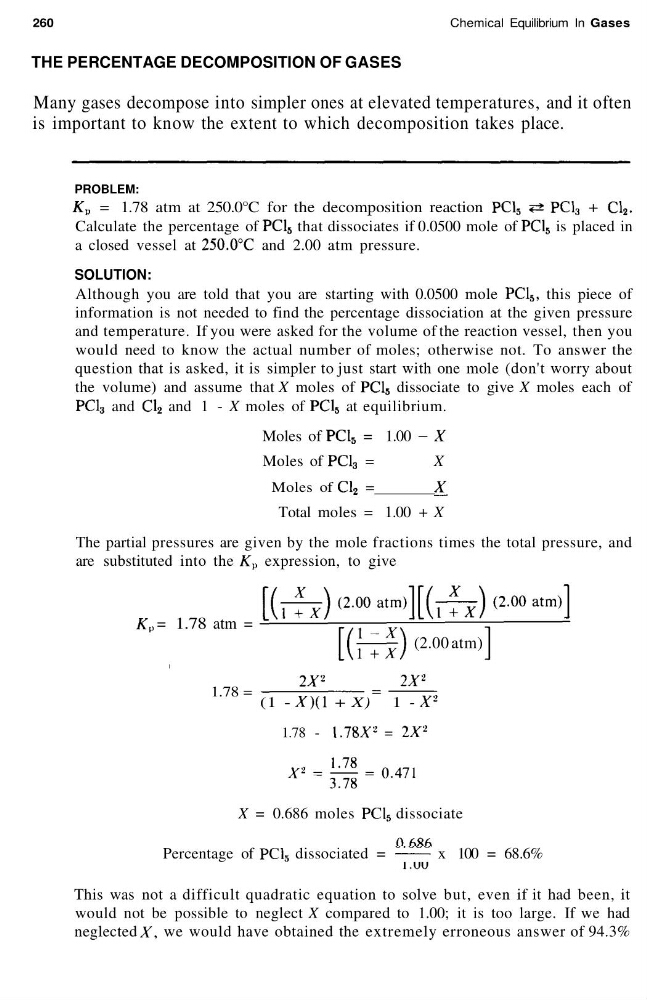
Moles of PC1 5 = 1.00 -JV
Moles of PC1 3 =
X
Moles of C1 2 =
X_
Total moles = 1.00 + X
The partial pressures are given by the mole fractions times the total pressure, and
are substituted into the K v expression, to give
[(rf^)
(2 -
00atm) ][(rf¥)
(2 -
00atm) ]
(2.00 atm)
?Y
2
7Y
2
1.78 =
K f = 1.78 atm =
(1 - A'Kl + X) 1 - X
2
1.78 - 1.78A"
2 = 2X'
2
X = 0.686 moles PC1 5 dissociate
Percentage of PC1 5 dissociated = -
1
— x 100 = 68.6%
This was not a difficult quadratic equation to solve but, even if it had been, it
would not be possible to neglect X compared to 1.00; it is too large. If we had
neglected X, we would have obtained the extremely erroneous answer of 94.3%
Chemical Equilibrium In Gases
THE PERCENTAGE DECOMPOSITION OF GASES
Many gases decompose into simpler ones at elevated temperatures, and it often
is important to know the extent to which decomposition takes place.
PROBLEM:
K g = 1.78 atm at 250.0°C for the decomposition reaction PC1 5 <± PC1 3 + C1 2 .
Calculate the percentage of PC1 5 that dissociates if 0.0500 mole of PC1 5 is placed in
a closed vessel at 250.0°C and 2.00 atm pressure.
SOLUTION:
Although you are told that you are starting with 0.0500 mole PC1 5 , this piece of
information is not needed to find the percentage dissociation at the given pressure
and temperature. If you were asked for the volume of the reaction vessel, then you
would need to know the actual number of moles; otherwise not. To answer the
question that is asked, it is simpler to just start with one mole (don't worry about
the volume) and assume that X moles of PC1 5 dissociate to give X moles each of
PC1 3 and C1 2 and 1 - X moles of PC1 5 at equilibrium.
Moles of PC1 5 = 1.00 -JV
Moles of PC1 3 =
X
Moles of C1 2 =
X_
Total moles = 1.00 + X
The partial pressures are given by the mole fractions times the total pressure, and
are substituted into the K v expression, to give
[(rf^)
(2 -
00atm) ][(rf¥)
(2 -
00atm) ]
(2.00 atm)
?Y
2
7Y
2
1.78 =
K f = 1.78 atm =
(1 - A'Kl + X) 1 - X
2
1.78 - 1.78A"
2 = 2X'
2
X = 0.686 moles PC1 5 dissociate
Percentage of PC1 5 dissociated = -
1
— x 100 = 68.6%
This was not a difficult quadratic equation to solve but, even if it had been, it
would not be possible to neglect X compared to 1.00; it is too large. If we had
neglected X, we would have obtained the extremely erroneous answer of 94.3%