

The Effect of Change in Partial Pressure of One Gas
259
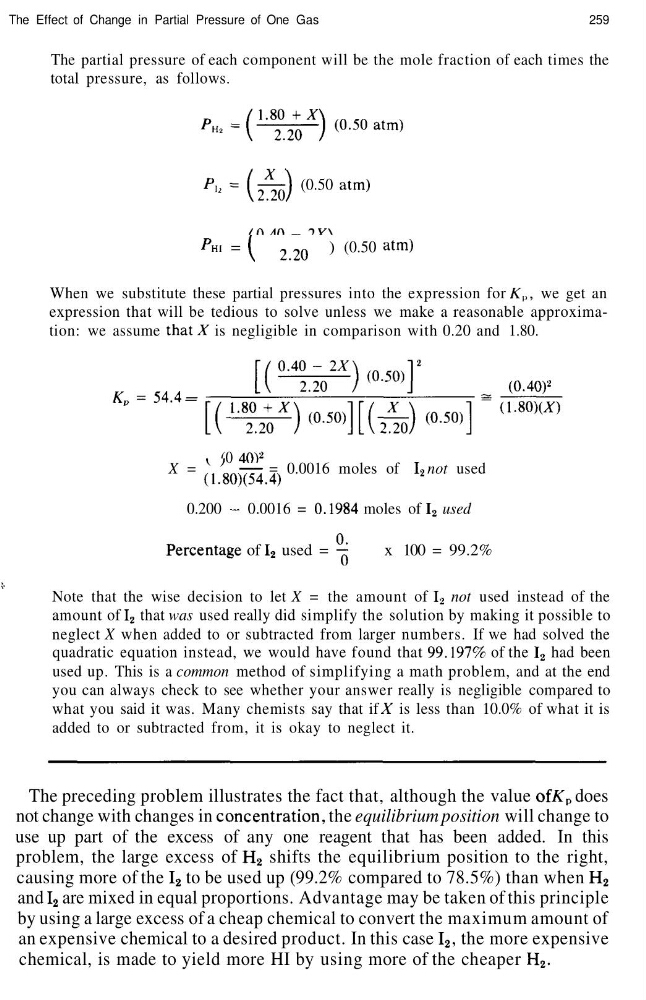
The partial pressure of each component will be the mole fraction of each times the
total pressure, as follows.
'""(2.20)
(0.50 atm)
PH, = (
220 ) (0.50 atm)
When we substitute these partial pressures into the expression for K v , we get an
expression that will be tedious to solve unless we make a reasonable approximation: we assume that^V is negligible in comparison with 0.20 and 1.80.
K =54.4 =
(0 40V
X =
v ; - = 0.0016 moles of I 2 not used
(1.80)(54.4)
0.200 - 0.0016 = 0.1984 moles of I 2 used
Percentage of I 2 used = ° Q
x 100 = 99.2%
Note that the wise decision to let X = the amount of I 2 not used instead of the
amount of I 2 that was used really did simplify the solution by making it possible to
neglect X when added to or subtracted from larger numbers. If we had solved the
quadratic equation instead, we would have found that 99.197% of the I 2 had been
used up. This is a common method of simplifying a math problem, and at the end
you can always check to see whether your answer really is negligible compared to
what you said it was. Many chemists say that if A" is less than 10.0% of what it is
added to or subtracted from, it is okay to neglect it.
The preceding problem illustrates the fact that, although the value of K p does
not change with changes in concentration, the equilibrium position will change to
use up part of the excess of any one reagent that has been added. In this
problem, the large excess of H 2 shifts the equilibrium position to the right,
causing more of the I 2 to be used up (99.2% compared to 78.5%) than when H 2
and I 2 are mixed in equal proportions. Advantage may be taken of this principle
by using a large excess of a cheap chemical to convert the maximum amount of
an expensive chemical to a desired product. In this case I 2 , the more expensive
chemical, is made to yield more HI by using more of the cheaper H 2 .
259
The partial pressure of each component will be the mole fraction of each times the
total pressure, as follows.
'""(2.20)
(0.50 atm)
PH, = (
220 ) (0.50 atm)
When we substitute these partial pressures into the expression for K v , we get an
expression that will be tedious to solve unless we make a reasonable approximation: we assume that^V is negligible in comparison with 0.20 and 1.80.
K =54.4 =
(0 40V
X =
v ; - = 0.0016 moles of I 2 not used
(1.80)(54.4)
0.200 - 0.0016 = 0.1984 moles of I 2 used
Percentage of I 2 used = ° Q
x 100 = 99.2%
Note that the wise decision to let X = the amount of I 2 not used instead of the
amount of I 2 that was used really did simplify the solution by making it possible to
neglect X when added to or subtracted from larger numbers. If we had solved the
quadratic equation instead, we would have found that 99.197% of the I 2 had been
used up. This is a common method of simplifying a math problem, and at the end
you can always check to see whether your answer really is negligible compared to
what you said it was. Many chemists say that if A" is less than 10.0% of what it is
added to or subtracted from, it is okay to neglect it.
The preceding problem illustrates the fact that, although the value of K p does
not change with changes in concentration, the equilibrium position will change to
use up part of the excess of any one reagent that has been added. In this
problem, the large excess of H 2 shifts the equilibrium position to the right,
causing more of the I 2 to be used up (99.2% compared to 78.5%) than when H 2
and I 2 are mixed in equal proportions. Advantage may be taken of this principle
by using a large excess of a cheap chemical to convert the maximum amount of
an expensive chemical to a desired product. In this case I 2 , the more expensive
chemical, is made to yield more HI by using more of the cheaper H 2 .