

258
Chemical Equilibrium in Gases
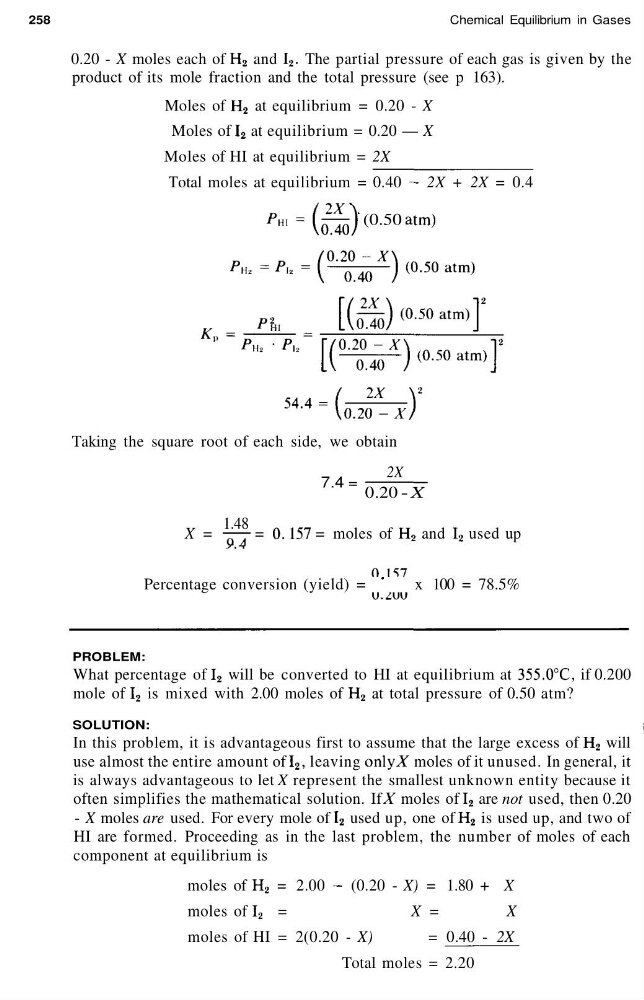
0.20 - X moles each of H 2 and I 2 . The partial pressure of each gas is given by the
product of its mole fraction and the total pressure (see p 163).
Moles of H 2 at equilibrium = 0.20 - X
Moles of I 2 at equilibrium = 0.20 — X
Moles of HI at equilibrium = 2X
Total moles at equilibrium = 0.40 - 2X + 2X = 0.4
(
IX \
—) (0.50 atm)
Taking the square root of each side, we obtain
2X
7.4 = 0.20 - X
1.48
X = -£— = 0. 157 = moles of H 2 and I 2 used up
Percentage conversion (yield) = '
x 100 = 78.5%
PROBLEM:
What percentage of I 2 will be converted to HI at equilibrium at 355.0°C, if 0.200
mole of I 2 is mixed with 2.00 moles of H 2 at total pressure of 0.50 atm?
SOLUTION:
In this problem, it is advantageous first to assume that the large excess of H 2 will
use almost the entire amount of I 2 , leaving only A' moles of it unused. In general, it
is always advantageous to let X represent the smallest unknown entity because it
often simplifies the mathematical solution. If A' moles of I 2 are not used, then 0.20
- X moles are used. For every mole of I 2 used up, one of H 2 is used up, and two of
HI are formed. Proceeding as in the last problem, the number of moles of each
component at equilibrium is
moles of H 2 = 2.00 - (0.20 - X) = 1.80 + X
moles of I 2 =
X =
X
moles of HI = 2(0.20 - X)
= 0.40 - 2X
Total moles = 2.20
Chemical Equilibrium in Gases
0.20 - X moles each of H 2 and I 2 . The partial pressure of each gas is given by the
product of its mole fraction and the total pressure (see p 163).
Moles of H 2 at equilibrium = 0.20 - X
Moles of I 2 at equilibrium = 0.20 — X
Moles of HI at equilibrium = 2X
Total moles at equilibrium = 0.40 - 2X + 2X = 0.4
(
IX \
—) (0.50 atm)
Taking the square root of each side, we obtain
2X
7.4 = 0.20 - X
1.48
X = -£— = 0. 157 = moles of H 2 and I 2 used up
Percentage conversion (yield) = '
x 100 = 78.5%
PROBLEM:
What percentage of I 2 will be converted to HI at equilibrium at 355.0°C, if 0.200
mole of I 2 is mixed with 2.00 moles of H 2 at total pressure of 0.50 atm?
SOLUTION:
In this problem, it is advantageous first to assume that the large excess of H 2 will
use almost the entire amount of I 2 , leaving only A' moles of it unused. In general, it
is always advantageous to let X represent the smallest unknown entity because it
often simplifies the mathematical solution. If A' moles of I 2 are not used, then 0.20
- X moles are used. For every mole of I 2 used up, one of H 2 is used up, and two of
HI are formed. Proceeding as in the last problem, the number of moles of each
component at equilibrium is
moles of H 2 = 2.00 - (0.20 - X) = 1.80 + X
moles of I 2 =
X =
X
moles of HI = 2(0.20 - X)
= 0.40 - 2X
Total moles = 2.20