

257
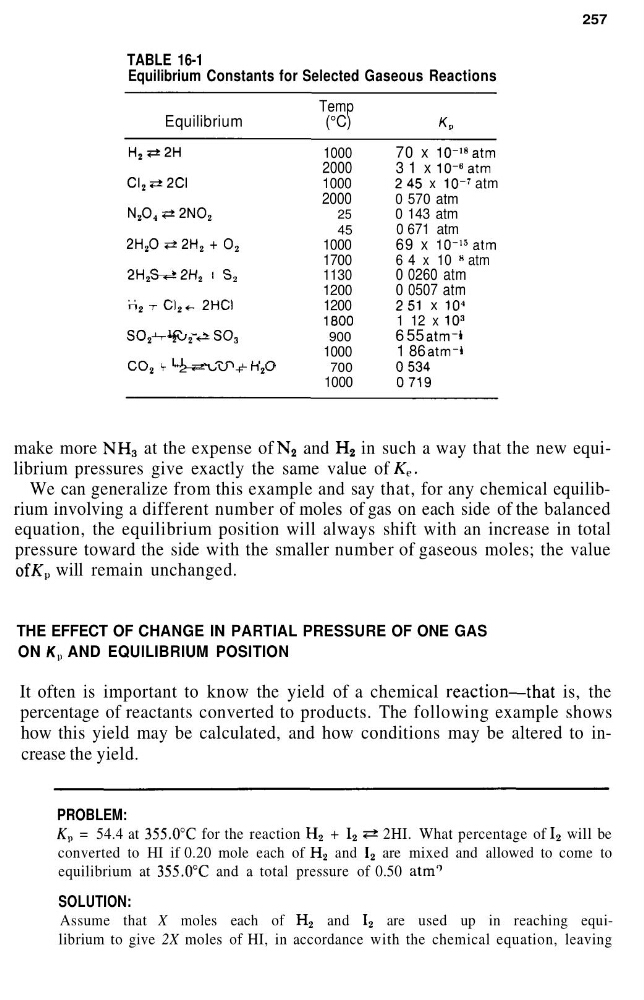
TABLE 16-1
Equilibrium Constants for Selected Gaseous Reactions
Temp
Equilibrium
(°C)
K p
H 2 ?±2H
CI 2 *±2CI
N 2 O 4 ?±2NO 2
2H 2 O*±2H 2 + 0 2
QU O
» OUI
i Q
C.i\2& 4~- £."2 ' ^2
112 ~r" {s\2 *~ ^Hwl
O/*^ _i_ l/^ — »• QO
OW2 ~>~ 2^-'2 ^~^ ^*-^3
o/*^ i^ LI i oo _i _ u r^
0^2 ' "2 *^ wvj + n2
|
-'
1000
2000
1000
2000
25
45
1000
1700
1130
1200
1200
1800
900
1000
700
1000
70 x 10-'
8 atm
3 1 x 10⁶ atm
245 x 10~
7 atm
0 570 atm
0 143 atm
0 671 atm
69 x 10-'
5 atm
6 4 x 10
8 atm
0 0260 atm
0 0507 atm
251 x 10"
1 12 x 10
3
6 55 atm-i
1 86 atm-l
0534
0719
make more NH 3 at the expense of N 2 and H 2 in such a way that the new equilibrium pressures give exactly the same value of K e .
We can generalize from this example and say that, for any chemical equilibrium involving a different number of moles of gas on each side of the balanced
equation, the equilibrium position will always shift with an increase in total
pressure toward the side with the smaller number of gaseous moles; the value
of K p will remain unchanged.
THE EFFECT OF CHANGE IN PARTIAL PRESSURE OF ONE GAS
ON K p AND EQUILIBRIUM POSITION
It often is important to know the yield of a chemical reaction—that is, the
percentage of reactants converted to products. The following example shows
how this yield may be calculated, and how conditions may be altered to increase the yield.
PROBLEM:
Kp = 54.4 at 355.0°C for the reaction H 2 + I 2 ?± 2HI. What percentage of I 2 will be
converted to HI if 0.20 mole each of H 2 and I 2 are mixed and allowed to come to
equilibrium at 355.0°C and a total pressure of 0.50 atm
9
SOLUTION:
Assume that X moles each of H 2 and I 2 are used up in reaching equilibrium to give 2X moles of HI, in accordance with the chemical equation, leaving
TABLE 16-1
Equilibrium Constants for Selected Gaseous Reactions
Temp
Equilibrium
(°C)
K p
H 2 ?±2H
CI 2 *±2CI
N 2 O 4 ?±2NO 2
2H 2 O*±2H 2 + 0 2
QU O
» OUI
i Q
C.i\2& 4~- £."2 ' ^2
112 ~r" {s\2 *~ ^Hwl
O/*^ _i_ l/^ — »• QO
OW2 ~>~ 2^-'2 ^~^ ^*-^3
o/*^ i^ LI i oo _i _ u r^
0^2 ' "2 *^ wvj + n2
|
-'
1000
2000
1000
2000
25
45
1000
1700
1130
1200
1200
1800
900
1000
700
1000
70 x 10-'
8 atm
3 1 x 10⁶ atm
245 x 10~
7 atm
0 570 atm
0 143 atm
0 671 atm
69 x 10-'
5 atm
6 4 x 10
8 atm
0 0260 atm
0 0507 atm
251 x 10"
1 12 x 10
3
6 55 atm-i
1 86 atm-l
0534
0719
make more NH 3 at the expense of N 2 and H 2 in such a way that the new equilibrium pressures give exactly the same value of K e .
We can generalize from this example and say that, for any chemical equilibrium involving a different number of moles of gas on each side of the balanced
equation, the equilibrium position will always shift with an increase in total
pressure toward the side with the smaller number of gaseous moles; the value
of K p will remain unchanged.
THE EFFECT OF CHANGE IN PARTIAL PRESSURE OF ONE GAS
ON K p AND EQUILIBRIUM POSITION
It often is important to know the yield of a chemical reaction—that is, the
percentage of reactants converted to products. The following example shows
how this yield may be calculated, and how conditions may be altered to increase the yield.
PROBLEM:
Kp = 54.4 at 355.0°C for the reaction H 2 + I 2 ?± 2HI. What percentage of I 2 will be
converted to HI if 0.20 mole each of H 2 and I 2 are mixed and allowed to come to
equilibrium at 355.0°C and a total pressure of 0.50 atm
9
SOLUTION:
Assume that X moles each of H 2 and I 2 are used up in reaching equilibrium to give 2X moles of HI, in accordance with the chemical equation, leaving