

256
Chemical Equilibrium In Gases
PROBLEM:
Starting with a 3: 1 mixture of H 2 and N 2 at 450.0°C, the equilibrium mixture is
found to be 9.6% NH 3 , 22.6% N 2 , and 67.8% H 2 by volume. The total pressure is
50.0 atm. Calculate K v and K c . The reaction is N 2 + 3H 2 ?± 2NH 3 .
SOLUTION:
According to Dalton's law of partial pressures (see p 163), the partial pressure of a
gas in a mixture is given by the product of its volume fraction and the total
pressure. Therefore the equilibrium pressure of each gas is
P NH3 = (0.096)(50.0 atm) = 4.8 atm
PX, = (0.226)(50.0 atm) =11.3 atm
P Hz = (0.678)(50.0 atm) = 33.9 atm
Total pressure = 50.0 atm
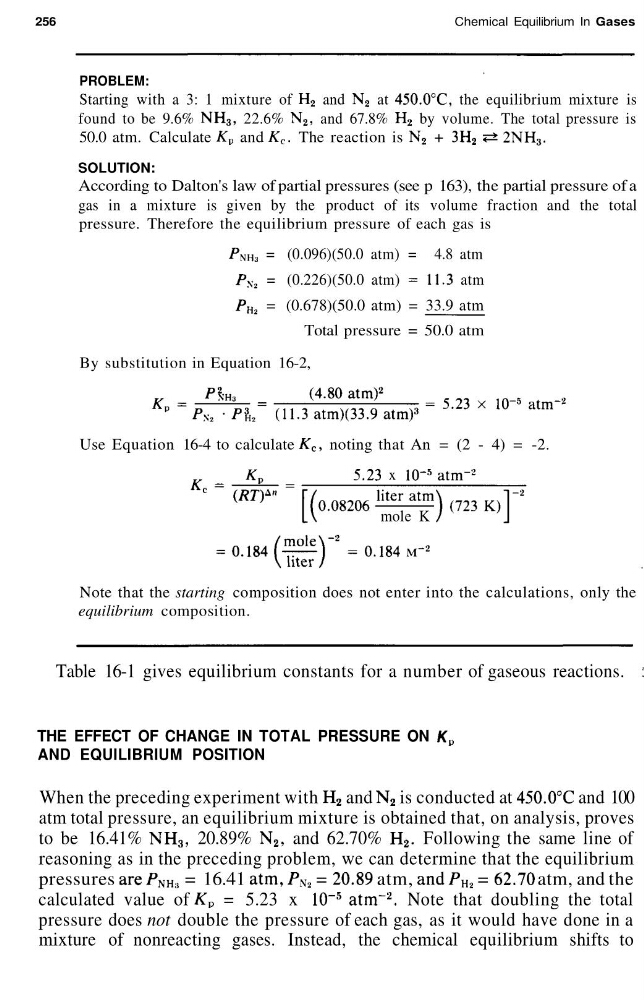
By substitution in Equation 16-2,
Use Equation 16-4 to calculate K c , noting that An = (2 - 4) = -2.
5.23 x IP'
5 atm~
2
mole K
Note that the starting composition does not enter into the calculations, only the
equilibrium composition.
Table 16-1 gives equilibrium constants for a number of gaseous reactions.
THE EFFECT OF CHANGE IN TOTAL PRESSURE ON K p
AND EQUILIBRIUM POSITION
When the preceding experiment with H 2 and N 2 is conducted at 450.0°C and 100
atm total pressure, an equilibrium mixture is obtained that, on analysis, proves
to be 16.41% NH 3 , 20.89% N 2 , and 62.70% H 2 . Following the same line of
reasoning as in the preceding problem, we can determine that the equilibrium
pressures areP m3 = 16.41 atm,P N2 = 20.89 atm, and/V = 62.70 atm, and the
calculated value of K p = 5.23 x 10"
5 atm"
2 . Note that doubling the total
pressure does not double the pressure of each gas, as it would have done in a
mixture of nonreacting gases. Instead, the chemical equilibrium shifts to
Chemical Equilibrium In Gases
PROBLEM:
Starting with a 3: 1 mixture of H 2 and N 2 at 450.0°C, the equilibrium mixture is
found to be 9.6% NH 3 , 22.6% N 2 , and 67.8% H 2 by volume. The total pressure is
50.0 atm. Calculate K v and K c . The reaction is N 2 + 3H 2 ?± 2NH 3 .
SOLUTION:
According to Dalton's law of partial pressures (see p 163), the partial pressure of a
gas in a mixture is given by the product of its volume fraction and the total
pressure. Therefore the equilibrium pressure of each gas is
P NH3 = (0.096)(50.0 atm) = 4.8 atm
PX, = (0.226)(50.0 atm) =11.3 atm
P Hz = (0.678)(50.0 atm) = 33.9 atm
Total pressure = 50.0 atm
By substitution in Equation 16-2,
Use Equation 16-4 to calculate K c , noting that An = (2 - 4) = -2.
5.23 x IP'
5 atm~
2
mole K
Note that the starting composition does not enter into the calculations, only the
equilibrium composition.
Table 16-1 gives equilibrium constants for a number of gaseous reactions.
THE EFFECT OF CHANGE IN TOTAL PRESSURE ON K p
AND EQUILIBRIUM POSITION
When the preceding experiment with H 2 and N 2 is conducted at 450.0°C and 100
atm total pressure, an equilibrium mixture is obtained that, on analysis, proves
to be 16.41% NH 3 , 20.89% N 2 , and 62.70% H 2 . Following the same line of
reasoning as in the preceding problem, we can determine that the equilibrium
pressures areP m3 = 16.41 atm,P N2 = 20.89 atm, and/V = 62.70 atm, and the
calculated value of K p = 5.23 x 10"
5 atm"
2 . Note that doubling the total
pressure does not double the pressure of each gas, as it would have done in a
mixture of nonreacting gases. Instead, the chemical equilibrium shifts to