

Determination of K.
255
amount. This dependence on temperature is discussed at the end of this chapter. Equation 16-1 applies to any chemical reaction at equilibrium, no matter
how many or how complicated the intermediate steps in going from reactants to
products.
A good understanding of the principles of chemical equilibrium is important
for the prediction of the yield of a reaction at a given temperature and for
knowing how to change the yield to your advantage. You will also be able to
predict the effect of temperature changes on the yield. Every living biological
system contains thousands of reversible reactions whose shifting equilibria
must be carefully controlled for the health of the system. Every industrial
chemical process is optimized by using the principles of chemical equilibrium.
Special cases of chemical equilibrium in solution are considered in several
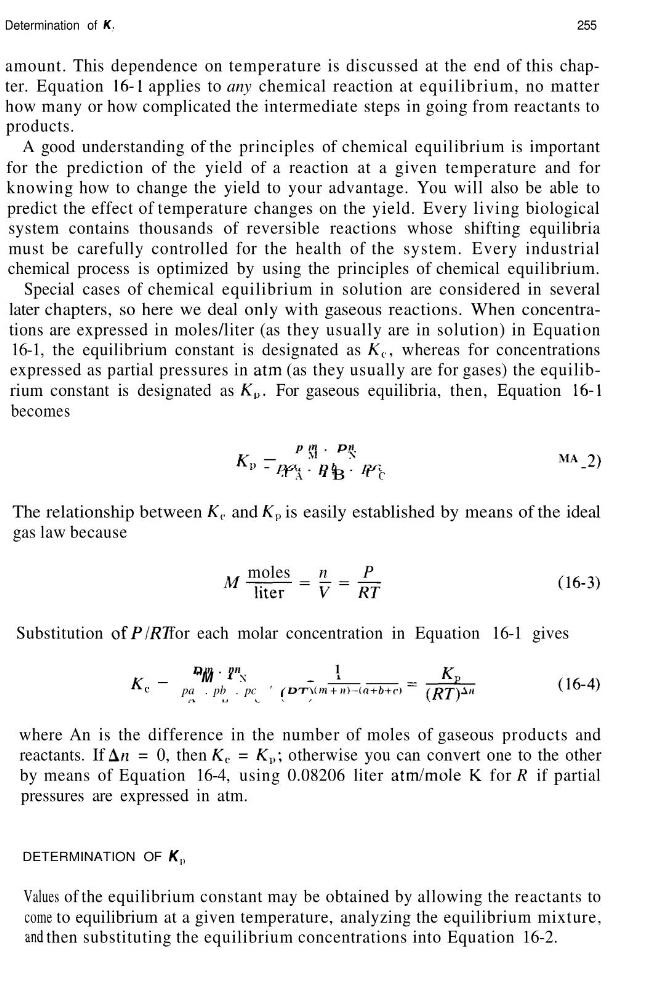
later chapters, so here we deal only with gaseous reactions. When concentrations are expressed in moles/liter (as they usually are in solution) in Equation
16-1, the equilibrium constant is designated as /Q, whereas for concentrations
expressed as partial pressures in atm (as they usually are for gases) the equilibrium constant is designated as K v . For gaseous equilibria, then, Equation 16-1
becomes
p m . pn
k- —
M
N
MA ~>\
i> - pa . pb . pc
-
"A. ' B "c
The relationship between A",, and K p is easily established by means of the ideal
gas law because
moles
n
P
.
Substitution ofP/RT for each molar concentration in Equation 16-1 gives
Dm . pn
1
_
"M -r.x
_
. _ _
c
pa . pb . pc ' ( D-T\(m + >i)-(a+b+c)
where An is the difference in the number of moles of gaseous products and
reactants. If A« = 0, then K c = K v ; otherwise you can convert one to the other
by means of Equation 16-4, using 0.08206 liter atm/mole K for R if partial
pressures are expressed in atm.
DETERMINATION OF K,,
Values of the equilibrium constant may be obtained by allowing the reactants to
come to equilibrium at a given temperature, analyzing the equilibrium mixture,
and then substituting the equilibrium concentrations into Equation 16-2.
255
amount. This dependence on temperature is discussed at the end of this chapter. Equation 16-1 applies to any chemical reaction at equilibrium, no matter
how many or how complicated the intermediate steps in going from reactants to
products.
A good understanding of the principles of chemical equilibrium is important
for the prediction of the yield of a reaction at a given temperature and for
knowing how to change the yield to your advantage. You will also be able to
predict the effect of temperature changes on the yield. Every living biological
system contains thousands of reversible reactions whose shifting equilibria
must be carefully controlled for the health of the system. Every industrial
chemical process is optimized by using the principles of chemical equilibrium.
Special cases of chemical equilibrium in solution are considered in several
later chapters, so here we deal only with gaseous reactions. When concentrations are expressed in moles/liter (as they usually are in solution) in Equation
16-1, the equilibrium constant is designated as /Q, whereas for concentrations
expressed as partial pressures in atm (as they usually are for gases) the equilibrium constant is designated as K v . For gaseous equilibria, then, Equation 16-1
becomes
p m . pn
k- —
M
N
MA ~>\
i> - pa . pb . pc
-
"A. ' B "c
The relationship between A",, and K p is easily established by means of the ideal
gas law because
moles
n
P
.
Substitution ofP/RT for each molar concentration in Equation 16-1 gives
Dm . pn
1
_
"M -r.x
_
. _ _
c
pa . pb . pc ' ( D-T\(m + >i)-(a+b+c)
where An is the difference in the number of moles of gaseous products and
reactants. If A« = 0, then K c = K v ; otherwise you can convert one to the other
by means of Equation 16-4, using 0.08206 liter atm/mole K for R if partial
pressures are expressed in atm.
DETERMINATION OF K,,
Values of the equilibrium constant may be obtained by allowing the reactants to
come to equilibrium at a given temperature, analyzing the equilibrium mixture,
and then substituting the equilibrium concentrations into Equation 16-2.