

248
Chemical Kinetics
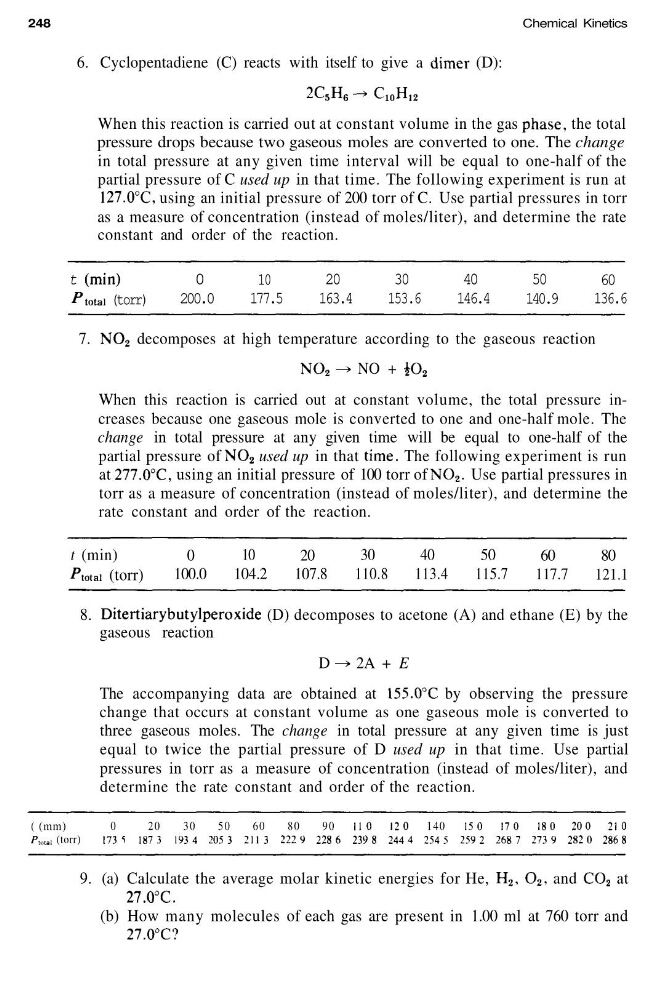
6. Cyclopentadiene (C) reacts with itself to give a dimer (D):
2C 5 H 6 —> C 10 H 12
When this reaction is carried out at constant volume in the gas phase, the total
pressure drops because two gaseous moles are converted to one. The change
in total pressure at any given time interval will be equal to one-half of the
partial pressure of C used up in that time. The following experiment is run at
127.0°C, using an initial pressure of 200 torr of C. Use partial pressures in torr
as a measure of concentration (instead of moles/liter), and determine the rate
constant and order of the reaction.
t (min)
^ total (torr)
0
200.0
10
177.5
20
163.4
30
153.6
40
146.4
50
140.9
60
136.6
7. NO 2 decomposes at high temperature according to the gaseous reaction
NO 2 -H> NO + iO 2
When this reaction is carried out at constant volume, the total pressure increases because one gaseous mole is converted to one and one-half mole. The
change in total pressure at any given time will be equal to one-half of the
partial pressure of NO 2 used up in that time. The following experiment is run
at 277.0°C, using an initial pressure of 100 torr of NO 2 . Use partial pressures in
torr as a measure of concentration (instead of moles/liter), and determine the
rate constant and order of the reaction.
t (min)
-Ptotai (torr)
0
100.0
10
104.2
20
107.8
30
110.8
40
113.4
50
115.7
60
117.7
80
121.1
8. Ditertiarybutylperoxide (D) decomposes to acetone (A) and ethane (E) by the
gaseous reaction
D -> 2A + E
The accompanying data are obtained at 155.0°C by observing the pressure
change that occurs at constant volume as one gaseous mole is converted to
three gaseous moles. The change in total pressure at any given time is just
equal to twice the partial pressure of D used up in that time. Use partial
pressures in torr as a measure of concentration (instead of moles/liter), and
determine the rate constant and order of the reaction.
( (mm)
0
20
30
50
60
80
90
110
120
140
150
170
180
200 210
/>„„„ (torr)
1735 1873 1934 2053 2113 2229 2286 2398 2444 2545 2592 2687 2739 2820 2868
9. (a) Calculate the average molar kinetic energies for He, H 2 , O 2 , and CO 2 at
27.0°C.
(b) How many molecules of each gas are present in 1.00 ml at 760 torr and
27.0°C?
Chemical Kinetics
6. Cyclopentadiene (C) reacts with itself to give a dimer (D):
2C 5 H 6 —> C 10 H 12
When this reaction is carried out at constant volume in the gas phase, the total
pressure drops because two gaseous moles are converted to one. The change
in total pressure at any given time interval will be equal to one-half of the
partial pressure of C used up in that time. The following experiment is run at
127.0°C, using an initial pressure of 200 torr of C. Use partial pressures in torr
as a measure of concentration (instead of moles/liter), and determine the rate
constant and order of the reaction.
t (min)
^ total (torr)
0
200.0
10
177.5
20
163.4
30
153.6
40
146.4
50
140.9
60
136.6
7. NO 2 decomposes at high temperature according to the gaseous reaction
NO 2 -H> NO + iO 2
When this reaction is carried out at constant volume, the total pressure increases because one gaseous mole is converted to one and one-half mole. The
change in total pressure at any given time will be equal to one-half of the
partial pressure of NO 2 used up in that time. The following experiment is run
at 277.0°C, using an initial pressure of 100 torr of NO 2 . Use partial pressures in
torr as a measure of concentration (instead of moles/liter), and determine the
rate constant and order of the reaction.
t (min)
-Ptotai (torr)
0
100.0
10
104.2
20
107.8
30
110.8
40
113.4
50
115.7
60
117.7
80
121.1
8. Ditertiarybutylperoxide (D) decomposes to acetone (A) and ethane (E) by the
gaseous reaction
D -> 2A + E
The accompanying data are obtained at 155.0°C by observing the pressure
change that occurs at constant volume as one gaseous mole is converted to
three gaseous moles. The change in total pressure at any given time is just
equal to twice the partial pressure of D used up in that time. Use partial
pressures in torr as a measure of concentration (instead of moles/liter), and
determine the rate constant and order of the reaction.
( (mm)
0
20
30
50
60
80
90
110
120
140
150
170
180
200 210
/>„„„ (torr)
1735 1873 1934 2053 2113 2229 2286 2398 2444 2545 2592 2687 2739 2820 2868
9. (a) Calculate the average molar kinetic energies for He, H 2 , O 2 , and CO 2 at
27.0°C.
(b) How many molecules of each gas are present in 1.00 ml at 760 torr and
27.0°C?