

Problems A
247
ent intermediate activated complex. This alternative pathway is shown by the
dotted line in Figure 15-8. With a smaller activation energy required, there will
be a larger fraction of molecules that can react (the area to the right of the
dotted line in Figure 15-6), and the reaction will go faster. Note that a catalyst
lowers the activation for the forward and reverse reactions by exactly the same
amount, and that (A/fraction remains unchanged.
PROBLEMS A
1. The following counts per minute (cpm) are obtained for a sample of an unknown isotope at 10 min intervals, beginning with t = 0: 10,000, 8166, 7583,
6464, 5381, 5023, 4466, 3622, 2981, 2690, 2239, 2141, 1775, 1603, 1348, 1114,
1048. Determine the half-life of the isotope.
2. As part of a radio-iodine treatment for a thyroid problem, a sample of radioactive Nal is injected into a person at 9:00 A.M. on a certain day. The iodide goes
almost immediately to the thyroid gland. If the sample has 10,000 cpm when
injected, how many cpm will there be at 3:00 P.M. on the same day? The
half-life of the iodine-128 isotope is 25.08 min.
3. How many milligrams of a 100 mg sample of radon-222 will disintegrate in 30
days, given that the half-life is 3.82 days?
4. The Dead Sea scrolls were found by radioactive carbon-dating techniques to
have 11.9 cpm per gram of carbon. Living material similar to that from which
they were made has 15.3 cpm per gram of carbon. How old must the scrolls
be, knowing that the half-life of carbon-14 is 5730 yr?
5. The/7-nitrophenyl ester of iV-carbobenzoxylysine reacts with water according
to the following equation (B and P are just symbols used to simplify description of this compound; H and O represent hydrogen and oxygen).
BOOP + H 2 O -^ BOOH + POH
There is a very great difference in the ultraviolet absorption of the products
and the reactants, so that the rate of the reaction can be followed easily by
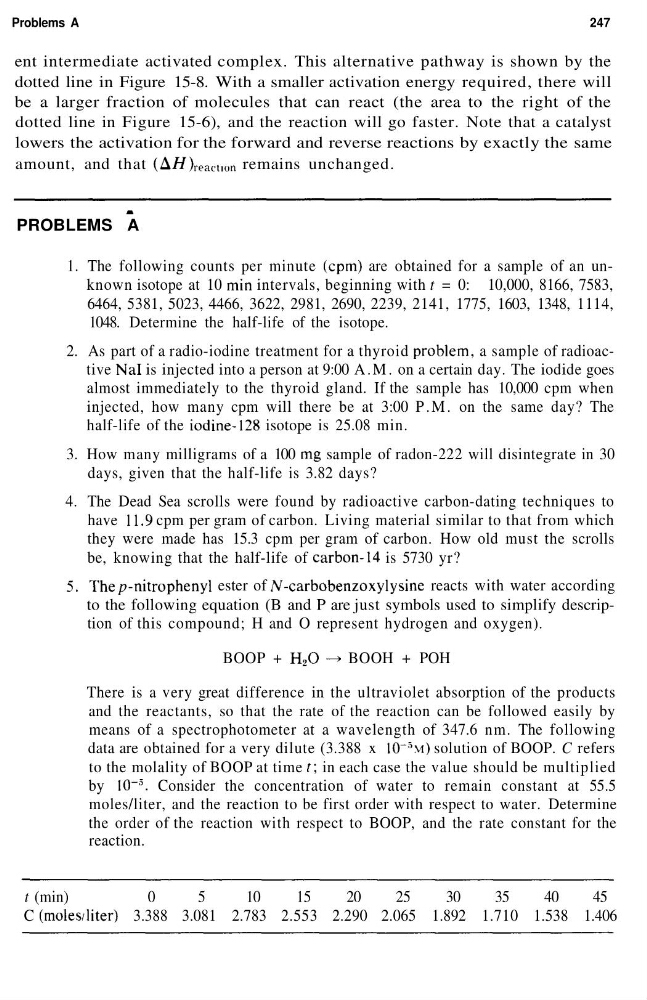
means of a spectrophotometer at a wavelength of 347.6 nm. The following
data are obtained for a very dilute (3.388 x 10~
5 M) solution of BOOP. C refers
to the molality of BOOP at time t; in each case the value should be multiplied
by 10~
5
. Consider the concentration of water to remain constant at 55.5
moles/liter, and the reaction to be first order with respect to water. Determine
the order of the reaction with respect to BOOP, and the rate constant for the
reaction.
t (min)
0
5
10
15
20
25
30
35
40
45
C (moles/liter) 3.388 3.081 2.783 2.553 2.290 2.065 1.892 1.710 1.538 1.406
247
ent intermediate activated complex. This alternative pathway is shown by the
dotted line in Figure 15-8. With a smaller activation energy required, there will
be a larger fraction of molecules that can react (the area to the right of the
dotted line in Figure 15-6), and the reaction will go faster. Note that a catalyst
lowers the activation for the forward and reverse reactions by exactly the same
amount, and that (A/fraction remains unchanged.
PROBLEMS A
1. The following counts per minute (cpm) are obtained for a sample of an unknown isotope at 10 min intervals, beginning with t = 0: 10,000, 8166, 7583,
6464, 5381, 5023, 4466, 3622, 2981, 2690, 2239, 2141, 1775, 1603, 1348, 1114,
1048. Determine the half-life of the isotope.
2. As part of a radio-iodine treatment for a thyroid problem, a sample of radioactive Nal is injected into a person at 9:00 A.M. on a certain day. The iodide goes
almost immediately to the thyroid gland. If the sample has 10,000 cpm when
injected, how many cpm will there be at 3:00 P.M. on the same day? The
half-life of the iodine-128 isotope is 25.08 min.
3. How many milligrams of a 100 mg sample of radon-222 will disintegrate in 30
days, given that the half-life is 3.82 days?
4. The Dead Sea scrolls were found by radioactive carbon-dating techniques to
have 11.9 cpm per gram of carbon. Living material similar to that from which
they were made has 15.3 cpm per gram of carbon. How old must the scrolls
be, knowing that the half-life of carbon-14 is 5730 yr?
5. The/7-nitrophenyl ester of iV-carbobenzoxylysine reacts with water according
to the following equation (B and P are just symbols used to simplify description of this compound; H and O represent hydrogen and oxygen).
BOOP + H 2 O -^ BOOH + POH
There is a very great difference in the ultraviolet absorption of the products
and the reactants, so that the rate of the reaction can be followed easily by
means of a spectrophotometer at a wavelength of 347.6 nm. The following
data are obtained for a very dilute (3.388 x 10~
5 M) solution of BOOP. C refers
to the molality of BOOP at time t; in each case the value should be multiplied
by 10~
5
. Consider the concentration of water to remain constant at 55.5
moles/liter, and the reaction to be first order with respect to water. Determine
the order of the reaction with respect to BOOP, and the rate constant for the
reaction.
t (min)
0
5
10
15
20
25
30
35
40
45
C (moles/liter) 3.388 3.081 2.783 2.553 2.290 2.065 1.892 1.710 1.538 1.406