

246
Enthalpy H
H Activated complex
H Products
^reverse
forward
Time course of reaction
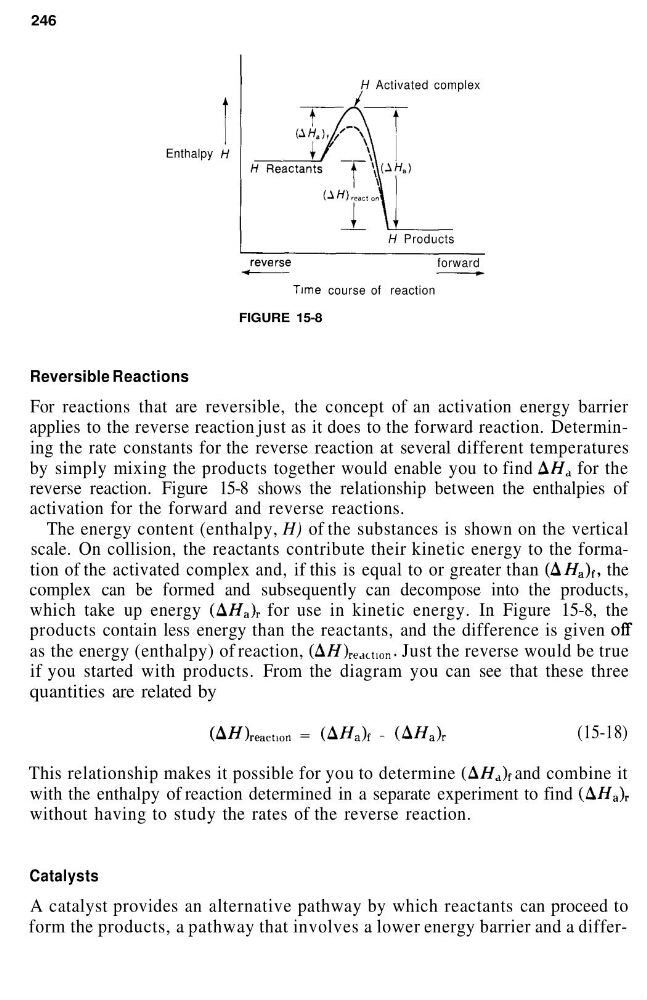
FIGURE 15-8
Reversible Reactions
For reactions that are reversible, the concept of an activation energy barrier
applies to the reverse reaction just as it does to the forward reaction. Determining the rate constants for the reverse reaction at several different temperatures
by simply mixing the products together would enable you to find A// d for the
reverse reaction. Figure 15-8 shows the relationship between the enthalpies of
activation for the forward and reverse reactions.
The energy content (enthalpy, H) of the substances is shown on the vertical
scale. On collision, the reactants contribute their kinetic energy to the formation of the activated complex and, if this is equal to or greater than (A// a ) f , the
complex can be formed and subsequently can decompose into the products,
which take up energy (A// a )r for use in kinetic energy. In Figure 15-8, the
products contain less energy than the reactants, and the difference is given off
as the energy (enthalpy) of reaction, (A//) redt tion- Just the reverse would be true
if you started with products. From the diagram you can see that these three
quantities are related by
(A//) re
= (A// a ) f - (A// a ) r
(15-18)
This relationship makes it possible for you to determine (A// d ) f and combine it
with the enthalpy of reaction determined in a separate experiment to find (A// a ) r
without having to study the rates of the reverse reaction.
Catalysts
A catalyst provides an alternative pathway by which reactants can proceed to
form the products, a pathway that involves a lower energy barrier and a differ-
Enthalpy H
H Activated complex
H Products
^reverse
forward
Time course of reaction
FIGURE 15-8
Reversible Reactions
For reactions that are reversible, the concept of an activation energy barrier
applies to the reverse reaction just as it does to the forward reaction. Determining the rate constants for the reverse reaction at several different temperatures
by simply mixing the products together would enable you to find A// d for the
reverse reaction. Figure 15-8 shows the relationship between the enthalpies of
activation for the forward and reverse reactions.
The energy content (enthalpy, H) of the substances is shown on the vertical
scale. On collision, the reactants contribute their kinetic energy to the formation of the activated complex and, if this is equal to or greater than (A// a ) f , the
complex can be formed and subsequently can decompose into the products,
which take up energy (A// a )r for use in kinetic energy. In Figure 15-8, the
products contain less energy than the reactants, and the difference is given off
as the energy (enthalpy) of reaction, (A//) redt tion- Just the reverse would be true
if you started with products. From the diagram you can see that these three
quantities are related by
(A//) re
= (A// a ) f - (A// a ) r
(15-18)
This relationship makes it possible for you to determine (A// d ) f and combine it
with the enthalpy of reaction determined in a separate experiment to find (A// a ) r
without having to study the rates of the reverse reaction.
Catalysts
A catalyst provides an alternative pathway by which reactants can proceed to
form the products, a pathway that involves a lower energy barrier and a differ-