

Problems A
249
10. Calculate the fraction of CH 4 molecules having kinetic energies greater than
13.0 kcal/mole at each of the following temperatures.
(a) 200 K
(d) 500 K
(b) 300 K
(e) 1000 K
(c) 400 K
11. How much faster will a reaction be at 50.0°C than at 20.0°C, when its activation energy is 15.0 kcal?
12. Two reactants for a given reaction are M and N.
(a) If, for a given initial concentration of M, a five-fold increase in the concentration of N causes a 25-fold increase in the initial rate of reaction, what
can be said about the order with respect to N?
(b) If M is not only a reactant but also the solvent, what is the probable order
with respect to M in the experimentally determined rate expression?
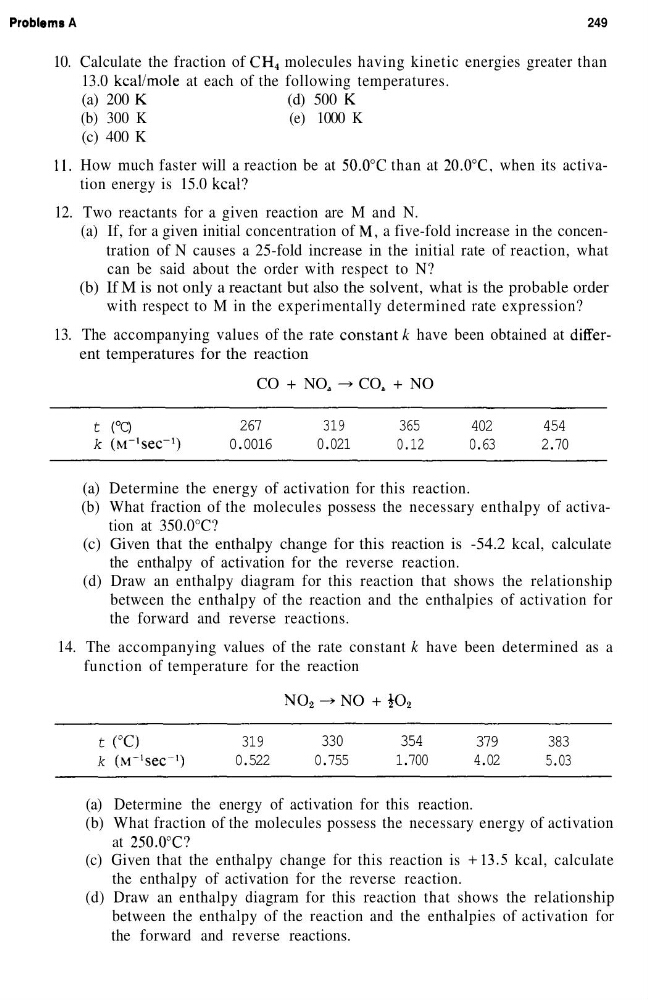
13. The accompanying values of the rate constant/: have been obtained at different temperatures for the reaction
CO + NO, -> CO, + NO
t (°C)
k (M-'sec1
)
267
0.0016
319
0.021
365
0.12
402
0.63
454
2.70
(a) Determine the energy of activation for this reaction.
(b) What fraction of the molecules possess the necessary enthalpy of activation at 350.0°C?
(c) Given that the enthalpy change for this reaction is -54.2 kcal, calculate
the enthalpy of activation for the reverse reaction.
(d) Draw an enthalpy diagram for this reaction that shows the relationship
between the enthalpy of the reaction and the enthalpies of activation for
the forward and reverse reactions.
14. The accompanying values of the rate constant k have been determined as a
function of temperature for the reaction
NO 2 -> NO + iO 2
t (°C)
k (M-'sec1
)
319
0.522
330
0.755
354
1.700
379
4.02
383
5.03
(a) Determine the energy of activation for this reaction.
(b) What fraction of the molecules possess the necessary energy of activation
at 250.0°C?
(c) Given that the enthalpy change for this reaction is +13.5 kcal, calculate
the enthalpy of activation for the reverse reaction.
(d) Draw an enthalpy diagram for this reaction that shows the relationship
between the enthalpy of the reaction and the enthalpies of activation for
the forward and reverse reactions.
249
10. Calculate the fraction of CH 4 molecules having kinetic energies greater than
13.0 kcal/mole at each of the following temperatures.
(a) 200 K
(d) 500 K
(b) 300 K
(e) 1000 K
(c) 400 K
11. How much faster will a reaction be at 50.0°C than at 20.0°C, when its activation energy is 15.0 kcal?
12. Two reactants for a given reaction are M and N.
(a) If, for a given initial concentration of M, a five-fold increase in the concentration of N causes a 25-fold increase in the initial rate of reaction, what
can be said about the order with respect to N?
(b) If M is not only a reactant but also the solvent, what is the probable order
with respect to M in the experimentally determined rate expression?
13. The accompanying values of the rate constant/: have been obtained at different temperatures for the reaction
CO + NO, -> CO, + NO
t (°C)
k (M-'sec1
)
267
0.0016
319
0.021
365
0.12
402
0.63
454
2.70
(a) Determine the energy of activation for this reaction.
(b) What fraction of the molecules possess the necessary enthalpy of activation at 350.0°C?
(c) Given that the enthalpy change for this reaction is -54.2 kcal, calculate
the enthalpy of activation for the reverse reaction.
(d) Draw an enthalpy diagram for this reaction that shows the relationship
between the enthalpy of the reaction and the enthalpies of activation for
the forward and reverse reactions.
14. The accompanying values of the rate constant k have been determined as a
function of temperature for the reaction
NO 2 -> NO + iO 2
t (°C)
k (M-'sec1
)
319
0.522
330
0.755
354
1.700
379
4.02
383
5.03
(a) Determine the energy of activation for this reaction.
(b) What fraction of the molecules possess the necessary energy of activation
at 250.0°C?
(c) Given that the enthalpy change for this reaction is +13.5 kcal, calculate
the enthalpy of activation for the reverse reaction.
(d) Draw an enthalpy diagram for this reaction that shows the relationship
between the enthalpy of the reaction and the enthalpies of activation for
the forward and reverse reactions.