

The Energy of Activation
243
The two series agree on the value of k that should be used in the overall rate
expression.
THE ENERGY OF ACTIVATION
Molecular collisions are a fundamental requirement for chemical reactions, and
concentrations are important because they determine the frequency of these
collisions. Nevertheless, most collisions do not result in a chemical reaction,
because the energy of collision is insufficient to surmount the barrier to reaction. This barrier, the energy required to rearrange atoms in going from reactants to products, is very substantial for most reactions; it is called the activation energy, or the enthalpy of activation (A// a ).
The average kinetic energy of molecules is proportional to the Kelvin temperature (~ 37 cal/mole), but there is an enormous continuous exchange of
energy that takes place between molecules at a given temperature. In fact, there
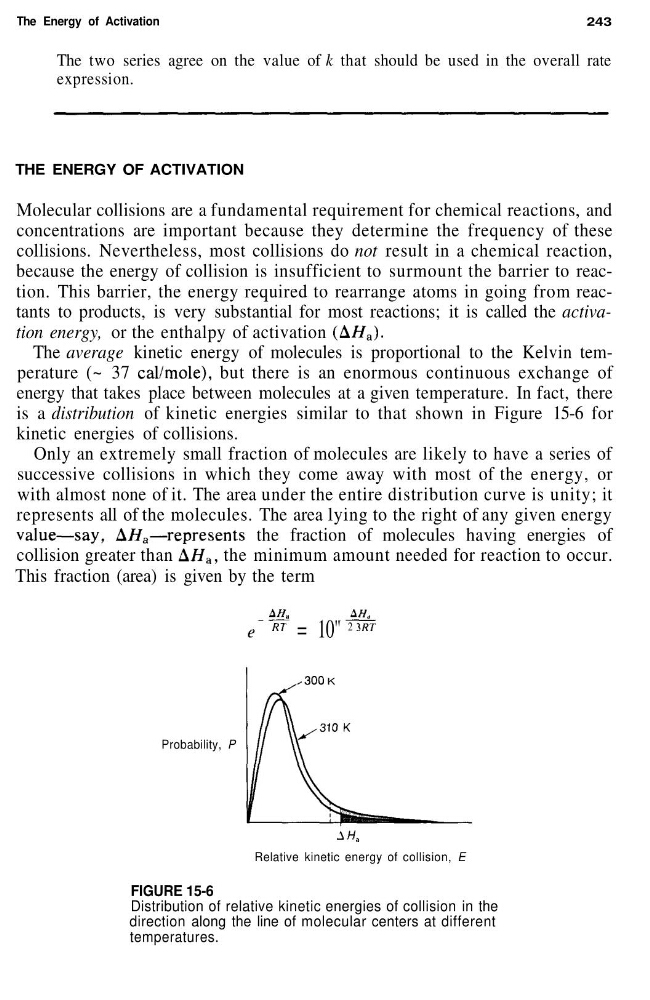
is a distribution of kinetic energies similar to that shown in Figure 15-6 for
kinetic energies of collisions.
Only an extremely small fraction of molecules are likely to have a series of
successive collisions in which they come away with most of the energy, or
with almost none of it. The area under the entire distribution curve is unity; it
represents all of the molecules. The area lying to the right of any given energy
value—say, A// a —represents the fraction of molecules having energies of
collision greater than A// a , the minimum amount needed for reaction to occur.
This fraction (area) is given by the term
A//.
RT = 10"
A//.
2 3RT
,300 K
Probability, P
AH,
Relative kinetic energy of collision, E
FIGURE 15-6
Distribution of relative kinetic energies of collision in the
direction along the line of molecular centers at different
temperatures.
243
The two series agree on the value of k that should be used in the overall rate
expression.
THE ENERGY OF ACTIVATION
Molecular collisions are a fundamental requirement for chemical reactions, and
concentrations are important because they determine the frequency of these
collisions. Nevertheless, most collisions do not result in a chemical reaction,
because the energy of collision is insufficient to surmount the barrier to reaction. This barrier, the energy required to rearrange atoms in going from reactants to products, is very substantial for most reactions; it is called the activation energy, or the enthalpy of activation (A// a ).
The average kinetic energy of molecules is proportional to the Kelvin temperature (~ 37 cal/mole), but there is an enormous continuous exchange of
energy that takes place between molecules at a given temperature. In fact, there
is a distribution of kinetic energies similar to that shown in Figure 15-6 for
kinetic energies of collisions.
Only an extremely small fraction of molecules are likely to have a series of
successive collisions in which they come away with most of the energy, or
with almost none of it. The area under the entire distribution curve is unity; it
represents all of the molecules. The area lying to the right of any given energy
value—say, A// a —represents the fraction of molecules having energies of
collision greater than A// a , the minimum amount needed for reaction to occur.
This fraction (area) is given by the term
A//.
RT = 10"
A//.
2 3RT
,300 K
Probability, P
AH,
Relative kinetic energy of collision, E
FIGURE 15-6
Distribution of relative kinetic energies of collision in the
direction along the line of molecular centers at different
temperatures.