

242
Chemical Kinetics
SOLUTION:
From the total pressure at each time interval, calculate the partial pressures of NO
and O 2 that must remain. From the information in the problem, you can see that in
series (1) P v , = 100 - 2(AP), and in series (2) P 0 , = 20.0 - AP. By using the ideal
gas law, it would be possible to convert these partial pressures to moles/liter, but
this usually is not done with gaseous reactions. Instead we shall simply use the
partial pressures (in torr) as the measure of concentration. Try, in succession, the
first-order, second-order, and third-order plots until a straight-line graph is obtained for each series.
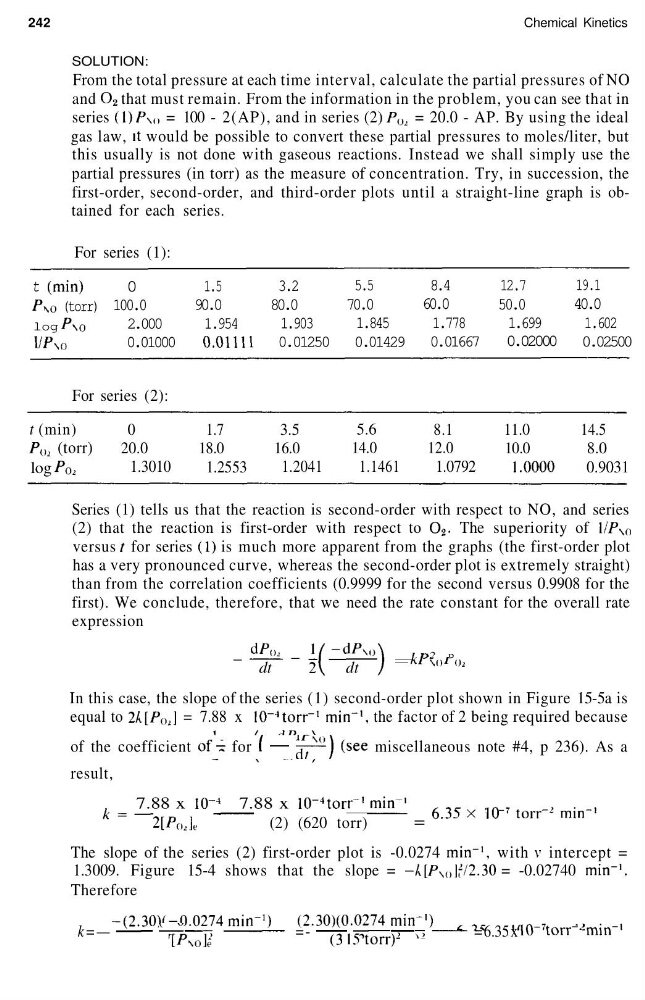
For series (1):
t (min)
PNO (torr)
log P NO
1/Pso
0
100.0
2.000
0.01000
1.5
90.0
1.954
0.01111
3.2
80.0
1.903
0.01250
5.5
70.0
1.845
0.01429
8.4
60.0
1.778
0.01667
12.7
50.0
1.699
0.02000
19.1
40.0
1.602
0.02500
For series (2):
t (min)
P 02 (torr)
log P 02
0
20.0
1.3010
1.7
18.0
1.2553
3.5
16.0
1.2041
5.6
14.0
1.1461
8.1
12.0
1.0792
11.0
10.0
1 .0000
14.5
8.0
0.9031
Series (1) tells us that the reaction is second-order with respect to NO, and series
(2) that the reaction is first-order with respect to O 2 . The superiority of 1/P\ 0
versus / for series (1) is much more apparent from the graphs (the first-order plot
has a very pronounced curve, whereas the second-order plot is extremely straight)
than from the correlation coefficients (0.9999 for the second versus 0.9908 for the
first). We conclude, therefore, that we need the rate constant for the overall rate
expression
/, r> 2 p
— K/\o/()2
dt
2\ dt
In this case, the slope of the series (1) second-order plot shown in Figure 15-5a is
equal to 2A[P<>J = 7.88 x 10~
4 torr"
1 min"
1 , the factor of 2 being required because
of the coefficient of-; for ( — JT^) (
see miscellaneous note #4, p 236). As a
result,
7.88 x 10"
4
7.88 x 10"
4 torr
1 min"
2[P 0 Je - (2) (620 torr)
, ,. in
=
6 '
35 X 10
The slope of the series (2) first-order plot is -0.0274 min"
1 , with v intercept =
1.3009. Figure 15-4 shows that the slope = -A.[P M) ]f/2.30 = -0.02740 min"
1 .
Therefore
-(2.30X-0.0274 min"
1 )
(2.30)(0.0274 min"
1 ) ,, ,. in .
, . .
k = — - Vs — n - = - - TTTTI — r; - = 6.35 x 10"
7 ton— ' mm"
1
[PsoJe
(3 15 torr)
2
Chemical Kinetics
SOLUTION:
From the total pressure at each time interval, calculate the partial pressures of NO
and O 2 that must remain. From the information in the problem, you can see that in
series (1) P v , = 100 - 2(AP), and in series (2) P 0 , = 20.0 - AP. By using the ideal
gas law, it would be possible to convert these partial pressures to moles/liter, but
this usually is not done with gaseous reactions. Instead we shall simply use the
partial pressures (in torr) as the measure of concentration. Try, in succession, the
first-order, second-order, and third-order plots until a straight-line graph is obtained for each series.
For series (1):
t (min)
PNO (torr)
log P NO
1/Pso
0
100.0
2.000
0.01000
1.5
90.0
1.954
0.01111
3.2
80.0
1.903
0.01250
5.5
70.0
1.845
0.01429
8.4
60.0
1.778
0.01667
12.7
50.0
1.699
0.02000
19.1
40.0
1.602
0.02500
For series (2):
t (min)
P 02 (torr)
log P 02
0
20.0
1.3010
1.7
18.0
1.2553
3.5
16.0
1.2041
5.6
14.0
1.1461
8.1
12.0
1.0792
11.0
10.0
1 .0000
14.5
8.0
0.9031
Series (1) tells us that the reaction is second-order with respect to NO, and series
(2) that the reaction is first-order with respect to O 2 . The superiority of 1/P\ 0
versus / for series (1) is much more apparent from the graphs (the first-order plot
has a very pronounced curve, whereas the second-order plot is extremely straight)
than from the correlation coefficients (0.9999 for the second versus 0.9908 for the
first). We conclude, therefore, that we need the rate constant for the overall rate
expression
/, r> 2 p
— K/\o/()2
dt
2\ dt
In this case, the slope of the series (1) second-order plot shown in Figure 15-5a is
equal to 2A[P<>J = 7.88 x 10~
4 torr"
1 min"
1 , the factor of 2 being required because
of the coefficient of-; for ( — JT^) (
see miscellaneous note #4, p 236). As a
result,
7.88 x 10"
4
7.88 x 10"
4 torr
1 min"
2[P 0 Je - (2) (620 torr)
, ,. in
=
6 '
35 X 10
The slope of the series (2) first-order plot is -0.0274 min"
1 , with v intercept =
1.3009. Figure 15-4 shows that the slope = -A.[P M) ]f/2.30 = -0.02740 min"
1 .
Therefore
-(2.30X-0.0274 min"
1 )
(2.30)(0.0274 min"
1 ) ,, ,. in .
, . .
k = — - Vs — n - = - - TTTTI — r; - = 6.35 x 10"
7 ton— ' mm"
1
[PsoJe
(3 15 torr)
2