

Illustrative Problems
241
PV
(730 - 18 torr)(V liters)
RT
"o a = 7^ = 7
rrr^TT
= 0.0389V moles 0 2
62.4
—T (293 K)
mole K /
The number of moles of H 2 O 2 remaining at each time interval will be
moles H 2 O 2 remaining = (0.01250 mole H 2 O 2 ) - (2
molg
s H*
O2
Vo.0389V moles O 2 )
\
mole O 2 /
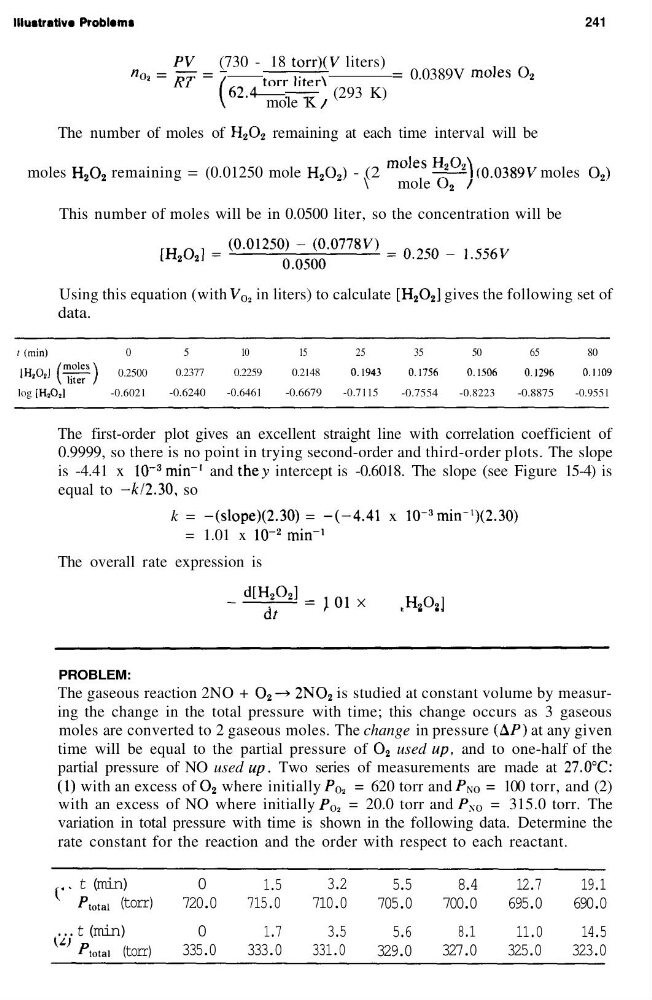
This number of moles will be in 0.0500 liter, so the concentration will be
Using this equation (with V 0z in liters) to calculate [H 2 O 2 ] gives the following set of
data.
t (min)
*™ (*£)
log [H202]
0
0.2500
-0.6021
5
0.2377
-0.6240
10
0.2259
-0.6461
15
0.2148
-0.6679
25
0. 1943
-0.7115
35
0.1756
-0.7554
50
0. 1506
-0.8223
65
0.1296
-0.8875
80
0.1109
-0.9551
The first-order plot gives an excellent straight line with correlation coefficient of
0.9999, so there is no point in trying second-order and third-order plots. The slope
is -4.41 x 10~
3 min"
1 and they intercept is -0.6018. The slope (see Figure 15-4) is
equal to -fc/2.30, so
k = -(slope)(2.30) = -(-4.41 x 10~
3 min1 )(2.30)
= 1.01 x ID"
2 min1
The overall rate expression is
0j] = i m x
H
dt
'
PROBLEM:
The gaseous reaction 2NO + O 2 —» 2NO 2 is studied at constant volume by measuring the change in the total pressure with time; this change occurs as 3 gaseous
moles are converted to 2 gaseous moles. The change in pressure (A.P) at any given
time will be equal to the partial pressure of O 2 used up, and to one-half of the
partial pressure of NO used up. Two series of measurements are made at 27.0°C:
(1) with an excess of O 2 where initially P 0 , = 620 torr and P N o = 100 torr, and (2)
with an excess of NO where initially P 0l = 20.0 torr and P xo = 315.0 torr. The
variation in total pressure with time is shown in the following data. Determine the
rate constant for the reaction and the order with respect to each reactant.
, t (min)
1
P total (torr)
... t (min)
ft.tai (torr)
0
720.0
0
335.0
1.5
715.0
1.7
333.0
3.2
710.0
3.5
331.0
5.5
705.0
5.6
329.0
8.4
700.0
8.1
327.0
12.7
695.0
11.0
325.0
19.1
690.0
14.5
323.0
241
PV
(730 - 18 torr)(V liters)
RT
"o a = 7^ = 7
rrr^TT
= 0.0389V moles 0 2
62.4
—T (293 K)
mole K /
The number of moles of H 2 O 2 remaining at each time interval will be
moles H 2 O 2 remaining = (0.01250 mole H 2 O 2 ) - (2
molg
s H*
O2
Vo.0389V moles O 2 )
\
mole O 2 /
This number of moles will be in 0.0500 liter, so the concentration will be
Using this equation (with V 0z in liters) to calculate [H 2 O 2 ] gives the following set of
data.
t (min)
*™ (*£)
log [H202]
0
0.2500
-0.6021
5
0.2377
-0.6240
10
0.2259
-0.6461
15
0.2148
-0.6679
25
0. 1943
-0.7115
35
0.1756
-0.7554
50
0. 1506
-0.8223
65
0.1296
-0.8875
80
0.1109
-0.9551
The first-order plot gives an excellent straight line with correlation coefficient of
0.9999, so there is no point in trying second-order and third-order plots. The slope
is -4.41 x 10~
3 min"
1 and they intercept is -0.6018. The slope (see Figure 15-4) is
equal to -fc/2.30, so
k = -(slope)(2.30) = -(-4.41 x 10~
3 min1 )(2.30)
= 1.01 x ID"
2 min1
The overall rate expression is
0j] = i m x
H
dt
'
PROBLEM:
The gaseous reaction 2NO + O 2 —» 2NO 2 is studied at constant volume by measuring the change in the total pressure with time; this change occurs as 3 gaseous
moles are converted to 2 gaseous moles. The change in pressure (A.P) at any given
time will be equal to the partial pressure of O 2 used up, and to one-half of the
partial pressure of NO used up. Two series of measurements are made at 27.0°C:
(1) with an excess of O 2 where initially P 0 , = 620 torr and P N o = 100 torr, and (2)
with an excess of NO where initially P 0l = 20.0 torr and P xo = 315.0 torr. The
variation in total pressure with time is shown in the following data. Determine the
rate constant for the reaction and the order with respect to each reactant.
, t (min)
1
P total (torr)
... t (min)
ft.tai (torr)
0
720.0
0
335.0
1.5
715.0
1.7
333.0
3.2
710.0
3.5
331.0
5.5
705.0
5.6
329.0
8.4
700.0
8.1
327.0
12.7
695.0
11.0
325.0
19.1
690.0
14.5
323.0