

240
Chemical Kinetics
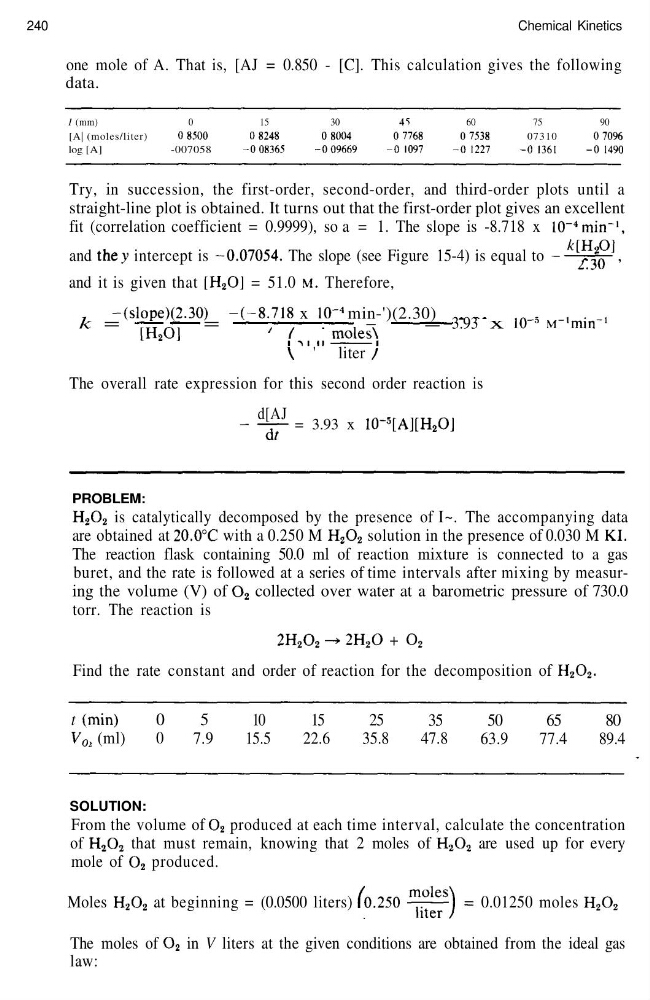
one mole of A. That is, [AJ = 0.850 - [C]. This calculation gives the following
data.
I (mm)
0
15
30
45
60
75
90
[A| (moles/liter)
08500
08248
08004
07768
07538
07310
07096
log [A]
-007058
-008365
-009669
-01097
-01227
-01361
-01490
Try, in succession, the first-order, second-order, and third-order plots until a
straight-line plot is obtained. It turns out that the first-order plot gives an excellent
fit (correlation coefficient = 0.9999), so a = 1. The slope is -8.718 x 10~
4 mirr
1 ,
*
and they intercept is -0.07054. The slope (see Figure 15-4) is equal to
and it is given that [H 2 O] = 51.0 M. Therefore,
-(slope)(2.30) -(-8.718 x 10'" min-')(2.30) . „
k = - - = - ; - : — - - = 3.93 x
[H 2 O]
/
moles\
V ' liter /
The overall rate expression for this second order reaction is
d[AJ
.
dt
= 3.93 x 10⁵ [A][H 2 OJ
PROBLEM:
H 2 O 2 is catalytically decomposed by the presence of I~. The accompanying data
are obtained at 20.0°C with a 0.250 M H 2 O 2 solution in the presence of 0.030 M KI.
The reaction flask containing 50.0 ml of reaction mixture is connected to a gas
buret, and the rate is followed at a series of time intervals after mixing by measuring the volume (V) of O 2 collected over water at a barometric pressure of 730.0
torr. The reaction is
2H 2 O 2 -» 2H 2 O + O 2
Find the rate constant and order of reaction for the decomposition of H 2 O 2 .
t (min)
V 02 (ml)
0
0
5
7.9
10
15.5
15
22.6
25
35.8
35
47.8
50
63.9
65
77.4
80
89.4
SOLUTION:
From the volume of O 2 produced at each time interval, calculate the concentration
of H 2 O 2 that must remain, knowing that 2 moles of H 2 O 2 are used up for every
mole of O 2 produced.
Moles H 2 O 2 at beginning = (0.0500 liters) ( 0.250 ?^1\ = 0.01250 moles H 2 O 2
The moles of O 2 in V liters at the given conditions are obtained from the ideal gas
law:
Chemical Kinetics
one mole of A. That is, [AJ = 0.850 - [C]. This calculation gives the following
data.
I (mm)
0
15
30
45
60
75
90
[A| (moles/liter)
08500
08248
08004
07768
07538
07310
07096
log [A]
-007058
-008365
-009669
-01097
-01227
-01361
-01490
Try, in succession, the first-order, second-order, and third-order plots until a
straight-line plot is obtained. It turns out that the first-order plot gives an excellent
fit (correlation coefficient = 0.9999), so a = 1. The slope is -8.718 x 10~
4 mirr
1 ,
*
and they intercept is -0.07054. The slope (see Figure 15-4) is equal to
and it is given that [H 2 O] = 51.0 M. Therefore,
-(slope)(2.30) -(-8.718 x 10'" min-')(2.30) . „
k = - - = - ; - : — - - = 3.93 x
[H 2 O]
/
moles\
V ' liter /
The overall rate expression for this second order reaction is
d[AJ
.
dt
= 3.93 x 10⁵ [A][H 2 OJ
PROBLEM:
H 2 O 2 is catalytically decomposed by the presence of I~. The accompanying data
are obtained at 20.0°C with a 0.250 M H 2 O 2 solution in the presence of 0.030 M KI.
The reaction flask containing 50.0 ml of reaction mixture is connected to a gas
buret, and the rate is followed at a series of time intervals after mixing by measuring the volume (V) of O 2 collected over water at a barometric pressure of 730.0
torr. The reaction is
2H 2 O 2 -» 2H 2 O + O 2
Find the rate constant and order of reaction for the decomposition of H 2 O 2 .
t (min)
V 02 (ml)
0
0
5
7.9
10
15.5
15
22.6
25
35.8
35
47.8
50
63.9
65
77.4
80
89.4
SOLUTION:
From the volume of O 2 produced at each time interval, calculate the concentration
of H 2 O 2 that must remain, knowing that 2 moles of H 2 O 2 are used up for every
mole of O 2 produced.
Moles H 2 O 2 at beginning = (0.0500 liters) ( 0.250 ?^1\ = 0.01250 moles H 2 O 2
The moles of O 2 in V liters at the given conditions are obtained from the ideal gas
law: