

239
' (mm)
0
10
31
67
100
133
178
|A| (moles'liter)
2.1 I ' 10-''
1.98 x II) '
1.76 x 10 "'
I 33 < 10 '
1 16 x 10 "'
09% - II)-''
0.743 x 10-'
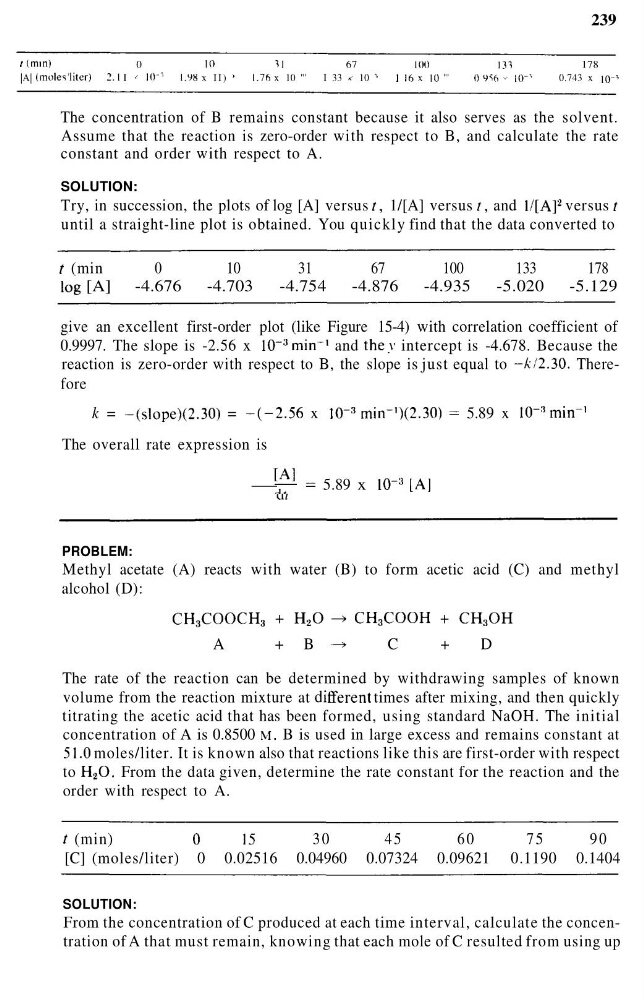
The concentration of B remains constant because it also serves as the solvent.
Assume that the reaction is zero-order with respect to B, and calculate the rate
constant and order with respect to A.
SOLUTION:
Try, in succession, the plots of log [A] versus /, 1/[A] versus t, and 1/[A]
2 versus /
until a straight-line plot is obtained. You quickly find that the data converted to
/ (min
0
10
31
67
100
133
178
log [A] -4.676
-4.703
-4.754
-4.876
-4.935
-5.020
-5.129
give an excellent first-order plot (like Figure 15-4) with correlation coefficient of
0.9997. The slope is -2.56 x 10~
3 min~' and they intercept is -4.678. Because the
reaction is zero-order with respect to B, the slope is just equal to -A:/2.30. Therefore
k = -(slope)(2.30) = -(-2.56 x 10~
3 min-')(2.30) = 5.89 x \Q~* miir
1
The overall rate expression is
j^ = 5.89 x 10~
3 [A]
PROBLEM:
Methyl acetate (A) reacts with water (B) to form acetic acid (C) and methyl
alcohol (D):
CH 3 COOCH 3 + H 2 0 -H> CH 3 COOH + CH 3 OH
A
+ B ->
C
+
D
The rate of the reaction can be determined by withdrawing samples of known
volume from the reaction mixture at different times after mixing, and then quickly
titrating the acetic acid that has been formed, using standard NaOH. The initial
concentration of A is 0.8500 M. B is used in large excess and remains constant at
51.0 moles/liter. It is known also that reactions like this are first-order with respect
to H 2 O. From the data given, determine the rate constant for the reaction and the
order with respect to A.
/ (min)
015
30
45
60
75
90
[C] (moles/liter) 0 0.02516 0.04960 0.07324 0.09621 0.1190 0.1404
SOLUTION:
From the concentration of C produced at each time interval, calculate the concentration of A that must remain, knowing that each mole of C resulted from using up
' (mm)
0
10
31
67
100
133
178
|A| (moles'liter)
2.1 I ' 10-''
1.98 x II) '
1.76 x 10 "'
I 33 < 10 '
1 16 x 10 "'
09% - II)-''
0.743 x 10-'
The concentration of B remains constant because it also serves as the solvent.
Assume that the reaction is zero-order with respect to B, and calculate the rate
constant and order with respect to A.
SOLUTION:
Try, in succession, the plots of log [A] versus /, 1/[A] versus t, and 1/[A]
2 versus /
until a straight-line plot is obtained. You quickly find that the data converted to
/ (min
0
10
31
67
100
133
178
log [A] -4.676
-4.703
-4.754
-4.876
-4.935
-5.020
-5.129
give an excellent first-order plot (like Figure 15-4) with correlation coefficient of
0.9997. The slope is -2.56 x 10~
3 min~' and they intercept is -4.678. Because the
reaction is zero-order with respect to B, the slope is just equal to -A:/2.30. Therefore
k = -(slope)(2.30) = -(-2.56 x 10~
3 min-')(2.30) = 5.89 x \Q~* miir
1
The overall rate expression is
j^ = 5.89 x 10~
3 [A]
PROBLEM:
Methyl acetate (A) reacts with water (B) to form acetic acid (C) and methyl
alcohol (D):
CH 3 COOCH 3 + H 2 0 -H> CH 3 COOH + CH 3 OH
A
+ B ->
C
+
D
The rate of the reaction can be determined by withdrawing samples of known
volume from the reaction mixture at different times after mixing, and then quickly
titrating the acetic acid that has been formed, using standard NaOH. The initial
concentration of A is 0.8500 M. B is used in large excess and remains constant at
51.0 moles/liter. It is known also that reactions like this are first-order with respect
to H 2 O. From the data given, determine the rate constant for the reaction and the
order with respect to A.
/ (min)
015
30
45
60
75
90
[C] (moles/liter) 0 0.02516 0.04960 0.07324 0.09621 0.1190 0.1404
SOLUTION:
From the concentration of C produced at each time interval, calculate the concentration of A that must remain, knowing that each mole of C resulted from using up