

238
Chemical Kinetics
SOLUTION:
You know that radioactive decay is first-order, so it is necessary only to find the
rate constant for decay, from which the half-life may be calculated by means of
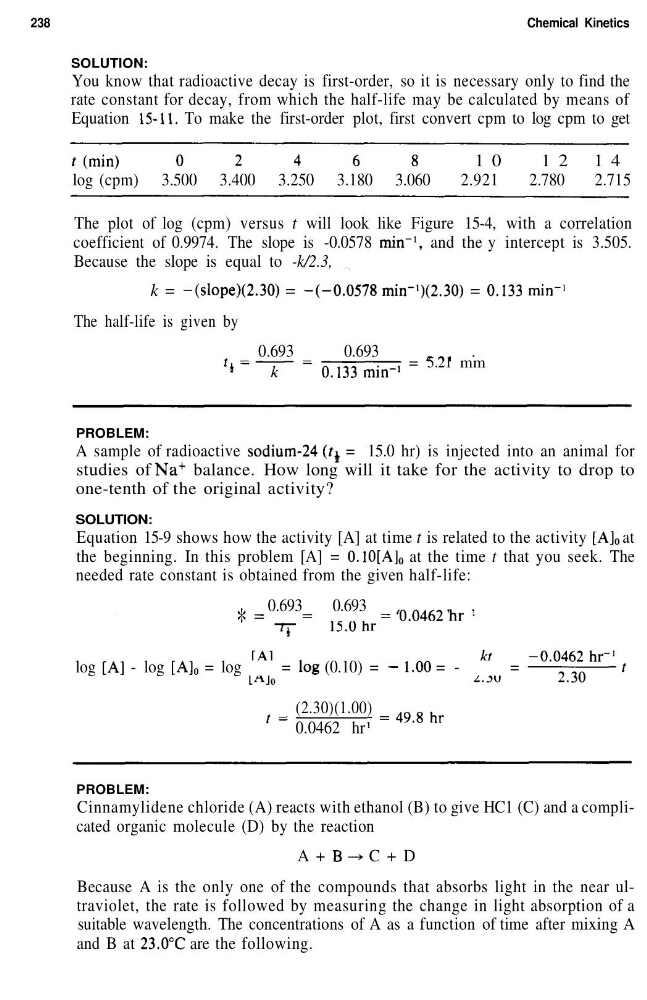
Equation 15-11. To make the first-order plot, first convert cpm to log cpm to get
/ (min)
0
2
4
6
8
10
12 14
log (cpm) 3.500 3.400 3.250 3.180 3.060
2.921
2.780
2.715
The plot of log (cpm) versus t will look like Figure 15-4, with a correlation
coefficient of 0.9974. The slope is -0.0578 min~', and the y intercept is 3.505.
Because the slope is equal to -k/2.3,
k = -(slope)(2.30) = -(-0.0578 min-')(2.30) = 0.133 min'
1
The half-life is given by
0.693
0.693
—
0.133mm-'
c „, .
= 5.21 mm
PROBLEM:
A sample of radioactive sodium-24 (t± = 15.0 hr) is injected into an animal for
studies of Na
+ balance. How long will it take for the activity to drop to
one-tenth of the original activity?
SOLUTION:
Equation 15-9 shows how the activity [A] at time t is related to the activity [AJ 0 at
the beginning. In this problem [A] = 0.10[A] 0 at the time t that you seek. The
needed rate constant is obtained from the given half-life:
0.693
0.693
„ „„,„ . ,
* = — =
= °0462 hr
log [A] - log [A]. = log
= log (0.10) = - 1.00 = -
=
(2.30)(1.00)
0.0462 hr
=
PROBLEM:
Cinnamylidene chloride (A) reacts with ethanol (B) to give HC1 (C) and a complicated organic molecule (D) by the reaction
A + B-» C + D
Because A is the only one of the compounds that absorbs light in the near ultraviolet, the rate is followed by measuring the change in light absorption of a
suitable wavelength. The concentrations of A as a function of time after mixing A
and B at 23.0°C are the following.
Chemical Kinetics
SOLUTION:
You know that radioactive decay is first-order, so it is necessary only to find the
rate constant for decay, from which the half-life may be calculated by means of
Equation 15-11. To make the first-order plot, first convert cpm to log cpm to get
/ (min)
0
2
4
6
8
10
12 14
log (cpm) 3.500 3.400 3.250 3.180 3.060
2.921
2.780
2.715
The plot of log (cpm) versus t will look like Figure 15-4, with a correlation
coefficient of 0.9974. The slope is -0.0578 min~', and the y intercept is 3.505.
Because the slope is equal to -k/2.3,
k = -(slope)(2.30) = -(-0.0578 min-')(2.30) = 0.133 min'
1
The half-life is given by
0.693
0.693
—
0.133mm-'
c „, .
= 5.21 mm
PROBLEM:
A sample of radioactive sodium-24 (t± = 15.0 hr) is injected into an animal for
studies of Na
+ balance. How long will it take for the activity to drop to
one-tenth of the original activity?
SOLUTION:
Equation 15-9 shows how the activity [A] at time t is related to the activity [AJ 0 at
the beginning. In this problem [A] = 0.10[A] 0 at the time t that you seek. The
needed rate constant is obtained from the given half-life:
0.693
0.693
„ „„,„ . ,
* = — =
= °0462 hr
log [A] - log [A]. = log
= log (0.10) = - 1.00 = -
=
(2.30)(1.00)
0.0462 hr
=
PROBLEM:
Cinnamylidene chloride (A) reacts with ethanol (B) to give HC1 (C) and a complicated organic molecule (D) by the reaction
A + B-» C + D
Because A is the only one of the compounds that absorbs light in the near ultraviolet, the rate is followed by measuring the change in light absorption of a
suitable wavelength. The concentrations of A as a function of time after mixing A
and B at 23.0°C are the following.