

Important Miscellaneous Comments
237
5. In the foregoing discussion, we have used the basic assumption that chemical reactions go to completion, or until at least one reactant is completely
used up — that they are not reversible. Many reactions do go to completion, or so
nearly so as to make no difference. But a huge number of reactions are reversible, and to such an extent that the products form and accumulate and then react
with each other to re-form the reactants. The reaction ultimately goes to a
position of dynamic equilibrium far from completion where the rate of the
forward reaction is the same as the rate of the reverse reaction, and the reaction
appears to have ceased. Under these conditions the experimenter observes the
net rate of reaction, which is simply the difference between the rates of the
forward and reverse reactions:
(15-15)
[M] and [N] can be expressed in terms of [A] through Equation 15-1, and
simpler expressions for use with rate studies can be derived (just as Equations
15-9 and 15-14 were derived from Equation 15-2) for the purpose of finding the
values of both the forward and reverse rate constants, k f and/c r . Such reactions
can also be studied by mixing only products together, as well as by mixing only
reactants together. Later we examine in some detail the situation that exists at
dynamic equilibrium.
ILLUSTRATIVE PROBLEMS
There is no end to the variety of problems that can be found in the area of
chemical kinetics. The few given here are fairly typical. To save space, actual
plots are not given; we refer to Figure 15-4 or 15-5 for the type of curve that
would be obtained. In each case the data are converted to the form needed in
the plots, so that you can graph them if you wish. Slopes andy intercepts of the
best-fit lines have been obtained by the method of least squares (see p 72).
PROBLEM:
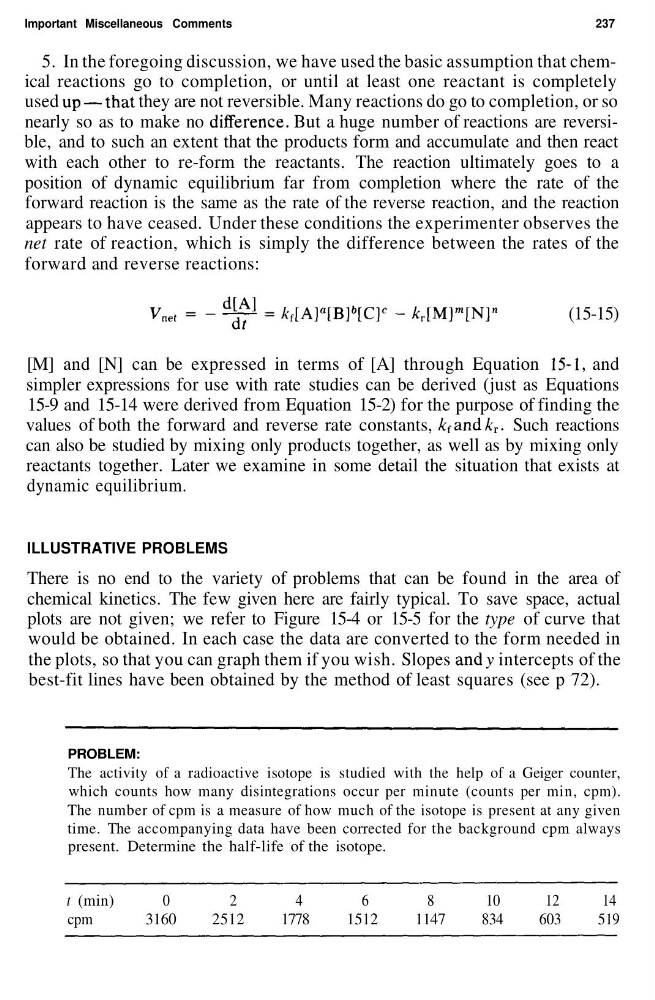
The activity of a radioactive isotope is studied with the help of a Geiger counter,
which counts how many disintegrations occur per minute (counts per min, cpm).
The number of cpm is a measure of how much of the isotope is present at any given
time. The accompanying data have been corrected for the background cpm always
present. Determine the half-life of the isotope.
t (min)
0
2
4
6
8
10
12
14
cpm
3160
2512
1778
1512
1147
834
603
519
237
5. In the foregoing discussion, we have used the basic assumption that chemical reactions go to completion, or until at least one reactant is completely
used up — that they are not reversible. Many reactions do go to completion, or so
nearly so as to make no difference. But a huge number of reactions are reversible, and to such an extent that the products form and accumulate and then react
with each other to re-form the reactants. The reaction ultimately goes to a
position of dynamic equilibrium far from completion where the rate of the
forward reaction is the same as the rate of the reverse reaction, and the reaction
appears to have ceased. Under these conditions the experimenter observes the
net rate of reaction, which is simply the difference between the rates of the
forward and reverse reactions:
(15-15)
[M] and [N] can be expressed in terms of [A] through Equation 15-1, and
simpler expressions for use with rate studies can be derived (just as Equations
15-9 and 15-14 were derived from Equation 15-2) for the purpose of finding the
values of both the forward and reverse rate constants, k f and/c r . Such reactions
can also be studied by mixing only products together, as well as by mixing only
reactants together. Later we examine in some detail the situation that exists at
dynamic equilibrium.
ILLUSTRATIVE PROBLEMS
There is no end to the variety of problems that can be found in the area of
chemical kinetics. The few given here are fairly typical. To save space, actual
plots are not given; we refer to Figure 15-4 or 15-5 for the type of curve that
would be obtained. In each case the data are converted to the form needed in
the plots, so that you can graph them if you wish. Slopes andy intercepts of the
best-fit lines have been obtained by the method of least squares (see p 72).
PROBLEM:
The activity of a radioactive isotope is studied with the help of a Geiger counter,
which counts how many disintegrations occur per minute (counts per min, cpm).
The number of cpm is a measure of how much of the isotope is present at any given
time. The accompanying data have been corrected for the background cpm always
present. Determine the half-life of the isotope.
t (min)
0
2
4
6
8
10
12
14
cpm
3160
2512
1778
1512
1147
834
603
519