

244
Chemical Kinetics
For a huge number of reactions, A// a is of the order of 12,800 cal/mole, which
at 25.0°C would correspond to a fraction of only 4 x 10~'°, less than a billionth
of all the molecules. This fraction increases exponentially with the temperature;
an increase of only 10.0°C will double the fraction of molecules with enough
energy to react. The distribution curve will also be shifted to the right to give a
larger area to the right of A// a , as shown in Figure 15-6.
The law of mass action (Equation 15-2) is always stated as applying to a
given temperature, and it appears not to have temperature involved in its
statement. Yet the rates of chemical reaction invariably increase markedly
with increase in temperature. Because concentrations will be negligibly
affected by temperature, the temperature-sensitive factor in the law of mass
action must be the rate constant, A:. As a good approximation, we say that k
is proportional to the fraction of molecules (or collisions) that have the required enthalpy of activation:
k = Ae
A//
RT _
= A-10
A/A.
2 3RT
(15-16)
where A is just a proportionality constant. This equation provides a
method of finding the enthalpy of activation for a given chemical reaction.
By taking the logarithm of each side and rearranging, we get
(15-17)
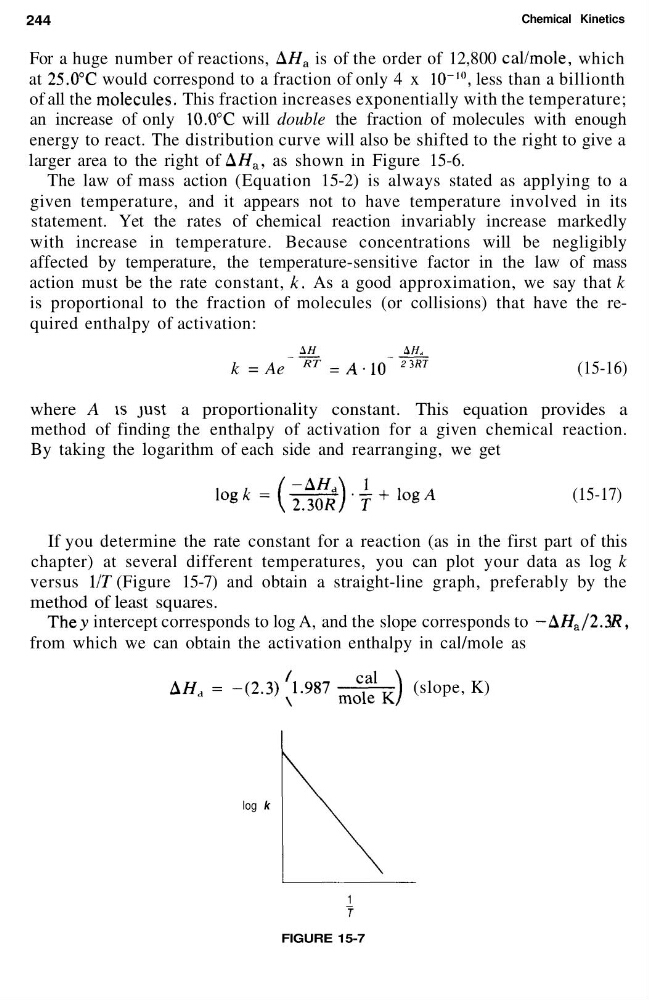
If you determine the rate constant for a reaction (as in the first part of this
chapter) at several different temperatures, you can plot your data as log k
versus l/T (Figure 15-7) and obtain a straight-line graph, preferably by the
method of least squares.
They intercept corresponds to log A, and the slope corresponds to -A// a /2.3/?,
from which we can obtain the activation enthalpy in cal/mole as
A// d = -(2.3) l(slope, K)
log k
FIGURE 15-7
Chemical Kinetics
For a huge number of reactions, A// a is of the order of 12,800 cal/mole, which
at 25.0°C would correspond to a fraction of only 4 x 10~'°, less than a billionth
of all the molecules. This fraction increases exponentially with the temperature;
an increase of only 10.0°C will double the fraction of molecules with enough
energy to react. The distribution curve will also be shifted to the right to give a
larger area to the right of A// a , as shown in Figure 15-6.
The law of mass action (Equation 15-2) is always stated as applying to a
given temperature, and it appears not to have temperature involved in its
statement. Yet the rates of chemical reaction invariably increase markedly
with increase in temperature. Because concentrations will be negligibly
affected by temperature, the temperature-sensitive factor in the law of mass
action must be the rate constant, A:. As a good approximation, we say that k
is proportional to the fraction of molecules (or collisions) that have the required enthalpy of activation:
k = Ae
A//
RT _
= A-10
A/A.
2 3RT
(15-16)
where A is just a proportionality constant. This equation provides a
method of finding the enthalpy of activation for a given chemical reaction.
By taking the logarithm of each side and rearranging, we get
(15-17)
If you determine the rate constant for a reaction (as in the first part of this
chapter) at several different temperatures, you can plot your data as log k
versus l/T (Figure 15-7) and obtain a straight-line graph, preferably by the
method of least squares.
They intercept corresponds to log A, and the slope corresponds to -A// a /2.3/?,
from which we can obtain the activation enthalpy in cal/mole as
A// d = -(2.3) l(slope, K)
log k
FIGURE 15-7