

234
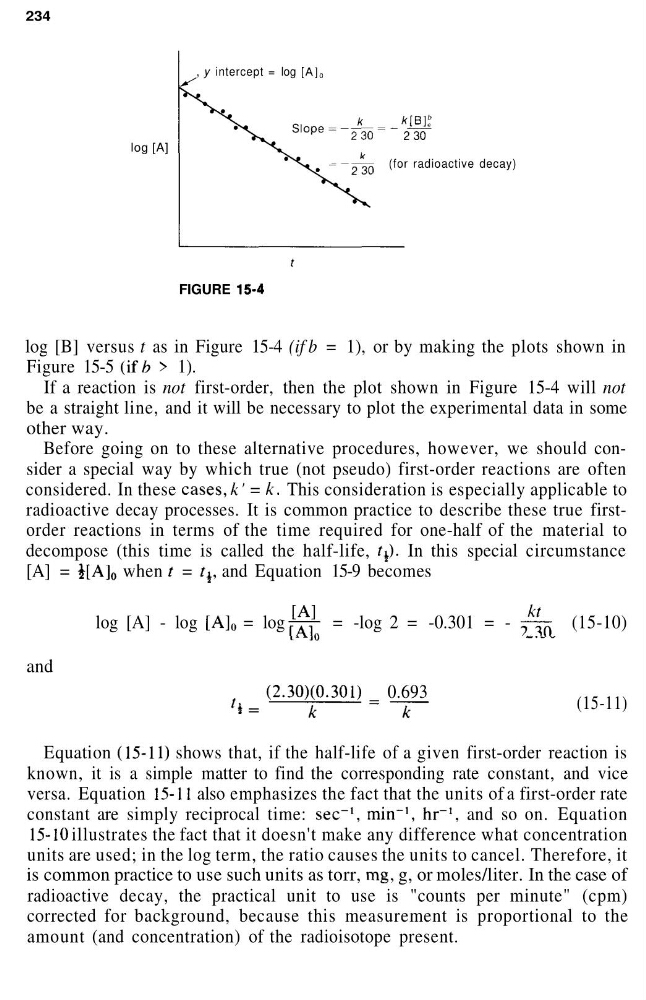
log [A]
, y intercept = log [A]0
230
^——-^r (for radioactive decay)
FIGURE 15-4
log [B] versus t as in Figure 15-4 (if b = 1), or by making the plots shown in
Figure 15-5 (if* > 1).
If a reaction is not first-order, then the plot shown in Figure 15-4 will not
be a straight line, and it will be necessary to plot the experimental data in some
other way.
Before going on to these alternative procedures, however, we should consider a special way by which true (not pseudo) first-order reactions are often
considered. In these cases,k' = k. This consideration is especially applicable to
radioactive decay processes. It is common practice to describe these true firstorder reactions in terms of the time required for one-half of the material to
decompose (this time is called the half-life, ?$). In this special circumstance
[A] = i[A] 0 when / = fj, and Equation 15-9 becomes
log [A] - log [A] 0 = log j^ = -log 2 = -0.301 = - =^ (15-10)
and
'* =
(2.30X0.301) 0.693
(15-11)
Equation (15-11) shows that, if the half-life of a given first-order reaction is
known, it is a simple matter to find the corresponding rate constant, and vice
versa. Equation 15-11 also emphasizes the fact that the units of a first-order rate
constant are simply reciprocal time: sec"
1 , min"
1 , hr"
1 , and so on. Equation
15-10 illustrates the fact that it doesn't make any difference what concentration
units are used; in the log term, the ratio causes the units to cancel. Therefore, it
is common practice to use such units as torr, mg, g, or moles/liter. In the case of
radioactive decay, the practical unit to use is "counts per minute" (cpm)
corrected for background, because this measurement is proportional to the
amount (and concentration) of the radioisotope present.
log [A]
, y intercept = log [A]0
230
^——-^r (for radioactive decay)
FIGURE 15-4
log [B] versus t as in Figure 15-4 (if b = 1), or by making the plots shown in
Figure 15-5 (if* > 1).
If a reaction is not first-order, then the plot shown in Figure 15-4 will not
be a straight line, and it will be necessary to plot the experimental data in some
other way.
Before going on to these alternative procedures, however, we should consider a special way by which true (not pseudo) first-order reactions are often
considered. In these cases,k' = k. This consideration is especially applicable to
radioactive decay processes. It is common practice to describe these true firstorder reactions in terms of the time required for one-half of the material to
decompose (this time is called the half-life, ?$). In this special circumstance
[A] = i[A] 0 when / = fj, and Equation 15-9 becomes
log [A] - log [A] 0 = log j^ = -log 2 = -0.301 = - =^ (15-10)
and
'* =
(2.30X0.301) 0.693
(15-11)
Equation (15-11) shows that, if the half-life of a given first-order reaction is
known, it is a simple matter to find the corresponding rate constant, and vice
versa. Equation 15-11 also emphasizes the fact that the units of a first-order rate
constant are simply reciprocal time: sec"
1 , min"
1 , hr"
1 , and so on. Equation
15-10 illustrates the fact that it doesn't make any difference what concentration
units are used; in the log term, the ratio causes the units to cancel. Therefore, it
is common practice to use such units as torr, mg, g, or moles/liter. In the case of
radioactive decay, the practical unit to use is "counts per minute" (cpm)
corrected for background, because this measurement is proportional to the
amount (and concentration) of the radioisotope present.