

231
[A]
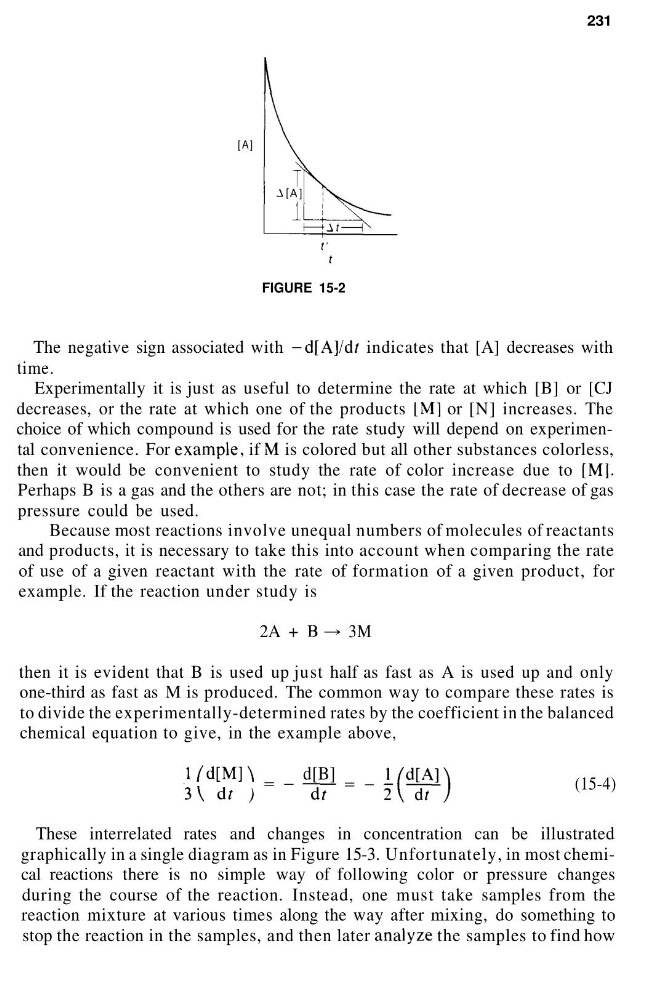
FIGURE 15-2
The negative sign associated with -d[A]/d? indicates that [A] decreases with
time.
Experimentally it is just as useful to determine the rate at which [B] or [CJ
decreases, or the rate at which one of the products [M] or [N] increases. The
choice of which compound is used for the rate study will depend on experimental convenience. For example, if M is colored but all other substances colorless,
then it would be convenient to study the rate of color increase due to [M].
Perhaps B is a gas and the others are not; in this case the rate of decrease of gas
pressure could be used.
Because most reactions involve unequal numbers of molecules of reactants
and products, it is necessary to take this into account when comparing the rate
of use of a given reactant with the rate of formation of a given product, for
example. If the reaction under study is
2A +
3M
then it is evident that B is used up just half as fast as A is used up and only
one-third as fast as M is produced. The common way to compare these rates is
to divide the experimentally-determined rates by the coefficient in the balanced
chemical equation to give, in the example above,
l/d[M]\
3\ dt )
d[B]
dt
K
(15-4)
These interrelated rates and changes in concentration can be illustrated
graphically in a single diagram as in Figure 15-3. Unfortunately, in most chemical reactions there is no simple way of following color or pressure changes
during the course of the reaction. Instead, one must take samples from the
reaction mixture at various times along the way after mixing, do something to
stop the reaction in the samples, and then later analyze the samples to find how
[A]
FIGURE 15-2
The negative sign associated with -d[A]/d? indicates that [A] decreases with
time.
Experimentally it is just as useful to determine the rate at which [B] or [CJ
decreases, or the rate at which one of the products [M] or [N] increases. The
choice of which compound is used for the rate study will depend on experimental convenience. For example, if M is colored but all other substances colorless,
then it would be convenient to study the rate of color increase due to [M].
Perhaps B is a gas and the others are not; in this case the rate of decrease of gas
pressure could be used.
Because most reactions involve unequal numbers of molecules of reactants
and products, it is necessary to take this into account when comparing the rate
of use of a given reactant with the rate of formation of a given product, for
example. If the reaction under study is
2A +
3M
then it is evident that B is used up just half as fast as A is used up and only
one-third as fast as M is produced. The common way to compare these rates is
to divide the experimentally-determined rates by the coefficient in the balanced
chemical equation to give, in the example above,
l/d[M]\
3\ dt )
d[B]
dt
K
(15-4)
These interrelated rates and changes in concentration can be illustrated
graphically in a single diagram as in Figure 15-3. Unfortunately, in most chemical reactions there is no simple way of following color or pressure changes
during the course of the reaction. Instead, one must take samples from the
reaction mixture at various times along the way after mixing, do something to
stop the reaction in the samples, and then later analyze the samples to find how