

Bond Energies (Enthalpies)
219
determine directly. For example, the enthalpy of formation of methyl alcohol
corresponds to the reaction
2H 2(9) + C (s) + |O 2(S) —> CH 3 OH U)
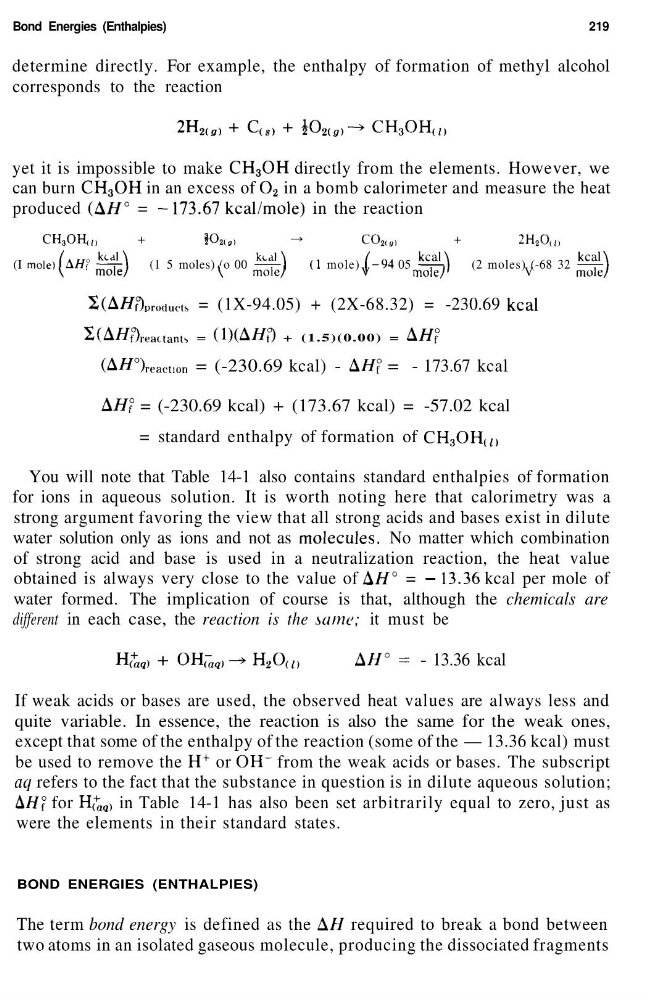
yet it is impossible to make CH 3 OH directly from the elements. However, we
can burn CH 3 OH in an excess of O 2 in a bomb calorimeter and measure the heat
produced (A//° = -173.67 kcal/mole) in the reaction
CH 3 OH ( ,,
+
?0 2(B)
-*
C0 2(B)
+
2H 2 0 (I)
(I mo\e)(bH? ^-}
(1 5 moles) (o 00 ^-}
( 1 mole) f -94 05 ^L)
(2 moles) (-68 32 ^IA
\
mole/
\
mole/
V
mole/
V
mole/
2(A# f °) products = (1X-94.05) + (2X-68.32) = -230.69 kcal
2(A//f°)reaaams = U)(A#f) + (1.5)(0.00) = A/ff°
eacuon = (-230.69 kcal) - A# f ° = - 173.67 kcal
A// f ° = (-230.69 kcal) + (173.67 kcal) = -57.02 kcal
= standard enthalpy of formation of CH 3 OH, , ()
You will note that Table 14-1 also contains standard enthalpies of formation
for ions in aqueous solution. It is worth noting here that calorimetry was a
strong argument favoring the view that all strong acids and bases exist in dilute
water solution only as ions and not as molecules. No matter which combination
of strong acid and base is used in a neutralization reaction, the heat value
obtained is always very close to the value of A//° = — 13.36 kcal per mole of
water formed. The implication of course is that, although the chemicals are
different in each case, the reaction is the same; it must be
H<+ 9) + OHfa,, -» H 2 0 (n
A//° = - 13.36 kcal
If weak acids or bases are used, the observed heat values are always less and
quite variable. In essence, the reaction is also the same for the weak ones,
except that some of the enthalpy of the reaction (some of the — 13.36 kcal) must
be used to remove the H
+ or OH~ from the weak acids or bases. The subscript
aq refers to the fact that the substance in question is in dilute aqueous solution;
A//? for H^,,,, in Table 14-1 has also been set arbitrarily equal to zero, just as
were the elements in their standard states.
BOND ENERGIES (ENTHALPIES)
The term bond energy is defined as the A// required to break a bond between
two atoms in an isolated gaseous molecule, producing the dissociated fragments
219
determine directly. For example, the enthalpy of formation of methyl alcohol
corresponds to the reaction
2H 2(9) + C (s) + |O 2(S) —> CH 3 OH U)
yet it is impossible to make CH 3 OH directly from the elements. However, we
can burn CH 3 OH in an excess of O 2 in a bomb calorimeter and measure the heat
produced (A//° = -173.67 kcal/mole) in the reaction
CH 3 OH ( ,,
+
?0 2(B)
-*
C0 2(B)
+
2H 2 0 (I)
(I mo\e)(bH? ^-}
(1 5 moles) (o 00 ^-}
( 1 mole) f -94 05 ^L)
(2 moles) (-68 32 ^IA
\
mole/
\
mole/
V
mole/
V
mole/
2(A# f °) products = (1X-94.05) + (2X-68.32) = -230.69 kcal
2(A//f°)reaaams = U)(A#f) + (1.5)(0.00) = A/ff°
eacuon = (-230.69 kcal) - A# f ° = - 173.67 kcal
A// f ° = (-230.69 kcal) + (173.67 kcal) = -57.02 kcal
= standard enthalpy of formation of CH 3 OH, , ()
You will note that Table 14-1 also contains standard enthalpies of formation
for ions in aqueous solution. It is worth noting here that calorimetry was a
strong argument favoring the view that all strong acids and bases exist in dilute
water solution only as ions and not as molecules. No matter which combination
of strong acid and base is used in a neutralization reaction, the heat value
obtained is always very close to the value of A//° = — 13.36 kcal per mole of
water formed. The implication of course is that, although the chemicals are
different in each case, the reaction is the same; it must be
H<+ 9) + OHfa,, -» H 2 0 (n
A//° = - 13.36 kcal
If weak acids or bases are used, the observed heat values are always less and
quite variable. In essence, the reaction is also the same for the weak ones,
except that some of the enthalpy of the reaction (some of the — 13.36 kcal) must
be used to remove the H
+ or OH~ from the weak acids or bases. The subscript
aq refers to the fact that the substance in question is in dilute aqueous solution;
A//? for H^,,,, in Table 14-1 has also been set arbitrarily equal to zero, just as
were the elements in their standard states.
BOND ENERGIES (ENTHALPIES)
The term bond energy is defined as the A// required to break a bond between
two atoms in an isolated gaseous molecule, producing the dissociated fragments