

218
Thermochemistry
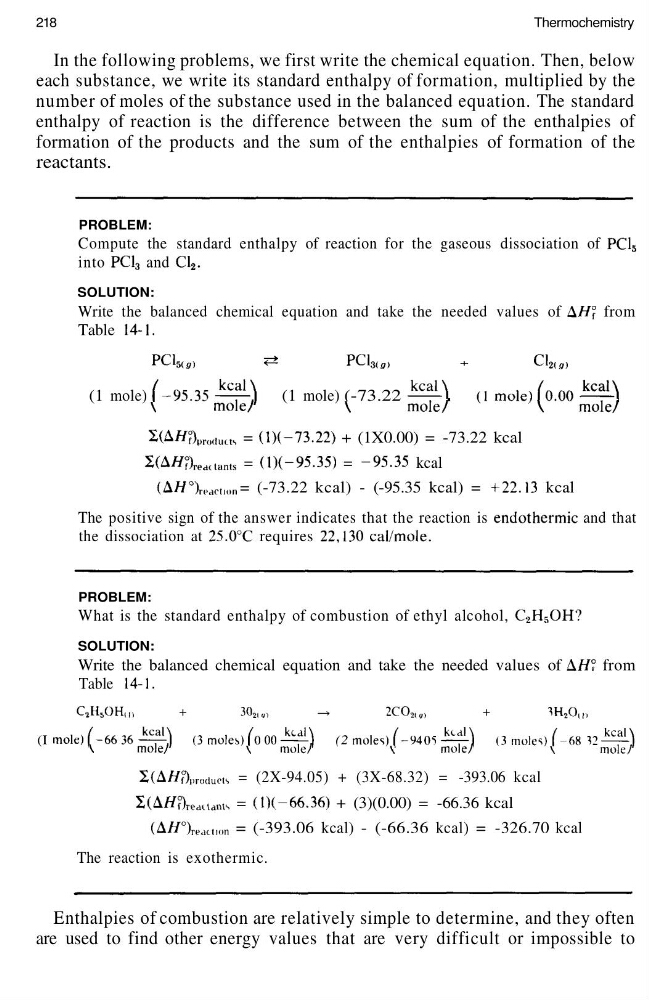
In the following problems, we first write the chemical equation. Then, below
each substance, we write its standard enthalpy of formation, multiplied by the
number of moles of the substance used in the balanced equation. The standard
enthalpy of reaction is the difference between the sum of the enthalpies of
formation of the products and the sum of the enthalpies of formation of the
reactants.
PROBLEM:
Compute the standard enthalpy of reaction for the gaseous dissociation of PC1 5
into PC1 3 and C1 2 .
SOLUTION:
Write the balanced chemical equation and take the needed values of A//? from
Table 14-1.
Pd5(9)
?*
PCl3<0)
+
CI2(9)
(1 mole) (-95.35-^-)
(1 mole) (-73.22
\
mole/
\
(
I
y » . . . i v » ^ y i v . v < u
.
|
mole/
V
mole/
Volets = dX-73.22) + (1X0.00) = -73.22 kcal
auanis = (l)(-95.35) = -95.35 kcal
^H°) r , Mtmn = (-73.22 kcal) - (-95.35 kcal) = +22.13 kcal
The positive sign of the answer indicates that the reaction is endothermic and that
the dissociation at 25.0°C requires 22,130 cal/mole.
PROBLEM:
What is the standard enthalpy of combustion of ethyl alcohol, C 2 H 5 OH?
SOLUTION:
Write the balanced chemical equation and take the needed values of A//° from
Table 14-1.
C 2 H 5 OH,,,
+
30 2IO ,
->
2C0 2(a)
+
1H 2 0,,,
(I mole) (-66 36-^L)
(3 moles) (o 00 —}
(2 moles) (~94 0^ —)
(3 moles) (-68 12 —}
\
mole/
\
mole/
\
mole/
\
mole/
S(A//a, ra iucts = (2X-94.05) + (3X-68.32) = -393.06 kcal
2(A//9re, c .ants = (1)(-66.36) + (3)(0.00) = -66.36 kcal
(A//°) r e.Ki,«m = (-393.06 kcal) - (-66.36 kcal) = -326.70 kcal
The reaction is exothermic.
Enthalpies of combustion are relatively simple to determine, and they often
are used to find other energy values that are very difficult or impossible to
Thermochemistry
In the following problems, we first write the chemical equation. Then, below
each substance, we write its standard enthalpy of formation, multiplied by the
number of moles of the substance used in the balanced equation. The standard
enthalpy of reaction is the difference between the sum of the enthalpies of
formation of the products and the sum of the enthalpies of formation of the
reactants.
PROBLEM:
Compute the standard enthalpy of reaction for the gaseous dissociation of PC1 5
into PC1 3 and C1 2 .
SOLUTION:
Write the balanced chemical equation and take the needed values of A//? from
Table 14-1.
Pd5(9)
?*
PCl3<0)
+
CI2(9)
(1 mole) (-95.35-^-)
(1 mole) (-73.22
\
mole/
\
(
I
y » . . . i v » ^ y i v . v < u
.
|
mole/
V
mole/
Volets = dX-73.22) + (1X0.00) = -73.22 kcal
auanis = (l)(-95.35) = -95.35 kcal
^H°) r , Mtmn = (-73.22 kcal) - (-95.35 kcal) = +22.13 kcal
The positive sign of the answer indicates that the reaction is endothermic and that
the dissociation at 25.0°C requires 22,130 cal/mole.
PROBLEM:
What is the standard enthalpy of combustion of ethyl alcohol, C 2 H 5 OH?
SOLUTION:
Write the balanced chemical equation and take the needed values of A//° from
Table 14-1.
C 2 H 5 OH,,,
+
30 2IO ,
->
2C0 2(a)
+
1H 2 0,,,
(I mole) (-66 36-^L)
(3 moles) (o 00 —}
(2 moles) (~94 0^ —)
(3 moles) (-68 12 —}
\
mole/
\
mole/
\
mole/
\
mole/
S(A//a, ra iucts = (2X-94.05) + (3X-68.32) = -393.06 kcal
2(A//9re, c .ants = (1)(-66.36) + (3)(0.00) = -66.36 kcal
(A//°) r e.Ki,«m = (-393.06 kcal) - (-66.36 kcal) = -326.70 kcal
The reaction is exothermic.
Enthalpies of combustion are relatively simple to determine, and they often
are used to find other energy values that are very difficult or impossible to