

217
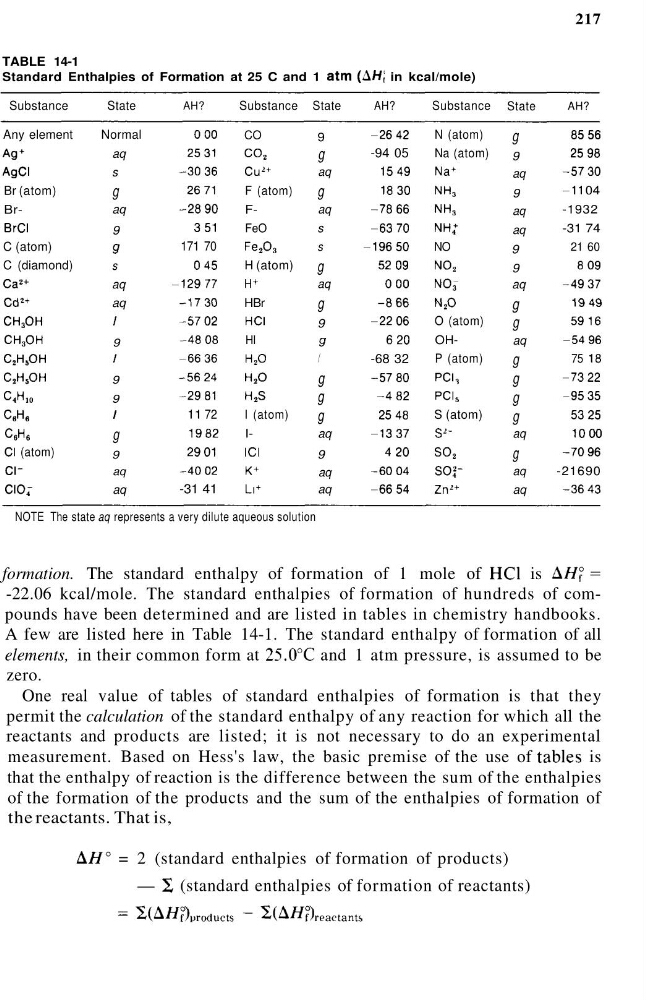
TABLE 14-1
Standard Enthalpies of Formation at 25 C and 1 atm (AH, in kcal/mole)
Substance
Any element
Ag*
AgCI
Br (atom)
BrBrCI
C (atom)
C (diamond)
Ca
2+
Cd"
CH3OH
CH3OH
C2H5OH
C2H5OH
C4H10
C6H6
C,H6
Cl (atom)
cicio 4 -
State
Normal
aq
s
g
aq
9
9
s
aq
aq
1
9
1
9
9
1
g
9
aq
aq
AH?
000
2531
-3036
2671
-2890
351
171 70
045
-12977
-1730
-5702
-4808
-6636
-5624
-2981
11 72
1982
2901
-4002
-31 41
Substance
CO
CO2
Cu"
F (atom)
FFeO
Fe203
H (atom)
H +
HBr
HCI
HI
H2O
H2O
H2S
I (atom)
IICI
K+
Li
+
State
9
g
aq
g
aq
s
s
g
aq
g
9
9
/
g
g
g
aq
9
aq
aq
AH?
-2642
-94 05
1549
1830
-7866
-6370
-19650
5209
000
-866
-2206
620
-68 32
-5780
-482
2548
-1337
420
-6004
-6654
Substance
N (atom)
Na (atom)
Na
+
NH3
NH3
NH4
+
NO
NO2
N03N20
O (atom)
OHP (atom)
PCI,
PCI5
S (atom)
s
2 -
SO2
S0|Zn
2+
State
g
9
aq
9
aq
aq
9
9
aq
g
g
aq
g
g
g
g
aq
g
aq
aq
AH?
8556
2598
-5730
-11 04
-1932
-31 74
21 60
809
-4937
1949
5916
-5496
75 18
-7322
-9535
5325
1000
-7096
-21690
-3643
NOTE The state aq represents a very dilute aqueous solution
formation. The standard enthalpy of formation of 1 mole of HCI is
-22.06 kcal/mole. The standard enthalpies of formation of hundreds of compounds have been determined and are listed in tables in chemistry handbooks.
A few are listed here in Table 14-1. The standard enthalpy of formation of all
elements, in their common form at 25.0°C and 1 atm pressure, is assumed to be
zero.
One real value of tables of standard enthalpies of formation is that they
permit the calculation of the standard enthalpy of any reaction for which all the
reactants and products are listed; it is not necessary to do an experimental
measurement. Based on Hess's law, the basic premise of the use of tables is
that the enthalpy of reaction is the difference between the sum of the enthalpies
of the formation of the products and the sum of the enthalpies of formation of
the reactants. That is,
= 2 (standard enthalpies of formation of products)
— 2 (standard enthalpies of formation of reactants)
TABLE 14-1
Standard Enthalpies of Formation at 25 C and 1 atm (AH, in kcal/mole)
Substance
Any element
Ag*
AgCI
Br (atom)
BrBrCI
C (atom)
C (diamond)
Ca
2+
Cd"
CH3OH
CH3OH
C2H5OH
C2H5OH
C4H10
C6H6
C,H6
Cl (atom)
cicio 4 -
State
Normal
aq
s
g
aq
9
9
s
aq
aq
1
9
1
9
9
1
g
9
aq
aq
AH?
000
2531
-3036
2671
-2890
351
171 70
045
-12977
-1730
-5702
-4808
-6636
-5624
-2981
11 72
1982
2901
-4002
-31 41
Substance
CO
CO2
Cu"
F (atom)
FFeO
Fe203
H (atom)
H +
HBr
HCI
HI
H2O
H2O
H2S
I (atom)
IICI
K+
Li
+
State
9
g
aq
g
aq
s
s
g
aq
g
9
9
/
g
g
g
aq
9
aq
aq
AH?
-2642
-94 05
1549
1830
-7866
-6370
-19650
5209
000
-866
-2206
620
-68 32
-5780
-482
2548
-1337
420
-6004
-6654
Substance
N (atom)
Na (atom)
Na
+
NH3
NH3
NH4
+
NO
NO2
N03N20
O (atom)
OHP (atom)
PCI,
PCI5
S (atom)
s
2 -
SO2
S0|Zn
2+
State
g
9
aq
9
aq
aq
9
9
aq
g
g
aq
g
g
g
g
aq
g
aq
aq
AH?
8556
2598
-5730
-11 04
-1932
-31 74
21 60
809
-4937
1949
5916
-5496
75 18
-7322
-9535
5325
1000
-7096
-21690
-3643
NOTE The state aq represents a very dilute aqueous solution
formation. The standard enthalpy of formation of 1 mole of HCI is
-22.06 kcal/mole. The standard enthalpies of formation of hundreds of compounds have been determined and are listed in tables in chemistry handbooks.
A few are listed here in Table 14-1. The standard enthalpy of formation of all
elements, in their common form at 25.0°C and 1 atm pressure, is assumed to be
zero.
One real value of tables of standard enthalpies of formation is that they
permit the calculation of the standard enthalpy of any reaction for which all the
reactants and products are listed; it is not necessary to do an experimental
measurement. Based on Hess's law, the basic premise of the use of tables is
that the enthalpy of reaction is the difference between the sum of the enthalpies
of the formation of the products and the sum of the enthalpies of formation of
the reactants. That is,
= 2 (standard enthalpies of formation of products)
— 2 (standard enthalpies of formation of reactants)