

216
Thermochemistry
not confined to a fixed volume. We shall avoid these complications here by
saying that A#° refers only to changes occurring at 25°C and at a constant
pressure of I atm; that is, the reactants and the products are in their standard
states .
Also, A// will always be negative for an exothermic reaction, because the
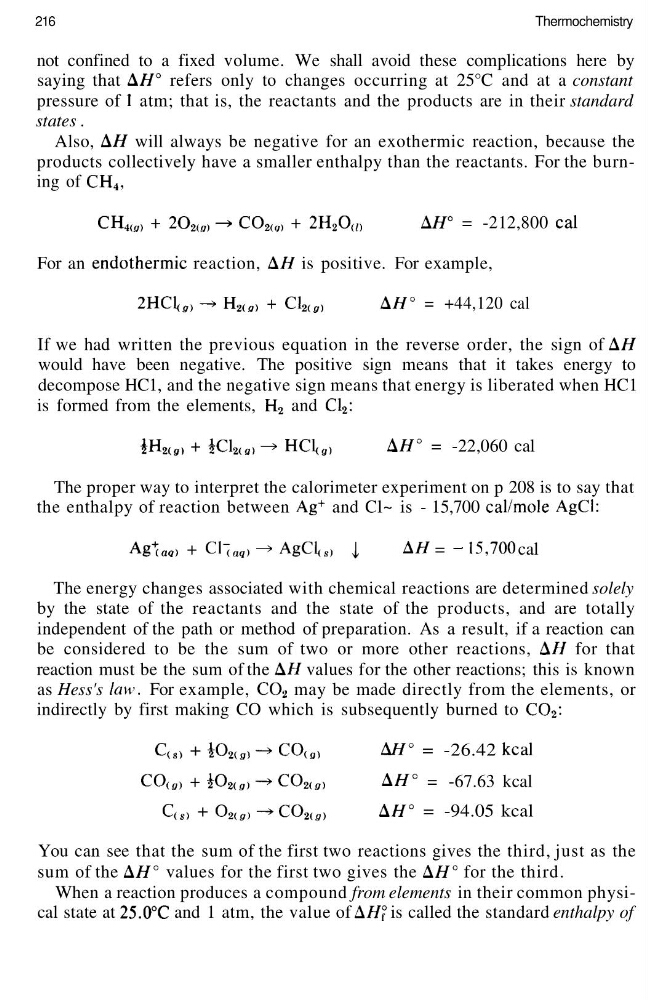
products collectively have a smaller enthalpy than the reactants. For the burning of CH 4 ,
CH 4<9) + 2O 2(9) -» CO 2(9) + 2H 2 O (0
A//° = -212,800 cal
For an endothermic reaction, A// is positive. For example,
-» H 2(9) + Cl 2(fl)
A//° = +44,120 cal
If we had written the previous equation in the reverse order, the sign of A//
would have been negative. The positive sign means that it takes energy to
decompose HC1, and the negative sign means that energy is liberated when HC1
is formed from the elements, H 2 and C1 2 :
iH 2(ff) + iCl 2(9) -»• HC1< 9)
A#° = -22,060 cal
The proper way to interpret the calorimeter experiment on p 208 is to say that
the enthalpy of reaction between Ag
+ and Cl~ is - 15,700 cal/mole AgCl:
Ag-U, + Cl-^, -» AgCU |
A// = - 15,700 cal
The energy changes associated with chemical reactions are determined solely
by the state of the reactants and the state of the products, and are totally
independent of the path or method of preparation. As a result, if a reaction can
be considered to be the sum of two or more other reactions, A// for that
reaction must be the sum of the A// values for the other reactions; this is known
as Hess's law. For example, CO 2 may be made directly from the elements, or
indirectly by first making CO which is subsequently burned to CO 2 :
Q s > + i0 2(9) -» C0 (9)
A//° = -26.42 kcal
CO (9) + K>« B) -» C0 2(ff)
A# ° = -67.63 kcal
Q s , + 0 2(9) -» C0 2(9)
A//° = -94.05 kcal
You can see that the sum of the first two reactions gives the third, just as the
sum of the A//° values for the first two gives the A//° for the third.
When a reaction produces a compound from elements in their common physical state at 25.0°C and 1 atm, the value of A// f ° is called the standard enthalpy of
Thermochemistry
not confined to a fixed volume. We shall avoid these complications here by
saying that A#° refers only to changes occurring at 25°C and at a constant
pressure of I atm; that is, the reactants and the products are in their standard
states .
Also, A// will always be negative for an exothermic reaction, because the
products collectively have a smaller enthalpy than the reactants. For the burning of CH 4 ,
CH 4<9) + 2O 2(9) -» CO 2(9) + 2H 2 O (0
A//° = -212,800 cal
For an endothermic reaction, A// is positive. For example,
-» H 2(9) + Cl 2(fl)
A//° = +44,120 cal
If we had written the previous equation in the reverse order, the sign of A//
would have been negative. The positive sign means that it takes energy to
decompose HC1, and the negative sign means that energy is liberated when HC1
is formed from the elements, H 2 and C1 2 :
iH 2(ff) + iCl 2(9) -»• HC1< 9)
A#° = -22,060 cal
The proper way to interpret the calorimeter experiment on p 208 is to say that
the enthalpy of reaction between Ag
+ and Cl~ is - 15,700 cal/mole AgCl:
Ag-U, + Cl-^, -» AgCU |
A// = - 15,700 cal
The energy changes associated with chemical reactions are determined solely
by the state of the reactants and the state of the products, and are totally
independent of the path or method of preparation. As a result, if a reaction can
be considered to be the sum of two or more other reactions, A// for that
reaction must be the sum of the A// values for the other reactions; this is known
as Hess's law. For example, CO 2 may be made directly from the elements, or
indirectly by first making CO which is subsequently burned to CO 2 :
Q s > + i0 2(9) -» C0 (9)
A//° = -26.42 kcal
CO (9) + K>« B) -» C0 2(ff)
A# ° = -67.63 kcal
Q s , + 0 2(9) -» C0 2(9)
A//° = -94.05 kcal
You can see that the sum of the first two reactions gives the third, just as the
sum of the A//° values for the first two gives the A//° for the third.
When a reaction produces a compound from elements in their common physical state at 25.0°C and 1 atm, the value of A// f ° is called the standard enthalpy of